 Pod Save America Hosts Call on Democrats to Cut All Israel Military Aid, No Longer Accept AIPAC Funding
 Jews, Israelis Targeted in Austria Amid Surge in Antisemitic Incidents; Local Jewish Community Calls for Action
 ‘All of Our Strength’: Over 1,000 Pro-Israel Activists Gather in DC for Solidarity Conference
 ‘Devastated’: Wesley LePatner, Killed in Manhattan Mass Shooting, Was a Jewish Communal, Philanthropic Leader
 Sen. Angus King Vows to No Longer Vote for Israel Military Aid Until Gaza Conditions Improve
 Europe Won’t Pressure Israel to ‘Commit Suicide’ Amid Gaza Backlash, Palestinian State Push, Says Israeli FM
 Israel’s National Soccer Coach Attacked in Athens Before Soccer Fans Chant ‘F–K Israel, Free Palestine’ at Match
 New York Judge Sentences Neo-Nazi to 5 Years for Livestreaming Bomb Threats Against Jewish Hospitals
 US Pressures Lebanon to Issue Cabinet Decision to Disarm Hezbollah Before Talks Continue
 UK Plans to Recognize Palestinian State in September Unless Israel Meets Conditions, Starmer Says


Germany Bans Iranian Airline From Its Airspace After US Pressure
Error: Contact form not found.
 by Reuters and Algemeiner Staff

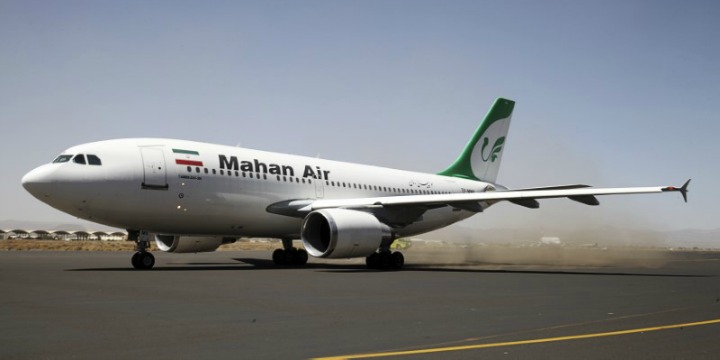
A Mahan Air plane taxis at Sanaa International Airport, following its first flight to Yemen from Iran, March 1, 2015. Photo: Reuters / Mohamed al-Sayaghi.
Germany has revoked the license of an Iranian airline because it has been transporting military equipment and personnel to Syria and other Middle East war zones, the Foreign Ministry said on Monday, after heavy US pressure on Berlin to act.
The United States imposed sanctions on Mahan Air in 2011, saying it provided financial and other support to Iran’s Islamic Revolutionary Guards, and has been pressing its European allies to follow suit.
The German ban on the airline takes immediate effect, a foreign ministry spokesman said.
Contacted by Reuters, Mahan Air in Tehran said it could not comment immediately on the ban.
The measure does not signal plans for the reimposition of broader sanctions against Iran, a German government source told Reuters.
Mahan Air, established in 1992 as Iran’s first private airline, has the country’s largest fleet of aircraft and has flights to a number of European countries, including France, Italy, Spain and Greece.
The US ambassador in Berlin, Richard Grenell, who has long objected to Mahan Air’s links to Germany, welcomed the ban.
“Mahan Air has flown terrorists, weapons, equipment, and funds to international locations to support Iranian terrorist proxy groups,” he said in a statement.
“Iran’s use of Mahan Air to support the Assad regime in Syria, for example, has contributed to incredible human suffering, violence, and political instability felt across the world,” he said, referring to Syrian President Bashar al-Assad.
‘Security needs’
German government spokesman Steffen Seibert denied that the decision to ban Mahan Air was the result of US pressure.
“The German decision is based on considerations of our security needs,” he told a regular news conference.
“It cannot be ruled out that this airline could also transport cargo to Germany that threatens our security. This is based on knowledge of past terrorist activities by Iran in Europe,” he added.
European countries have been under sustained US pressure to reimpose sanctions on Iran since President Donald Trump last year pulled Washington out of a nuclear non-proliferation treaty it had reached with Tehran under his predecessor Barack Obama.
Along with Iran, the other signatories to the deal — Germany, France, Britain, Russia and China — are still trying to keep it alive.
The European countries, with more extensive economic ties to Iran and mindful of the threat that would be posed by another nuclear state in their immediate neighborhood, have sought to shield themselves from the impact of Washington’s extra-territorial sanctions, with limited success.