 Pod Save America Hosts Call on Democrats to Cut All Israel Military Aid, No Longer Accept AIPAC Funding
 Jews, Israelis Targeted in Austria Amid Surge in Antisemitic Incidents; Local Jewish Community Calls for Action
 ‘All of Our Strength’: Over 1,000 Pro-Israel Activists Gather in DC for Solidarity Conference
 ‘Devastated’: Wesley LePatner, Killed in Manhattan Mass Shooting, Was a Jewish Communal, Philanthropic Leader
 Sen. Angus King Vows to No Longer Vote for Israel Military Aid Until Gaza Conditions Improve
 Europe Won’t Pressure Israel to ‘Commit Suicide’ Amid Gaza Backlash, Palestinian State Push, Says Israeli FM
 Israel’s National Soccer Coach Attacked in Athens Before Soccer Fans Chant ‘F–K Israel, Free Palestine’ at Match
 New York Judge Sentences Neo-Nazi to 5 Years for Livestreaming Bomb Threats Against Jewish Hospitals
 US Pressures Lebanon to Issue Cabinet Decision to Disarm Hezbollah Before Talks Continue
 UK Plans to Recognize Palestinian State in September Unless Israel Meets Conditions, Starmer Says


Turkey’s Alliance with the US Exists Only on Paper
Error: Contact form not found.
 by John Rossomando

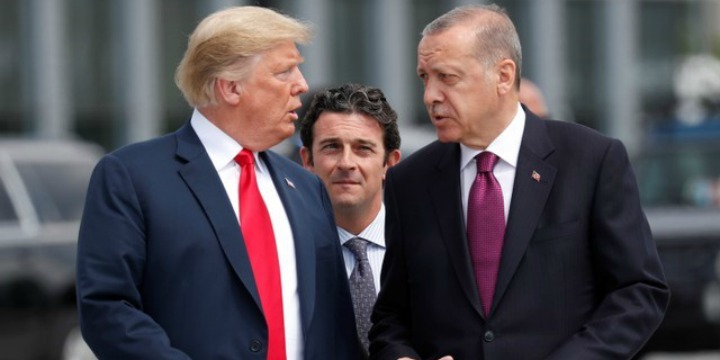
US President Donald Trump and his Turkish counterpart, Recep Tayyip Erdogan, gesture as they talk at the start of a NATO summit, July 2018. Photo: Reuters / Kevin Lamarque.
This week, Turkey chose not to attend a US-sponsored summit chaired by Secretary of State Mike Pompeo because the meeting was “anti-Iran.” The United States and Poland set up the summit to organize allies against Iranian influence.
Sixty countries, including Saudi Arabia and Egypt, did attend, Hürriyet Daily News reported, as did Israeli leader Benjamin Netanyahu. Qatar was noticeably absent.
“Turkey’s political participation … is out of the question,” said a Turkish Foreign Ministry spokesperson.
But when the targeted country is Israel, Turkey lacks such misgivings. Following President Donald Trump’s decision to move the US embassy to Jerusalem, Turkey called on the Organization for Islamic Cooperation to convene an extraordinary summit to confront the decision.
While posturing as an American NATO ally in the Middle East, Turkey has become increasingly cozy with US adversaries like Iran. President Recep Tayyip Erdogan denounced new Trump administration sanctions against Iran as “imperial” and told US officials that Turkey would not implement them. Turkey gets an estimated 200,000 barrels of oil per day from Iran at full capacity, as well as a fifth of its gas imports.
“We buy oil from Iran and we purchase it in proper conditions. What is the other option?” Turkish Foreign Minister Mevlut Çavuşoğlu asked last June.
A Federal court in New York convicted Turkish banker Mehmet Hakan Atilla last May of participating in a scheme to violate US sanctions on Iran. Atilla and others conspired to give the Iranian government and associated entities access to restricted oil revenues through US and international financial networks. The conspirators lied to US Treasury officials about Turkish state-owned Halkbank’s involvement in actions to help evade the sanctions.
Co-defendant Reza Zarrab claimed that these transactions could not have taken place without Erdogan’s approval, a hushed 2013 probe by Turkish prosecutors found. Turkish prosecutors also found evidence that suggested Erdogan received kickbacks from the transactions. Tehran received at least $13 billion in 2012 and 2013 alone due to this scheme.
President Trump granted Turkey a waiver from US sanctions in November, but — among other things — Iran and Turkey have vowed to work together following the US pullout from Syria.
This pattern shows that Turkey’s alliance with the US only exists on paper.
John Rossomando is a senior analyst at The Investigative Project on Terrorism.