 Pod Save America Hosts Call on Democrats to Cut All Israel Military Aid, No Longer Accept AIPAC Funding
 Jews, Israelis Targeted in Austria Amid Surge in Antisemitic Incidents; Local Jewish Community Calls for Action
 ‘All of Our Strength’: Over 1,000 Pro-Israel Activists Gather in DC for Solidarity Conference
 ‘Devastated’: Wesley LePatner, Killed in Manhattan Mass Shooting, Was a Jewish Communal, Philanthropic Leader
 Sen. Angus King Vows to No Longer Vote for Israel Military Aid Until Gaza Conditions Improve
 Europe Won’t Pressure Israel to ‘Commit Suicide’ Amid Gaza Backlash, Palestinian State Push, Says Israeli FM
 Israel’s National Soccer Coach Attacked in Athens Before Soccer Fans Chant ‘F–K Israel, Free Palestine’ at Match
 New York Judge Sentences Neo-Nazi to 5 Years for Livestreaming Bomb Threats Against Jewish Hospitals
 US Pressures Lebanon to Issue Cabinet Decision to Disarm Hezbollah Before Talks Continue
 UK Plans to Recognize Palestinian State in September Unless Israel Meets Conditions, Starmer Says


Yad Vashem Exhibit Details Death March of 1,300 Jewish Women in January 1945
Error: Contact form not found.
 by JNS.org


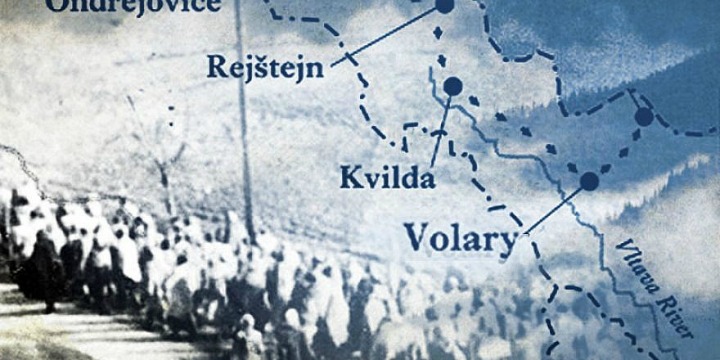
A Nazi-enforced death march of Jewish women prisoners began from the Schlesiersee (today Sława) concentration camp in Upper Silesia in western Poland on Jan. 24, 1945, ending 106 days and some 800 kilometers later on May 5, 1945, in the town of Volary (German: Wallern) in Czechoslovakia. Photo: Yad Vashem.
JNS.org – To mark Women’s History Month, the Yad Vashem Holocaust memorial and museum in Jerusalem is featuring an online exhibit titled “The Death March to Volary,” depicting the fate of Jewish women forced on a death march in the winter of 1945.
Of the 1,000-plus prisoners sent on the march, some 350 survived.
The exhibit utilizes updated research on Nazi-enforced marches of concentration and labor camp prisoners over long distances under unbearable conditions, during which the prisoners were abused by their accompanying guards and often murdered along the way.
Testimonies of survivors and US Army veterans are included, as well as documentation from the trials of death-march commander Alois Dörr and his accomplices, shedding light on this little-known chapter of the Holocaust.
The exhibition—available in English, Hebrew, German and Spanish—is currently being featured on Yad Vashem’s website. It retraces the march utilizing interviews with surviving women, written testimony and historical pictures.
The march began on Jan. 24, 1945, when female Jewish prisoners were evacuated from the Schlesiersee (today Sława) concentration camp in Upper Silesia in western Poland, a region annexed to Germany. The women were forced to march on foot in a southwesterly direction, unaware of their destination, in freezing conditions.
It concluded 106 days and more than 800 kilometers later on May 5, 1945, in the town of Volary (German: Wallern) in Czechoslovakia, not far from the border with Germany and Austria. There, they were liberated by the US Army.
The exhibit also features testimony of one of the liberating US servicemen, Maj. Aaron S. Cahan, a Jewish medical officer who describes the condition of the survivors.
“My first glance at these individuals was one of extreme shock—not ever believing that a human being can be degraded, can be starved, can be so skinny and even live under such circumstances,” he recollected. “I was surprised and shocked when I asked one of these girls how old she was and she said 17, when to me she appeared to be no less than 50.”
Accompanied by some of the survivors, the Americans retraced the steps of the women as far as was possible to gather bodies of those who had died along the way. They buried 95 victims in a special cemetery that the residents of Volary have tended to this day.
For more information, visit Yad Vashem’s website.