 Pod Save America Hosts Call on Democrats to Cut All Israel Military Aid, No Longer Accept AIPAC Funding
 Jews, Israelis Targeted in Austria Amid Surge in Antisemitic Incidents; Local Jewish Community Calls for Action
 ‘All of Our Strength’: Over 1,000 Pro-Israel Activists Gather in DC for Solidarity Conference
 ‘Devastated’: Wesley LePatner, Killed in Manhattan Mass Shooting, Was a Jewish Communal, Philanthropic Leader
 Sen. Angus King Vows to No Longer Vote for Israel Military Aid Until Gaza Conditions Improve
 Europe Won’t Pressure Israel to ‘Commit Suicide’ Amid Gaza Backlash, Palestinian State Push, Says Israeli FM
 Israel’s National Soccer Coach Attacked in Athens Before Soccer Fans Chant ‘F–K Israel, Free Palestine’ at Match
 New York Judge Sentences Neo-Nazi to 5 Years for Livestreaming Bomb Threats Against Jewish Hospitals
 US Pressures Lebanon to Issue Cabinet Decision to Disarm Hezbollah Before Talks Continue
 UK Plans to Recognize Palestinian State in September Unless Israel Meets Conditions, Starmer Says


After Trump’s Worrying Moves, America’s Asian Allies Should Adjust Their Security Policies
Error: Contact form not found.
 by Alon Levkowitz

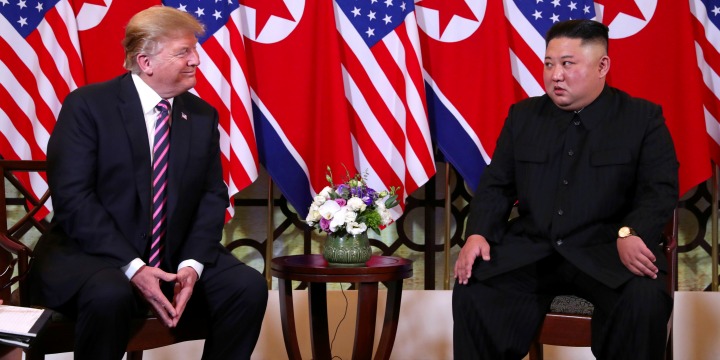
US President Donald Trump looks toward North Korean leader Kim Jong Un during a one-on-one bilateral meeting in Hanoi, Vietnam, Feb. 28, 2019. Photo: Reuters / Leah Millis.
For many years, the cost of the deployment of US forces in South Korea and Japan has been a key matter of discussion between Washington and its Asian allies. Over time, Tokyo and Seoul have increased their share of those costs. They not only pay for the US forces that are deployed on their soil, but they have also purchased billions of dollars of US military equipment.
In many cases, these countries were expected by Washington to choose US weapons systems over EU or Israeli defense manufacturers. Washington’s main argument was that the weapon systems used by South Korea and Japan should be synchronized with the equipment of the US forces deployed in those countries. And in view of the sacrifices made on their behalf by American soldiers, they were expected to prefer US products.
Over the years, Washington has indicated its desire that its Asian allies share more of the burden of expenditures in that region. During his presidential campaign and then during his first year in office, President Donald Trump stressed the need to decrease the cost to the US taxpayer by increasing the Asian share of expenses. Trump repeatedly praised the fact that Japan and South Korea have purchased US weapons, which aligns with his political agenda to help the US defense industry. He also expressed a desire to revise economic agreements between the US and its allies in Asia, especially the Free Trade Agreements (FTAs) that Washington signed under previous administrations.
After the Singapore summit in June 2018, President Trump declared that he would freeze US-South Korean joint military drills because they threaten North Korea. Trump thus became the first American president ever to endorse Pyongyang’s argument against the drills. He also stressed that freezing the drills would save US taxpayer money, a message he reiterated after the Hanoi summit in February 2019. “The reason I do not want military drills with South Korea,” he tweeted, “is to save hundreds of millions of dollars for the US.”
President Trump’s focus on the cost of security raises questions about the commitment of his administration to America’s Asian allies. Does he intend to maintain the force readiness of US and Asian forces to defend them? Suspending military drills will negatively affect the competence of all concerned: the US forces in the region, the Japanese forces, and the South Korean forces. With that in mind, Japan, South Korea, and even Australia might be well advised to reevaluate their security policy during the Trump administration.
If Trump continues to focus on the cost of drills and not on the need to maintain the competence of the military forces, the security of the US’s Asian allies will be endangered in the long run. Tokyo, Seoul, and even Canberra should consider increasing their financial contribution to the cost of US forces, and at the same time, begin an incremental change in their defense policy to ensure that they will continue to train effectively even without US forces in the region.
Dr. Alon Levkowitz, a research associate at the Begin-Sadat Center for Strategic Studies, is an expert on East Asian security, the Korean Peninsula, and Asian international organizations.
This article was originally published by The BESA Center.