 Pod Save America Hosts Call on Democrats to Cut All Israel Military Aid, No Longer Accept AIPAC Funding
 Jews, Israelis Targeted in Austria Amid Surge in Antisemitic Incidents; Local Jewish Community Calls for Action
 ‘All of Our Strength’: Over 1,000 Pro-Israel Activists Gather in DC for Solidarity Conference
 ‘Devastated’: Wesley LePatner, Killed in Manhattan Mass Shooting, Was a Jewish Communal, Philanthropic Leader
 Sen. Angus King Vows to No Longer Vote for Israel Military Aid Until Gaza Conditions Improve
 Europe Won’t Pressure Israel to ‘Commit Suicide’ Amid Gaza Backlash, Palestinian State Push, Says Israeli FM
 Israel’s National Soccer Coach Attacked in Athens Before Soccer Fans Chant ‘F–K Israel, Free Palestine’ at Match
 New York Judge Sentences Neo-Nazi to 5 Years for Livestreaming Bomb Threats Against Jewish Hospitals
 US Pressures Lebanon to Issue Cabinet Decision to Disarm Hezbollah Before Talks Continue
 UK Plans to Recognize Palestinian State in September Unless Israel Meets Conditions, Starmer Says


Israel and the Arab World, 71 Years On
Error: Contact form not found.
 by Eyal Zisser / Israel Hayom / JNS.org

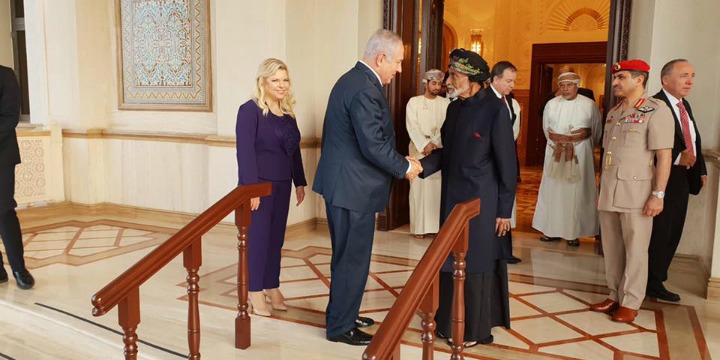
Israeli Prime Minister Benjamin Netanyahu shakes hands with Omani Sultan Qaboos bin Said, in this photo published on Oct. 26, 2018. Photo: Netanyahu’s Facebook account.
JNS.org – In the first decades following its establishment, the State of Israel’s relations with the Arab world were marked by bloody conflict, the result of the Arab refusal to accept Israel’s existence and perception of Israel as an emissary or outpost of the Western world in the heart of the Middle East. Arab states opposed the 1947 UN Partition Plan for Palestine, and invaded the new state to thwart its establishment.
Ever since, Israel has stood weak and isolated in relation to a hostile region that seeks to destroy it. In fact, many in the world held Israel responsible for the conflict with its neighbors, and saw the conflict as the central cause of regional instability and backwardness that resulted in the appearance of Islamic terrorism that quickly spread throughout the world.
But against the background of all of this, a dramatic revolution is now underway. Seventy years after its establishment, Israel is a powerful regional player and, more importantly, a legitimate and accepted country, even a desired ally in Arab eyes. Israel has peaceful ties with some of its neighbors, and even, in the form of an undeclared ally, established strategic relations with certain Arab countries, in particular on issues of security but also on economic matters.
This revolution is the result of the bolstering of Israel’s regional and international standing and, of course, its military and economic growth at home. But it is also a reflection of the changing face of the Middle East, and in particular the sunset of Arab nationalism and the weakening of the Arab states in relation to the strengthening of Iran and Turkey. Iran’s threatening shadow and quite possibly the challenge presented by Turkey have pushed Israel and the Arab states to cooperate. After all, in light of Washington’s retreat from the region, Israel has been left at the forefront of the struggle against Iran. The determination it has shown in the face of Tehran’s efforts to establish itself militarily in Syria have scored Israel points in the eyes of its Arab neighbors, and in particular among Gulf Arab states that feel under threat from the ayatollahs.
These trends have sidelined the Palestinian issue, which was always seen as an obstacle to any attempt to promote Israel-Arab ties. This question, however, remains important, and may even constitute a glass ceiling of sorts for efforts to establish peaceful relations between Israel and its neighbors. But the Arab regimes have succeeded in maneuvering between their peoples’ commitment to the fate of the Palestinians and the interests pushing their countries towards improving ties with Israel.
The alliance between Israel and its neighbors is now focused on the Iranian threat, but it could expand to other issues. Israel and the Arabs share many common interests, like the struggle against radical Islam and the advancement of the regional economy. Israel’s security cooperation with Greece and Cyprus, and the formal institutionalization of the economic relationship between these countries and Egypt are a testament to the ability to expand the array of relationships and alliances beyond strategic issues and even beyond the Middle Eastern arena.
Israel is also working to advance ties with countries like Azerbaijan in Central Asia and Ethiopia, Kenya, and Chad in Africa. But this renewed “periphery alliance” is completely different from the alliances Israel established in the late 1950s with Iran and Turkey against then-Egyptian President Gamal Abdel Nasser. This time, Israel is the axis around which the alliance revolves.
These trends are an expression of Israel’s transformation from a marginal and weak player ostracized by the Arab world to a powerful country and desirable ally. This too is one of the markers of Israel’s upcoming 71st Independence Day.
Eyal Zisser is a lecturer in the Middle East History Department at Tel Aviv University. This article first appeared in Israel Hayom.