 Pod Save America Hosts Call on Democrats to Cut All Israel Military Aid, No Longer Accept AIPAC Funding
 Jews, Israelis Targeted in Austria Amid Surge in Antisemitic Incidents; Local Jewish Community Calls for Action
 ‘All of Our Strength’: Over 1,000 Pro-Israel Activists Gather in DC for Solidarity Conference
 ‘Devastated’: Wesley LePatner, Killed in Manhattan Mass Shooting, Was a Jewish Communal, Philanthropic Leader
 Sen. Angus King Vows to No Longer Vote for Israel Military Aid Until Gaza Conditions Improve
 Europe Won’t Pressure Israel to ‘Commit Suicide’ Amid Gaza Backlash, Palestinian State Push, Says Israeli FM
 Israel’s National Soccer Coach Attacked in Athens Before Soccer Fans Chant ‘F–K Israel, Free Palestine’ at Match
 New York Judge Sentences Neo-Nazi to 5 Years for Livestreaming Bomb Threats Against Jewish Hospitals
 US Pressures Lebanon to Issue Cabinet Decision to Disarm Hezbollah Before Talks Continue
 UK Plans to Recognize Palestinian State in September Unless Israel Meets Conditions, Starmer Says


Iran Plans No Changes to Nuclear Centrifuges, IAEA Ties: Spokesman
Error: Contact form not found.
 by Reuters and Algemeiner Staff

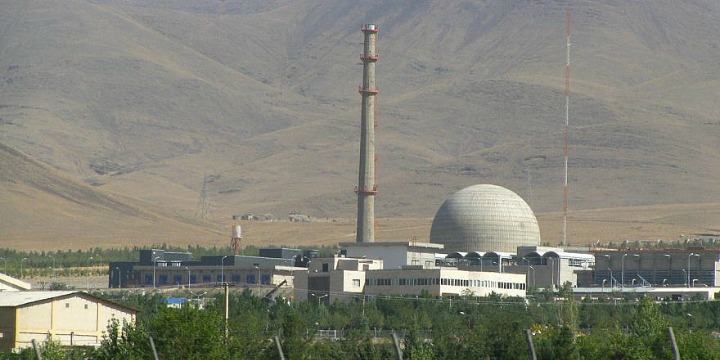
The Iran nuclear program’s Arak heavy-water reactor. Photo: Nanking2012 via Wikimedia Commons.
Iran has no plans to launch centrifuge machines able to enrich uranium at higher capacity or to alter its relations with the UN nuclear watchdog, the spokesman for its civilian nuclear agency was quoted as saying on Thursday.
Last week, Iran notified China, France, Germany, Russia and Britain that would scale back some commitments under its 2015 nuclear deal, a year after the United States withdrew from the pact and reimposed sanctions on Tehran.
Iran’s initial moves, involving the stockpiling of some nuclear materials, did not appear to violate the deal’s terms.
But Iran warned that unless the other signatories to the deal protect Iran’s economy from US sanctions within 60 days, Tehran would start refining uranium to a fissile purity above that deemed suitable for fueling civilian power plants.
“We do not currently have any plan to increase capacity and production process by changing the capacity of centrifuges,” Behrouz Kamalvandi, spokesman of the Atomic Energy Organization of Iran, told the semi-official news agency ISNA.
“Increasing the capacity and production process is being carried out with the same number of already installed centrifuges in Natanz (enrichment plant),” Kamalvandi said.
Regarding enhanced monitoring of Iranian nuclear sites by the IAEA under the deal, “in some stages, and to carry out some technical work, the IAEA needs to be informed in advance, which has been done and is being done,” ISNA quoted him as saying.
The restrictions on uranium enrichment accepted by Iran under the deal were aimed at extending the time it would need to produce a nuclear bomb, if it chose to, to a year from roughly two to three months. The United States and the IAEA believe Iran had a clandestine nuclear weapons program that it later abandoned. Tehran denies ever having had one.
The deal imposes a 15-year cap on the level of purity to which Iran can enrich uranium at 3.67 percent, far below the 90 percent of weapons grade. It is also well below the 20 percent level to which Iran enriched uranium before the deal.
Iran is also allowed to refine uranium only with its first-generation, lower-capacity IR-1 centrifuges. It can use small numbers of more advanced centrifuges for research, but without accumulating enriched uranium.