 Pod Save America Hosts Call on Democrats to Cut All Israel Military Aid, No Longer Accept AIPAC Funding
 Jews, Israelis Targeted in Austria Amid Surge in Antisemitic Incidents; Local Jewish Community Calls for Action
 ‘All of Our Strength’: Over 1,000 Pro-Israel Activists Gather in DC for Solidarity Conference
 ‘Devastated’: Wesley LePatner, Killed in Manhattan Mass Shooting, Was a Jewish Communal, Philanthropic Leader
 Sen. Angus King Vows to No Longer Vote for Israel Military Aid Until Gaza Conditions Improve
 Europe Won’t Pressure Israel to ‘Commit Suicide’ Amid Gaza Backlash, Palestinian State Push, Says Israeli FM
 Israel’s National Soccer Coach Attacked in Athens Before Soccer Fans Chant ‘F–K Israel, Free Palestine’ at Match
 New York Judge Sentences Neo-Nazi to 5 Years for Livestreaming Bomb Threats Against Jewish Hospitals
 US Pressures Lebanon to Issue Cabinet Decision to Disarm Hezbollah Before Talks Continue
 UK Plans to Recognize Palestinian State in September Unless Israel Meets Conditions, Starmer Says


The PA Doesn’t Care About Economic ‘Carrots’
Error: Contact form not found.
 by Eyal Zisser / Israel Hayom / JNS.org

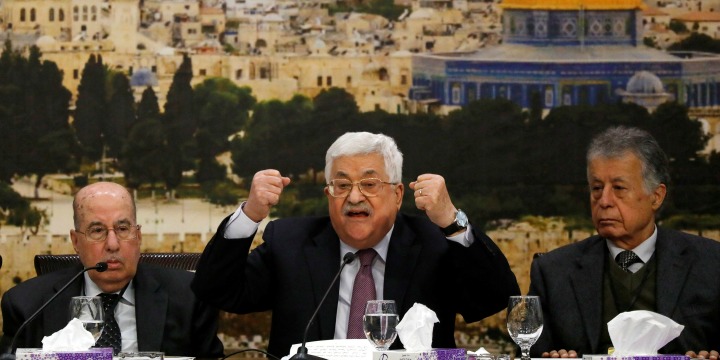
Palestinian Authority President Mahmoud Abbas speaks during a meeting of the Palestinian Central Council in Ramallah, January 14, 2018. Photo: Reuters / Mohamad Torokman.
JNS.org – On the eve of the US-sponsored economic workshop in Bahrain, the American administration revealed parts of its Middle East peace plan over the weekend, highlighted by a $50 billion Palestinian investment and infrastructure proposal. Half of the funds would be earmarked for Judea and Samaria and Gaza, and the other half for economic projects in neighboring Arab countries, particularly Egypt and Jordan.
Some of the projects mentioned are reminiscent of past proposals, such as a railroad and highway connecting the Gaza Strip to Judea and Samaria, or the construction of manufacturing plants of the kind the Palestinians have already burned and destroyed in previous bouts of violence.
The devil, however, is in the details. Indeed, a more thorough examination of the US economic plan raises questions and doubts over its feasibility. It isn’t entirely clear, for example, where the money will come from. The Americans hope Persian Gulf emirates will donate generously, but these countries have a reputation for being quick to promise money, whether on behalf of the Palestinians or other regional issues, but slow on following through.
In any case, the target of $50 billion is expected to be met over a period of 10 years, and while this means $5 billion per year — a far smaller amount to be sure — we still can’t be sure the Americans will be able to raise it.
All this notwithstanding, we should keep in mind that the economic part of the plan is completely dependent on the ability to make diplomatic inroads. It goes without saying, therefore, that as long as Israel’s security situation remains tenuous and as long as Hamas continues to rule the Gaza Strip, the ability to advance economic initiatives is limited or close to zero.
These details, however, don’t interest the Palestinians. The Palestinians have already decided to reject the American plan outright, along with rejecting all Arab or international attempts to promote stability or even an Israeli-Palestinian arrangement. From the Palestinians’ perspective, the only possible solution involves the international community imposing the entirety of their demands on Israel.
Moreover, the Palestinians’ behavior over the years teaches us that stability and economic development don’t top their list of priorities, and that a situation of volatility and constant distress better serves their national and political goals.
The American administration is full of good intentions but it too understands that the Israeli-Palestinian conflict isn’t about real estate and can’t be solved with a stack of dollars, even $50 billion worth.
Eyal Zisser is a lecturer in the Middle East History Department at Tel Aviv University. A version of this column first appeared in Israel Hayom.