 Pod Save America Hosts Call on Democrats to Cut All Israel Military Aid, No Longer Accept AIPAC Funding
 Jews, Israelis Targeted in Austria Amid Surge in Antisemitic Incidents; Local Jewish Community Calls for Action
 ‘All of Our Strength’: Over 1,000 Pro-Israel Activists Gather in DC for Solidarity Conference
 ‘Devastated’: Wesley LePatner, Killed in Manhattan Mass Shooting, Was a Jewish Communal, Philanthropic Leader
 Sen. Angus King Vows to No Longer Vote for Israel Military Aid Until Gaza Conditions Improve
 Europe Won’t Pressure Israel to ‘Commit Suicide’ Amid Gaza Backlash, Palestinian State Push, Says Israeli FM
 Israel’s National Soccer Coach Attacked in Athens Before Soccer Fans Chant ‘F–K Israel, Free Palestine’ at Match
 New York Judge Sentences Neo-Nazi to 5 Years for Livestreaming Bomb Threats Against Jewish Hospitals
 US Pressures Lebanon to Issue Cabinet Decision to Disarm Hezbollah Before Talks Continue
 UK Plans to Recognize Palestinian State in September Unless Israel Meets Conditions, Starmer Says


Has Iran Called the American Bluff?
Error: Contact form not found.
 by Oded Granot / JNS.org

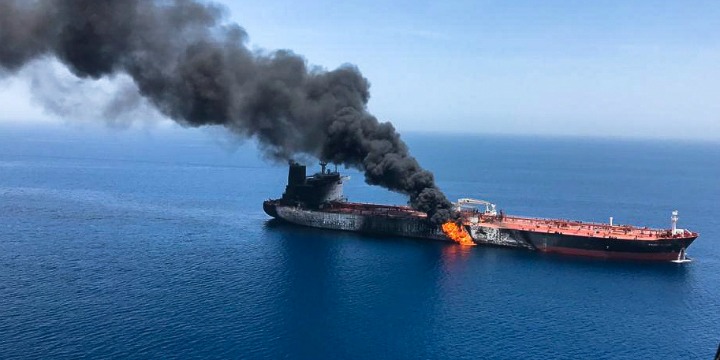
An oil tanker is seen after it was attacked at the Gulf of Oman, in waters between Gulf Arab states and Iran, June 13, 2019. Photo: ISNA/Handout via REUTERS.
JNS.org – Iran’s hostile messages to the United States reached new heights when an American spy drone was shot down by the Islamic Revolutionary Guard Corps (IRGC) over the Persian Gulf. In Saudi Arabia, meanwhile, facilities were hit by ballistic missiles fired by Houthi rebels in Yemen that are loyal to Iran.
The Iranians say that the advanced US drone surveillance aircraft, which is capable of staying in the air for more than 30 hours and is equipped with sophisticated observation systems, was downed because it had infiltrated Iranian airspace. This claim contradicts the statement issued by the US military that the drone was shot down in international airspace. Regardless, the incident illustrates Iran’s determination to continue provoking the United States, despite its stated desire to avoid war.
Iran’s escalation in the Persian Gulf has been gradual. The six attacks on oil tankers in or near the Strait of Hormuz since May were specifically designed to avoid leaving fingerprints. In the wake of the drone incident, however, the chief of the IRGC was quick to threaten the US, warning it should “not to cross the red line.”
Tehran has decided to push the envelope in the Persian Gulf for two main reasons. One pertains, of course, to its domestic situation. Iran is seeking to create a new equation whereby the tighter the noose of US-imposed economic sanctions, the greater the risk of a conflagration in the Gulf. Conversely, if the United States decides to loosen the noose, perhaps Iran will be more amenable to talking.
The other reason behind Iran’s escalation in the Gulf stems from the belief in Tehran that the White House is so afraid of conflict and military quagmire in the Gulf that it won’t rush to retaliate — even against more severe provocations. This assessment was strengthened not only by Donald Trump’s stated desire to avoid war with Iran, but also his tempered response to the oil tanker attacks.
In formulating their assessment, the Iranians are also leaning on the hesitancy within the United States to deploy additional forces in the Persian Gulf, Trump’s fundamental desire to withdraw from the Middle East, his recently launched reelection campaign, and the fact that his acting defense secretary is stepping down. Ayatollah Ali Khamenei and his advisers believe that under these circumstances, Iran now has a decent chance of stinging the United States without getting stung back.
Are the Iranians wrong? The IRGC chief pointed to Tehran’s red lines, but it isn’t clear he knows what Trump’s red lines are. Is Washington still preparing its response to the drone incident, or will it only respond with military force if a manned plane is hit? What is clear is that the situation in the Persian Gulf is highly combustible, and that both sides are closer to conflict than to dialogue and negotiations over a new nuclear deal.
Oded Granot is a journalist and international commentator on the Middle East. A version of this column first appeared in Israel Hayom.