 Pod Save America Hosts Call on Democrats to Cut All Israel Military Aid, No Longer Accept AIPAC Funding
 Jews, Israelis Targeted in Austria Amid Surge in Antisemitic Incidents; Local Jewish Community Calls for Action
 ‘All of Our Strength’: Over 1,000 Pro-Israel Activists Gather in DC for Solidarity Conference
 ‘Devastated’: Wesley LePatner, Killed in Manhattan Mass Shooting, Was a Jewish Communal, Philanthropic Leader
 Sen. Angus King Vows to No Longer Vote for Israel Military Aid Until Gaza Conditions Improve
 Europe Won’t Pressure Israel to ‘Commit Suicide’ Amid Gaza Backlash, Palestinian State Push, Says Israeli FM
 Israel’s National Soccer Coach Attacked in Athens Before Soccer Fans Chant ‘F–K Israel, Free Palestine’ at Match
 New York Judge Sentences Neo-Nazi to 5 Years for Livestreaming Bomb Threats Against Jewish Hospitals
 US Pressures Lebanon to Issue Cabinet Decision to Disarm Hezbollah Before Talks Continue
 UK Plans to Recognize Palestinian State in September Unless Israel Meets Conditions, Starmer Says


The Beginning of the End of the Erdogan Era?
Error: Contact form not found.
 by Eyal Zisser / Israel Hayom / JNS.org

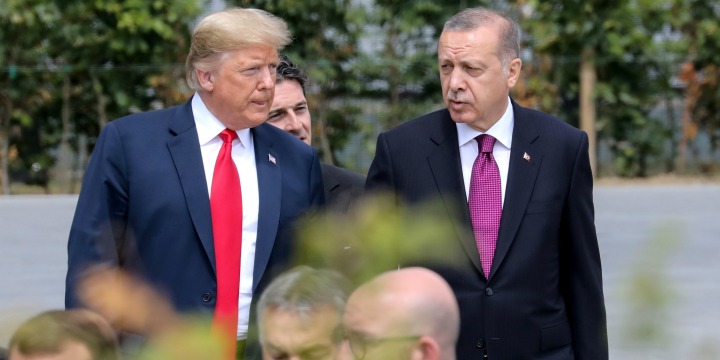
US President Donald Trump speaks withh Turkey’s President Recep Tayyip Erdogan ahead of the opening ceremony of the NATO (North Atlantic Treaty Organization) summit, at the NATO headquarters in Brussels, Belgium, July 11, 2018. Photo: Ludovic Marin/Pool via REUTERS.
JNS.org – Turkish President Recep Tayyip Erdogan’s downfall in the runoff mayoral election in Istanbul — Turkey’s largest city — was more than just another of the many thorns in the side he has suffered in the two decades he has ruled Turkey with an iron fist. It was a resounding slap in the face, one that was particularly humiliating and could herald the beginning of the end of the Erdogan era.
In theory, this was a municipal election that had nothing to do with national politics. But Erdogan insisted on making the Istanbul election about himself, thereby turning it into a test of his personal power. One which he failed.
Three months ago, Turkey held municipal elections, and the results were unexpected. Everyone assumed that Erdogan’s party would win by a landslide, since over the course of his many years in power, he has gradually hacked away at Turkish democracy and the institutions that were supposed to protect it. He took away judicial independence, ousted opponents from universities and public office, brought the army under his control, and took over the media.
But Erdogan suffered a serious defeat. His opponents won in the country’s three biggest cities: the capital, Ankara; Izmir, an important port; and Istanbul, which is home to 16 million residents — nearly a quarter of the country’s population. In a desperate attempt to turn the tide, Erdogan forced the local election committee in Istanbul to declare a new election, claiming fraud and irregularities. He was trying to take advantage of the fact that the gap between the candidates stood at only one percent.
Istanbul has special significance for Erdogan: He started his political career there in 1994, when he was elected mayor. Thus, the Islamists got their foot in the door, and eventually gained control of the entire country. Eight years later, Erdogan was elected prime minister, and became president in 2014. In that role, he had the Turkish constitution changed to give him unprecedented power, to the extent that he is allowed to remain in office until 2029.
The first decade of his leadership was characterized by his success in bringing Turkey a level of political stability it had never known, and moving the Turkish economy forward. Many members of the secularist camp supported him because they were sick of the army’s ceaseless interference in political affairs, and wanted to see Erdogan — his alliance with the Islamists notwithstanding — in a position to defend Turkish democracy against the military.
But gaining power whetted his appetite. Erdogan put a check on the army simply so he could become an autocrat. He aspired to bring down the legacy of Mustafa Kemal Atatürk, the founder of modern, secular Turkey, and make his country an Islamic state.
In the past few years, however, it would seem that Lady Luck is turning a cold shoulder to Erdogan. The Turkish economy is in rough shape, and Turkey has found itself isolated and even defeated when it comes to international affairs in the region. Erdogan has turned out to be an able politician as far as domestic affairs go, but a failure in diplomacy and foreign policy. The growing dissatisfaction with his approach led to his people losing the Istanbul election.
Because he was seen as an omnipotent ruler, Erdogan’s defeat is breathing new life into the opposition, proving that it can join ranks and pummel him at the voting booth. That is encouraging many Turks to stop bowing down before him. It will be a long process, and the president, who still enjoys considerable popular support, is determined to stay in power. Still, even the longest of journeys begins with a single step — and that step was taken last month in Istanbul.
Eyal Zisser is a lecturer in the Middle East History Department at Tel Aviv University. A version of this article first appeared in Israel Hayom.