 Pod Save America Hosts Call on Democrats to Cut All Israel Military Aid, No Longer Accept AIPAC Funding
 Jews, Israelis Targeted in Austria Amid Surge in Antisemitic Incidents; Local Jewish Community Calls for Action
 ‘All of Our Strength’: Over 1,000 Pro-Israel Activists Gather in DC for Solidarity Conference
 ‘Devastated’: Wesley LePatner, Killed in Manhattan Mass Shooting, Was a Jewish Communal, Philanthropic Leader
 Sen. Angus King Vows to No Longer Vote for Israel Military Aid Until Gaza Conditions Improve
 Europe Won’t Pressure Israel to ‘Commit Suicide’ Amid Gaza Backlash, Palestinian State Push, Says Israeli FM
 Israel’s National Soccer Coach Attacked in Athens Before Soccer Fans Chant ‘F–K Israel, Free Palestine’ at Match
 New York Judge Sentences Neo-Nazi to 5 Years for Livestreaming Bomb Threats Against Jewish Hospitals
 US Pressures Lebanon to Issue Cabinet Decision to Disarm Hezbollah Before Talks Continue
 UK Plans to Recognize Palestinian State in September Unless Israel Meets Conditions, Starmer Says


New US Sanctions Against Iran Nuclear Program Target IRGC’s Control of Construction Sector
Error: Contact form not found.
 by Ben Cohen

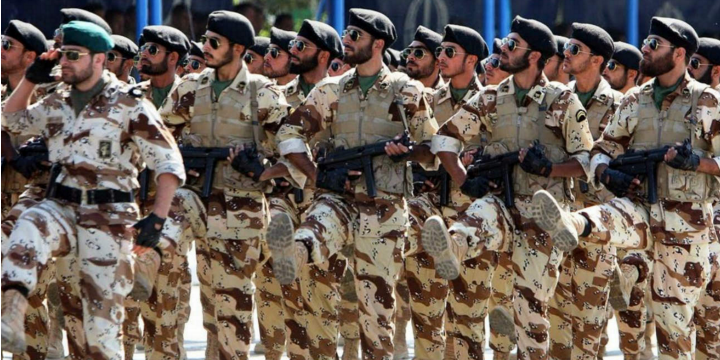
Members of Iran’s Islamic Revolutionary Guard Corps (IRGC) marching in a parade. Photo: Wikimedia Commons.
The US government announced a new squeeze on the Tehran regime’s nuclear program on Thursday with an additional layer of economic sanctions that target the Islamic Revolutionary Guard Corps’ (IRGC) control of Iran’s lucrative construction sector.
The fresh sanctions were intended to “help preserve oversight of Iran’s civil nuclear program, reduce proliferation risks, constrain Iran’s ability to shorten its ‘breakout time’ to a nuclear weapon, and prevent the regime from reconstituting sites for proliferation-sensitive purposes,” Morgan Ortagus — a spokesperson for the US State Department — stated.
Ortagus said that the decision was based on two determinations by Secretary of State Mike Pompeo. One had identified “the construction sector of Iran as being controlled directly or indirectly by the Islamic Revolutionary Guard Corps (IRGC),” while the other had named “four strategic materials as being used in connection with Iran’s nuclear, military, or ballistic missile programs.”
As a consequence, according to a State Department explanation, “the sale, supply, or transfer to or from Iran of raw and semi-finished metals, graphite, coal, and software for integrating industrial purposes will be sanctionable if those materials are to be used in connection with the Iranian construction sector.”
Saeed Ghasseminejad — a senior adviser at the Washington, DC-based Foundation for the Defense of Democracies (FDD) think tank — told The Algemeiner that while the new sanctions did not blacklist the entire Iranian construction center, they represented “one step in that direction.”
“The construction sector is heavily penetrated by the IRGC,” Ghasseminejad said on Friday. “The Guard has used the construction sector to generate billions of dollars in revenue, as a cover for its operatives and proxies outside Iran and a procurement network for its illicit missiles and nuclear program.”
According to industry analysts, Iran’s construction sector has enjoyed a rebound over the last two years, as a result of the lifting of sanctions under the 2015 nuclear deal negotiated between the Tehran regime and six world powers led by the US. But the reimposition of sanctions following the Trump administration’s withdrawal from the deal in May 2018 has dampened previously optimistic projections of further growth in the sector, which is valued at nearly $200 billion annually.
Created in 1979 in the wake of the Islamist seizure of power in Iran, the IRGC is the regime’s first line of defense and operates separately from the regular Iranian armed forces. Its so-called “Quds Force” operates across the Middle East, providing arms, financing and other assistance to Islamist terror groups in Iraq, Syria, Lebanon and the Palestinian territories.
The IRGC emerged as a key player in Iran’s economy during the 1990s, a period when political leaders like the late former Iranian President Hashemi Rafsanjani actively encouraged government agencies to bid for private sector contracts. Over the last two decades, IRGC front companies have automatically been awarded with hundreds of contracts in oil and natural gas extraction, pipeline construction and other infrastructure development projects.
As the State Department observed on Thursday, many of the materials used in these sectors also have a military dual use. The new sanctions will now apply to a range of pipes and foils made from “materials used in connection with the nuclear, military, or ballistic missile programs of Iran,” the State Department said.