 Pod Save America Hosts Call on Democrats to Cut All Israel Military Aid, No Longer Accept AIPAC Funding
 Jews, Israelis Targeted in Austria Amid Surge in Antisemitic Incidents; Local Jewish Community Calls for Action
 ‘All of Our Strength’: Over 1,000 Pro-Israel Activists Gather in DC for Solidarity Conference
 ‘Devastated’: Wesley LePatner, Killed in Manhattan Mass Shooting, Was a Jewish Communal, Philanthropic Leader
 Sen. Angus King Vows to No Longer Vote for Israel Military Aid Until Gaza Conditions Improve
 Europe Won’t Pressure Israel to ‘Commit Suicide’ Amid Gaza Backlash, Palestinian State Push, Says Israeli FM
 Israel’s National Soccer Coach Attacked in Athens Before Soccer Fans Chant ‘F–K Israel, Free Palestine’ at Match
 New York Judge Sentences Neo-Nazi to 5 Years for Livestreaming Bomb Threats Against Jewish Hospitals
 US Pressures Lebanon to Issue Cabinet Decision to Disarm Hezbollah Before Talks Continue
 UK Plans to Recognize Palestinian State in September Unless Israel Meets Conditions, Starmer Says


What Will Soleimani’s Death Mean for Iran’s Nuclear Program?
Error: Contact form not found.
 by Raphael Ofek

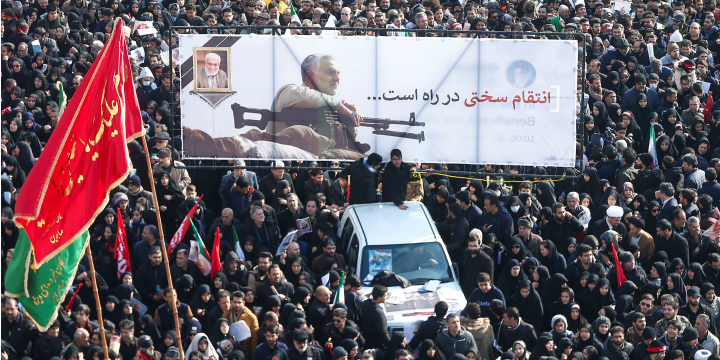
Iranians take part in a funeral procession for the late Maj. Gen. Qassem Soleimani in Tehran, Jan. 6, 2020. Photo: Nazanin Tabatabaee / WANA (West Asia News Agency) via Reuters.
In July 2019, Iran began to violate the nuclear deal in a number of ways in order to pressure the EU to neutralize the effect of the sanctions that had been imposed on it by the US.
Its violations included:
- enriching uranium above the maximum permitted quantity of 300 kg UF6 (uranium hexa-fluoride compound) enriched at 3.67%;
- raising the level of uranium enrichment to 4.5%, above the permitted rate of 3.67%;
- producing and holding heavy water inventory beyond the 130 ton limit;
- operating advanced centrifuges of higher enrichment capacity; and
- renewing, in early November 2019, uranium enrichment at the Fordow underground enrichment facility
To no one’s surprise, US Democrats fiercely opposed President Donald Trump’s decision to withdraw from the 2015 Iran nuclear agreement (JCPOA). Some are now criticizing him for having eliminated Qassem Soleimani, and blame the president for previously driving Tehran to retreat from the nuclear deal.
A New York Times article by William Broad and David Sanger, published on January 6, made this linkage explicit in its subtitle, which read: “President Trump thought the nuclear deal was flawed because restrictions on Iran would end after 15 years. Now, responding to a US strike, Iran has declared the limits over after less than five.”
The article goes on to state, “It largely re-creates conditions that led Israel and the United States to consider destroying Iran’s facilities a decade ago; again bringing them closer to the potential of open conflict with Tehran that was avoided by the accord.”
This assertion is baseless. Had the US not withdrawn from the nuclear agreement and imposed sanctions on Iran, then at the end of the deal 10 years from now, Iran — which would likely still have an Islamist regime — could have broken out with full force to produce nuclear weapons. Considering the existential danger Iranian nuclear weapons would pose to Israel, the Middle East at large, and probably even the US, the odds of war breaking out with Iran would have been high if not inevitable.
How far is the Tehran regime prepared to go in the nuclear field? For the time being, it appears that despite its breaches of the nuclear deal over the past year and the shake-up of recent days, Iran is approaching this matter with caution. It fears, first of all, that unequivocal efforts at this stage to advance towards nuclear weapons could cause it to be attacked by the US and Israel. This would likely result in the destruction of parts of its nuclear infrastructure, probably including its uranium enrichment facilities at Natanz and Fordow. Trump responded to Iran’s withdrawal from the nuclear deal by tweeting, “Iran will never have nuclear weapons.” As Tehran just learned, Trump is capable of dramatic action and willing to use force.
Secondly, Iran does not want to cause the collapse of its relationship with the EU, which continues to show it considerable sympathy. Finally, it is doubtful whether Iran’s economy, which has been hard-hit by the sanctions, will allow it to continue to invest in the nuclear weapons project right now.
Tehran’s caution is reflected in the form of its military moves against the US, Israel, and the allies of those countries in the Arab world. Rather than confronting those countries directly, it conducts its operations via proxy militias (Hezbollah in Lebanon, pro-Iranian Iraqi militias, and the Houthi rebels in Yemen). Hence, its direct response to the Soleimani killing was carefully crafted and limited so as to avoid a wider escalation.
Lt. Col. (res.) Dr. Raphael Ofek, a BESA Center Research Associate, is an expert in the field of nuclear physics and technology who served as a senior analyst in the Israeli intelligence community.
A version of this article was originally published by The BESA Center.