 Pod Save America Hosts Call on Democrats to Cut All Israel Military Aid, No Longer Accept AIPAC Funding
 Jews, Israelis Targeted in Austria Amid Surge in Antisemitic Incidents; Local Jewish Community Calls for Action
 ‘All of Our Strength’: Over 1,000 Pro-Israel Activists Gather in DC for Solidarity Conference
 ‘Devastated’: Wesley LePatner, Killed in Manhattan Mass Shooting, Was a Jewish Communal, Philanthropic Leader
 Sen. Angus King Vows to No Longer Vote for Israel Military Aid Until Gaza Conditions Improve
 Europe Won’t Pressure Israel to ‘Commit Suicide’ Amid Gaza Backlash, Palestinian State Push, Says Israeli FM
 Israel’s National Soccer Coach Attacked in Athens Before Soccer Fans Chant ‘F–K Israel, Free Palestine’ at Match
 New York Judge Sentences Neo-Nazi to 5 Years for Livestreaming Bomb Threats Against Jewish Hospitals
 US Pressures Lebanon to Issue Cabinet Decision to Disarm Hezbollah Before Talks Continue
 UK Plans to Recognize Palestinian State in September Unless Israel Meets Conditions, Starmer Says


Yitzhak Rabin’s Killer Is Portrayed On Screen in ‘Incitement’
Error: Contact form not found.
 by Alan Zeitlin

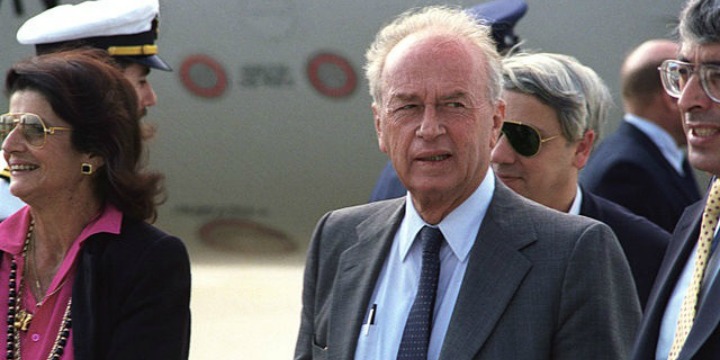
Yitzhak Rabin (center). Photo: Sgt. Robert G. Clambus via Wikimedia Commons.
In telling the story of the murder of Prime Minister Yitzhak Rabin from the viewpoint of the assassin, Yaron Zilberman had to watch his step.
The director and co-writer of Incitement knew he needed to strike the right balance in his portrayal of murderer Yigal Amir.
“It was a minefield,” Zilberman told me by phone. “If you make him too human, critics say there’s too much sympathy. If you make him too much like a monster, it seems not real, and they’ll say there’s nothing to learn from this.”
The film won the Israeli Oscar, known as the Ophir Award, for Best Picture due to a stellar script and a jaw dropping performance by Yehuda Nahari Halevi.
Halevi’s Amir is at times charming and charismatic, drawing the attraction of two women and causing many to sign up for his Shabbat group getaways. In other scenes, his eyes show a stubborn tunnel vision, bent on a path of violence that is bursting to come out. He is radicalized by the words of rabbis and the actions of a Jewish terrorist.
In one scene, on a rainy night, an Israeli soldier looks into Amir’s car window and is curious. Amir tells him not to worry because he is Jewish. The soldier lets him go through — to the funeral of Baruch Goldstein. In 1994, Goldstein went on a shooting spree in Hebron, murdering 29 Palestinians worshiping at the Cave of the Patriarchs before being killed. Would Amir have plotted to assassinate Rabin a year later without Goldstein’s act?
“I doubt it,” Zilberman said. “To see Goldstein being treated by some in the group as a hero ignited the possibility in him that he could be a hero.”
Early in the film, it’s easy to root for Amir to marry Nava, the woman who seems to be the love of his life, despite his mother saying she is an Ashkenazi and would never marry a Yemenite like him. But Nava rejects him and winds up marrying his friend. Did losing out on love result in his decision to turn to violence?
“He didn’t kill Rabin because the girl rejected him,” Zilberman said. “But my guess is if he had a good marriage and maybe children, he would have a different mindset with a lot more to lose.”
As Nava, Daniella Kertesz nails the role of a woman who is a great catch and is sweet, but quickly sees it won’t work out. His second woman of interest, Margalit, is given the perfect amount of rebellious heat by Sivan Mast. Amir tells her that Rabin is a traitor and that Jewish law will allow for a punishment, and says if she doesn’t believe him, she should ask a rabbi.
Anat Ravnitzki is stellar as a mother trying to protect her son. She tells him he is destined for something special. It’s gut-wrenching. Yoav Levi as the boy’s father is at first understated, but then lets it rip when he yells at his son for thinking he can sit in judgment over the head of a government.
Zilberman said it was a mistake not to indict rabbis who incited violence.
As for how Israeli agents allowed Amir to fire a loaded gun at such close range, the director said not to believe in conspiracy theories.
“I was told that 80% of political assassinations happen close to the car, which means after the event is over and everything seems to be fine. Everybody drops their guard. [Amir] managed to infiltrate and disguise himself as a driver of one of the vans. He used an opportunity to befriend a policeman as if he was an undercover.”
The director said the film shows the havoc one person can create.
“I think he killed the peace process,” Zilberman said.
Israelis could have voted for Shimon Peres, who most assuredly would have pushed on for peace talks. But even though it was by the slimmest of margins, Benjamin Netanyahu won.
Incitement is a film that should be required viewing because you can feel the boiling of the blood and the toiling of the soul of Amir. It puts forth the warning that rhetoric can quickly lead to violence. The director noted that there is a need for freedom of speech in a democracy, but said that especially in the Trump era, it is important for words to be chosen wisely.
“You have to be cautious and not incite with inflammatory language, especially if you are a politician, a religious leader, or a teacher,” he said. “You have to maintain that sensibility because there is always a risk. People may hear words and act on them.”
He said that there are those who argue that the Palestinians were not a real partner for peace and were bent on terrorism, but he thinks there was a chance for peace — and that there still is.
“I made this film because I wanted to honor the legacy of Rabin and make people realize there is still hope for peace,” he said.