 Pod Save America Hosts Call on Democrats to Cut All Israel Military Aid, No Longer Accept AIPAC Funding
 Jews, Israelis Targeted in Austria Amid Surge in Antisemitic Incidents; Local Jewish Community Calls for Action
 ‘All of Our Strength’: Over 1,000 Pro-Israel Activists Gather in DC for Solidarity Conference
 ‘Devastated’: Wesley LePatner, Killed in Manhattan Mass Shooting, Was a Jewish Communal, Philanthropic Leader
 Sen. Angus King Vows to No Longer Vote for Israel Military Aid Until Gaza Conditions Improve
 Europe Won’t Pressure Israel to ‘Commit Suicide’ Amid Gaza Backlash, Palestinian State Push, Says Israeli FM
 Israel’s National Soccer Coach Attacked in Athens Before Soccer Fans Chant ‘F–K Israel, Free Palestine’ at Match
 New York Judge Sentences Neo-Nazi to 5 Years for Livestreaming Bomb Threats Against Jewish Hospitals
 US Pressures Lebanon to Issue Cabinet Decision to Disarm Hezbollah Before Talks Continue
 UK Plans to Recognize Palestinian State in September Unless Israel Meets Conditions, Starmer Says


Visiting Auschwitz
Error: Contact form not found.
 by Shmuley Boteach

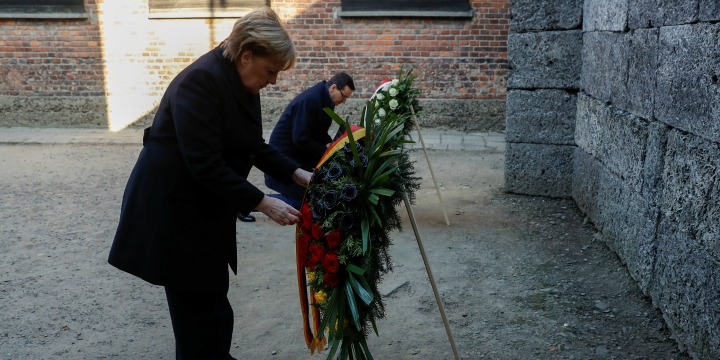
German Chancellor Angela Merkel and Polish Prime Minister Mateusz Morawiecki lay wreaths at the ‘death wall’ in the former Nazi German concentration and extermination camp of Auschwitz, in Oswiecim, Poland, Dec. 6, 2019. Photo: Reuters / Kacper Pempel.
Though I’ve been to Auschwitz countless times, it never grows easy or comfortable. But I keep returning, because I’m sure that the six million want us to visit. They want us to come to their graves. They don’t want to be forgotten. When we come, their tormented memories have just a tiny respite from the darkness of their demise.
As I come once again for the 75th anniversary of the camp’s liberation, so many stories come running back to me. There was the time, nearly three decades ago, when I visited Auschwitz for the first time. I saw giant crosses covering Auschwitz nearly everywhere. This was when Cardinal Jozef Glemp, the Archbishop of Krakow, who has been rightly criticized as an antisemite – in one sermon, he blamed the Jews for spreading alcoholism in Poland — allowed a Carmelite nunnery to actually move into the death camp and stay in the building where the Zyklon-B canisters were kept.
Ultimately, through the protests of Jewish leaders like Avi Weiss, and the personal intervention of one of the greatest popes of all time, John Paul II, the nuns left — and with them the crosses.
Then there was the time, years later, when my wife Debbie, whose family was devastated by the Holocaust, found the name of her great-uncle Zoltan Yisrael Wiesner in the rosters of names of those murdered in Auschwitz. He was just a teenager when he was taken from his parents, who watched his train depart the station while they scrambled, unsuccessfully, to show papers to his captors that would have freed him. His parents, Debbie’s great-grandparents, never recovered from the murder of their son. And I saw in my wife’s eyes that the pain of confronting relatives murdered in the Holocaust is of course generational. There was nothing I could say to comfort Debbie. I just stood and read the name with her in silence.
I also recalled visiting Auschwitz on the 69th anniversary of the liberation, when I walked through the terrifying train gates with Israel’s Chief Rabbi David Lau holding a Torah. We were surrounded by high-ranking IDF officers and soldiers in uniform — most of whom had an empty, vacuous gaze — and my thoughts turned to what would have been, what might have been, had the Jewish people had a state and an army when Hitler came to power.
And then there was the time when I traveled to Auschwitz with Elisha Wiesel, just a few months after the passing of his father. We walked around Crematoria 2 and 3, where his relatives almost certainly died, and where their ashes were now a part of the very earth where we tread. I had nothing to say to Elisha, either. What words could be offered?
But perhaps most moving of all was in the summer of 2017 when I took my children on an eight-week tour of the ghettos and killing fields of Europe and most of the extermination camps and crematoria. I wanted my children to know that amidst the joys of being a Jew — which are endless — they had come at a terrible price from whose memory we dare never escape.
Rabbi Shmuley Boteach, whom The Washington Post calls “the most famous Rabbi in America,” is the international best-selling author of 33 books, including the upcoming Holocaust Holiday: One Family’s Descent into Genocide Memory Hell. Follow him on Twitter and Instagram @RabbiShmuley.