 Pod Save America Hosts Call on Democrats to Cut All Israel Military Aid, No Longer Accept AIPAC Funding
 Jews, Israelis Targeted in Austria Amid Surge in Antisemitic Incidents; Local Jewish Community Calls for Action
 ‘All of Our Strength’: Over 1,000 Pro-Israel Activists Gather in DC for Solidarity Conference
 ‘Devastated’: Wesley LePatner, Killed in Manhattan Mass Shooting, Was a Jewish Communal, Philanthropic Leader
 Sen. Angus King Vows to No Longer Vote for Israel Military Aid Until Gaza Conditions Improve
 Europe Won’t Pressure Israel to ‘Commit Suicide’ Amid Gaza Backlash, Palestinian State Push, Says Israeli FM
 Israel’s National Soccer Coach Attacked in Athens Before Soccer Fans Chant ‘F–K Israel, Free Palestine’ at Match
 New York Judge Sentences Neo-Nazi to 5 Years for Livestreaming Bomb Threats Against Jewish Hospitals
 US Pressures Lebanon to Issue Cabinet Decision to Disarm Hezbollah Before Talks Continue
 UK Plans to Recognize Palestinian State in September Unless Israel Meets Conditions, Starmer Says


A Historic Peace Opportunity That Must Be Seized
Error: Contact form not found.
 by Gershon Hacohen

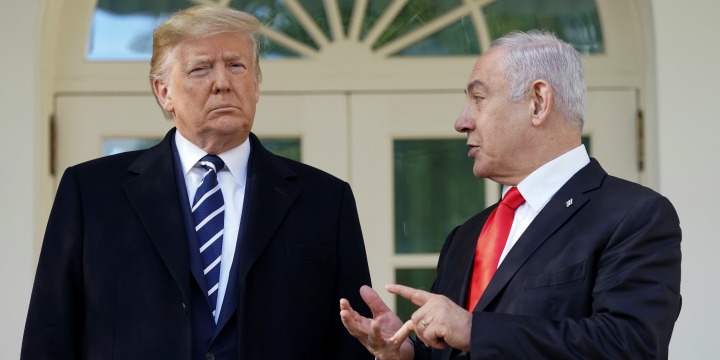
US President Donald Trump and Israeli Prime Minister Benjamin Netanyahu talk outside the Oval Office of the White House in Washington, DC, Jan. 27, 2020. Photo: Reuters / Kevin Lamarque.
On May 14, 1948, a few hours before the declaration of Israel’s establishment, Chaim Weizmann, soon to become the Jewish state’s first president, sent an urgent telegram from Geneva: “The decision must be made immediately. The gates of heaven have opened for a moment, and if we enter them our state will be established; if not, who knows if we will see its establishment in our day if at all.”
At such moments, leaders and policymakers must make fateful decisions. Those who procrastinate and wait for detailed staff assessments risk squandering the opportunity.
From its inception, the Zionist enterprise has existed in constant tension between two contending visions regarding the overriding goal of the prospective Jewish state: redemption and reconstitution of statehood in the ancestral homeland versus an internationally-recognized safe haven for persecuted Jews. And while Israel has largely succeeded at reconciling these two visions and creating a broad common denominator for a unified national endeavor, the yawning gap between the approaches reveals itself all over again at every fateful juncture.
We now see the two visions once more in confrontation: on the one hand, the desire to retain the Jordan Valley for security reasons only; on the other, the aim of applying full sovereignty to this tract of land and settling it accordingly. The shift President Trump has brought about in the American approach to the Israeli-Palestinian conflict touches the very heart of the Israeli controversy and presents a unique historic opportunity.
In the decades attending the formation of the US-Israel alliance in the late 1960s, successive US administrations have expressed a commitment to Israel’s security but denied its claim to the parts of the homeland that were captured in the 1967 war. By way of imposing a solution on the Israeli government, President Barack Obama and Secretary of State John Kerry tasked Gen. John Allen with crafting a security plan that would allay Israel’s security concerns about an almost total withdrawal from the West Bank, including the Jordan Valley, and require it to “choose between peace and ideology” (as columnist Thomas Friedman put it in The New York Times). With this plan, the administration sought to fulfill its commitment to Israel’s security while rejecting its demand for defensible borders that do not conform to the 1967 lines (a demand consistent with UN Security Council Resolution 242 of November 1967).
The greatness of the Trump plan lies in the fact that unlike preceding American peace initiatives, it recognizes Israel’s right to retain territories beyond the 1967 lines as a matter of historical right and not solely as a measure to be taken for security purposes. Though the plan does not grant Israel all it desires, it plainly repudiates the precedent established by the peace treaty with Egypt, which mandated a complete Israeli withdrawal to the last centimeter. It was this precedent that led then-Prime Minister Ehud Barak (at the Camp David summit in July 2000) to offer full Israeli territorial swaps for the settlement blocs that would remain in its hands (comprising about 3% of West Bank territory).
With his plan, President Trump joins Lord Balfour and other world leaders who saw in Israel’s rebirth in its ancestral homeland the tidings of a cosmic redemption, not just the provision of a haven to a persecuted people. Israel has received a precious gift, and it must decide what to make of the potential it harbors. About such moments it is said: “There are those who gain the world in a single moment and there are those who lose the world in a single moment.”
Maj. Gen. (res.) Gershon Hacohen is a senior research fellow at the Begin-Sadat Center for Strategic Studies. He served in the IDF for 42 years. He commanded troops in battles with Egypt and Syria. He was formerly a corps commander and commander of the IDF Military Colleges.
A version of this article was originally published by Israel Hayom and The BESA Center.