 Pod Save America Hosts Call on Democrats to Cut All Israel Military Aid, No Longer Accept AIPAC Funding
 Jews, Israelis Targeted in Austria Amid Surge in Antisemitic Incidents; Local Jewish Community Calls for Action
 ‘All of Our Strength’: Over 1,000 Pro-Israel Activists Gather in DC for Solidarity Conference
 ‘Devastated’: Wesley LePatner, Killed in Manhattan Mass Shooting, Was a Jewish Communal, Philanthropic Leader
 Sen. Angus King Vows to No Longer Vote for Israel Military Aid Until Gaza Conditions Improve
 Europe Won’t Pressure Israel to ‘Commit Suicide’ Amid Gaza Backlash, Palestinian State Push, Says Israeli FM
 Israel’s National Soccer Coach Attacked in Athens Before Soccer Fans Chant ‘F–K Israel, Free Palestine’ at Match
 New York Judge Sentences Neo-Nazi to 5 Years for Livestreaming Bomb Threats Against Jewish Hospitals
 US Pressures Lebanon to Issue Cabinet Decision to Disarm Hezbollah Before Talks Continue
 UK Plans to Recognize Palestinian State in September Unless Israel Meets Conditions, Starmer Says


Why Europe and Israel Need Each Other
Error: Contact form not found.
 by Raanan Eliaz

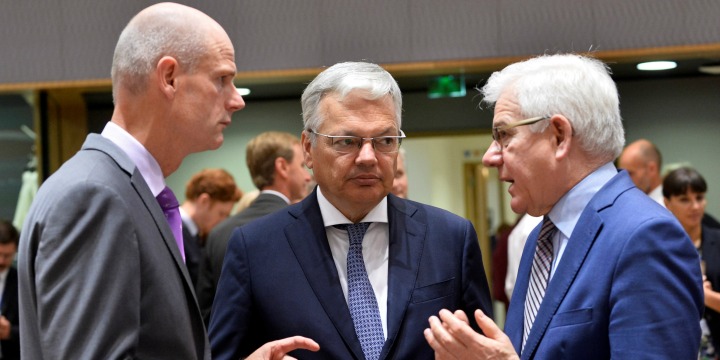
(L-R) Foreign Ministers of the Netherlands, Stef Blok, Belgium, Didier Reynders and Poland, Jacek Czaputowicz, attend a EU foreign ministers meeting in Brussels, Belgium July 15, 2019. Photo: REUTERS/Johanna Geron.
Europe’s well-intentioned but obsolete strategy has dramatically contributed to the prolongation of the Arab-Israeli conflict. The Israeli elections scheduled for March 2 provide yet another opportunity for the EU to reestablish itself as a meaningful player in this troubled region, which is right in its immediate proximity. All parties involved have a lot to gain if the cards are played right in Brussels.
The third attempt by Israelis to elect a government in less than one year is not, as many may think, simply a referendum on the extension of Prime Minister Benjamin Netanyahu’s right-wing government. These elections are consequential for Israel’s very soul and democratic character. A new and more centrist government may emerge, in unity or without it, bringing fresh thinking and terminology to the forefront.
Whichever way the Israeli electorate goes, making a paradigmatic shift towards stronger engagement in the region should be a high priority for the EU. For most of the past decade, Europe’s influence in the Middle East has dwindled. Europe’s core choices on foreign and security matters, and the gap between words and actions, have alienated Israelis and all but helped Palestinians.
Not that President Donald Trump’s so called “Deal of the Century” can realistically be implemented as is, but it exposes in bright daylight the sharp contrast between false hopes that Europe has offered the Palestinians, and the grim reality in which they live.
A young generation of Palestinians has witnessed the misguided EU conduct, which has led the Palestinian leadership to reject consecutive and more favorable offers for a homeland over the past decades, proposals they are not likely to receive again. No matter which government sits in Jerusalem, Palestinian society today is fragmented and unable to take the bold steps necessary for the existence of an independent Palestinian state.
Arguably, such vision may still be possible, but the way to advance it must dramatically change, and Europe is a key player in leading the necessary reforms.
In and of itself, the EU must restore its unity after Brexit and establish a reinvigorated common foreign and security policy. Words are not enough — the EU should enhance structures that support unity and penalize members who do not abide by this. Relying solely on soft power is no longer enough. In today’s world, Europe needs to be more assertive militarily and hold capabilities to deter enemies, inside and outside its physical borders.
The future of the EU in the 21st century is tightly linked to its ability to develop defense capabilities to protect itself. The EU’s too soft approach towards violations of its own standards and values, internally and internationally, has turned dangerously deadly — first and foremost, to its own existence as a unified power, but also to international players such as the Palestinians.
When dealing with Israel and the Palestinian Authority, and more broadly within the context of the Middle East, Europe should update its old paradigms, expectations, and demands. It can no longer ignore the facts on the ground, some of which rise above the surface in Trump’s vision for the region.
As part of its survival strategy in this rough neighborhood, Israel, for its part, would need to further develop alliances, regionally and internationally. This interest surpasses expectations for democratization in the Arab world. That is why Israel will align with whoever can guarantee stability –not only the US, EU, Russia, China and additional global powers, but also those regimes in its vicinity, regardless of whether they are bound to its own values such as human rights and equality.
Another key Israeli self-preserving interest is to remain a liberal democratic country — not only because its moral justification depends on it, but because this also enables international Jewish solidarity, essential to keeping Israel secure among the family of nations.
There is a clear convergence of interests between the EU and Israel. Further developing regional alliances, boldly rejecting violence, and protecting liberal democracy wherever it is possible, will serve both Europe and Israel and eventually, Palestinian society in its quest for peaceful independence alongside Israel.
Raanan Eliaz is an expert on EU-Israel relations. Since the early 2000s he was engaged in the creation of a European movement to advance EU-Israel ties and has led as CEO a network of organizations he created, ELNET and the Forum of Strategic Dialogue, throughout 2017. Today he partakes in creating a parallel movement on the Israeli side.