 Pod Save America Hosts Call on Democrats to Cut All Israel Military Aid, No Longer Accept AIPAC Funding
 Jews, Israelis Targeted in Austria Amid Surge in Antisemitic Incidents; Local Jewish Community Calls for Action
 ‘All of Our Strength’: Over 1,000 Pro-Israel Activists Gather in DC for Solidarity Conference
 ‘Devastated’: Wesley LePatner, Killed in Manhattan Mass Shooting, Was a Jewish Communal, Philanthropic Leader
 Sen. Angus King Vows to No Longer Vote for Israel Military Aid Until Gaza Conditions Improve
 Europe Won’t Pressure Israel to ‘Commit Suicide’ Amid Gaza Backlash, Palestinian State Push, Says Israeli FM
 Israel’s National Soccer Coach Attacked in Athens Before Soccer Fans Chant ‘F–K Israel, Free Palestine’ at Match
 New York Judge Sentences Neo-Nazi to 5 Years for Livestreaming Bomb Threats Against Jewish Hospitals
 US Pressures Lebanon to Issue Cabinet Decision to Disarm Hezbollah Before Talks Continue
 UK Plans to Recognize Palestinian State in September Unless Israel Meets Conditions, Starmer Says


American Jews ‘Dismayed’ by Israel
Error: Contact form not found.
 by Jerold Auerbach

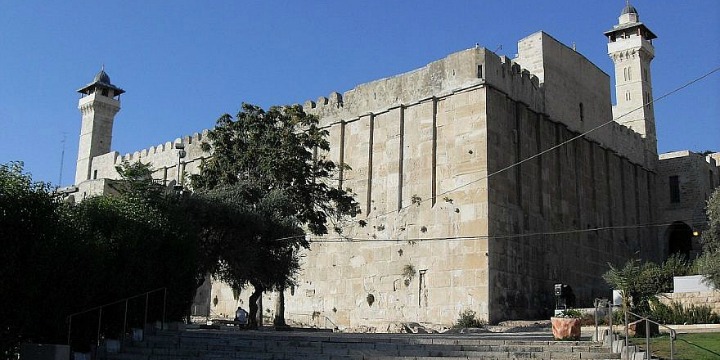
The Cave of the Patriarchs in Hebron. Photo: Wikimedia Commons.
Of the writing of books critical of Israel by American Jews, invariably liberals, there is no end. All that has changed is that women have now become participants in the newest version of “Me too.” In The Woman, Ilana Hammerman recently lacerated “the Occupation” — in translation, Israel’s return to Biblical Judea and Samaria following the Six-Day War.
Now, In Jerusalem by Lis Harris, a professor of writing at Columbia, decries Israel’s “hard-right drift, the erosion of its principles of liberal democracy, and its hidebound attitude toward the Occupation.” In Jerusalem, like The Woman, reveals more about the authors than the nation they are ostensibly writing about.
Harris self-identifies as “a secular, diaspora Jew.” She “felt implicated by the way the Palestinians were treated and could never quite shake the conviction that [Israel’s] antidemocratic moves … were so contrary to the Jewish values I was raised with.” Her disillusionment is grounded in “the Occupation” that followed Israel’s return to Judea and Samaria during the Six-Day War, and the growth of its population ever since in communities despised as “settlements.” Given her reliance upon left-wing sources — Benny Morris and Ari Shavit among them — her negative judgments about Israel are predictable.
Harris hopes to understand “the conflict’s effect on the lives of successive generations on each side.” Her “understanding” is a foregone conclusion: as she learned from Israeli and Palestinian friends, “normal life gave way to deep civic unrest engendered by the Occupation.” She finds the Israeli security wall, “built by descendants of a population once itself segregated and decimated behind walls,” to be “a nearly unabsorbable phenomenon.” The reason for the wall, grounded in years of repeated and devastating Palestinian terrorist attacks launched from the West Bank, is ignored.
With a fondness for misplaced analogies, Harris identifies Israeli “occupation” with American segregation before the civil rights movement. Worse yet, it is a form of apartheid, leaving Palestinians “under the boot of an unequal system codified by law.” Predictably, Israelis are to be blamed for not “seriously pursuing“ peace while supporting “the illegal spread of settlements.” Their ubiquitous presence “in what is supposed to become a viable contiguous Palestinian state unmoors one’s sense of the possible.” The only people without the right to live in the Biblical homeland of the Jewish people, it seems, are Jews.
Harris perceives “two traumatized populations” in Israel: Jews “who have never fully recovered from the depredations of the Holocaust, nor from their many wars and two intifadas” and Palestinians “who not only have not recovered from the events of 1948 and 1967 but have been traumatized anew” by nighttime Israeli raids, violent clashes, arrest, and loss of land. Palestinian terrorist attacks are unworthy of mention. Palestinians, for Harris, are always victims, never initiators. Israelis are their cruel conquerors.
In her quest for an understanding of the tyranny of Israeli occupation Harris befriended Yaron and Ruth Ezrahi. Yaron, a renowned scholar at Hebrew University (and prominent leftist), believes that his country is accurately described as an apartheid state. Following his lead, Harris blames “settlers and right-wing governments” for Israel’s moral demise. In Israel, she concludes, liberal democratic ideals are devalued by “nearly forty years of repressive occupation.” She seems unaware that the land Israel is “occupying” is its Biblical homeland.
A chapter about Ruth’s brothers, entitled “Soldiers,” reveals their disillusionment with Israel grounded in their military experiences during the 2006 Lebanon war. That prompts a two-page riff about Breaking the Silence, a group of Israeli military veterans who vigorously and publicly opposed it. Harris concludes: “I think the truth is it’s traumatic for anyone to have the experience of fighting in a war and then to keep repeating that experience in other wars.” She does not consider why Israel has had to fight so many wars in so short a time.
Israel, to be sure, is no less subject to criticism than any other country. But why it is lacerated so much more — especially by liberal Jews — deserves more careful analysis than Liz Harris seems capable of providing. In the end, her book demonstrates that the liberals’ war against Israel is a futile exercise.
Jerold S. Auerbach is the author of Print to Fit: The New York Times, Zionism, and Israel, 1896-2106, selected by Ruth Wisse and Martin Kramer as a Mosaic Best Book in 2019.