 Pod Save America Hosts Call on Democrats to Cut All Israel Military Aid, No Longer Accept AIPAC Funding
 Jews, Israelis Targeted in Austria Amid Surge in Antisemitic Incidents; Local Jewish Community Calls for Action
 ‘All of Our Strength’: Over 1,000 Pro-Israel Activists Gather in DC for Solidarity Conference
 ‘Devastated’: Wesley LePatner, Killed in Manhattan Mass Shooting, Was a Jewish Communal, Philanthropic Leader
 Sen. Angus King Vows to No Longer Vote for Israel Military Aid Until Gaza Conditions Improve
 Europe Won’t Pressure Israel to ‘Commit Suicide’ Amid Gaza Backlash, Palestinian State Push, Says Israeli FM
 Israel’s National Soccer Coach Attacked in Athens Before Soccer Fans Chant ‘F–K Israel, Free Palestine’ at Match
 New York Judge Sentences Neo-Nazi to 5 Years for Livestreaming Bomb Threats Against Jewish Hospitals
 US Pressures Lebanon to Issue Cabinet Decision to Disarm Hezbollah Before Talks Continue
 UK Plans to Recognize Palestinian State in September Unless Israel Meets Conditions, Starmer Says


The Need for Jewish Proofreaders
Error: Contact form not found.
 by Jeremy Rosen

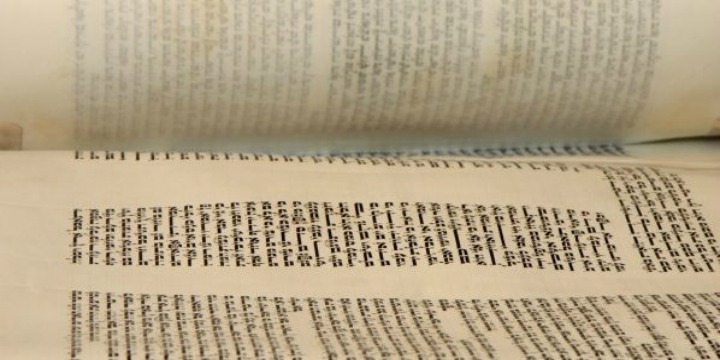
A Torah scroll. Photo: RabbiSacks.org.
I read The Economist religiously every week. Its coverage of world affairs in a concise and readable form, combined with its cultural, scientific, and review articles, are the best way to keep up to date with what’s going on.
I don’t always agree with its writers, particularly about the Israeli-Palestinian conflict or the American political scene. Even so, in this world of doctrinaire, one-sided newspapers, journals, and distorted if not fake news, its cultured, middle of the road, liberal stance, matches mine more than any other publication.
I also like its idiosyncratic and witty style — its recognition of the value of grammar, while accepting its flexibility, and the fact that language constantly changes and expands. I do find some of its stylistic decisions irking. I particularly dislike its acceptance of the expression “the likes of.” But I applaud, for example, its insistence on differentiating between datum and data — and the difference between disinterested and uninterested.
Every now and then, however, its writers manage to say something that really gets to me for its sheer ignorance, when they should know better. A year or so ago, it quoted Jesus as saying that “The poor shall never cease from the earth.” No, he didn’t say that. The Torah, Deuteronomy 15:11 said, “The poor (or destitute) shall not cease from the midst (of the) land (or the earth).”
Now, whenever you may think the Torah was revealed, written, or compiled, every scholar will agree that it was at least several hundred years, if not a thousand, before the Gospels. It is true that somewhere in the second century, the Gospel of John 12:8 has Jesus saying that “The poor you will always have with you”; and Mathew 26:11 says “The poor you will always have with you, but you will not always have me.” Neither of which rings either as poetical or as comprehensive as the earlier Biblical quote.
You’d have thought that even if a Christian does give priority to the New Testament, they ought to know that the quote comes from what they call the Old Testament. Surely Moses might have been given a little of the credit.
Then on October 5, The Economist (on page 43) had an article that said, “The first ten days of the Jewish new year, between Rosh Hashanah and Yom Kippur, are known as the days of atonement.” That’s strange. I know Yom Kippur is the Day of Atonement. But I always thought the Aseret Yemei Teshuvah, the first 10 days of the Jewish new year, between Rosh Hashanah and Yom Kippur were the Ten Days of Repentance. Did they know something I didn’t? Have I been wrong all my rabbinic life?
Recently, on February 22 (page 48), there was an article about the renovation of a synagogue in Egypt. It said that, “Over a decade ago the government restored the yeshiva of Moses Maimonides, the scholar who founded Orthodox Judaism in Cairo in the 12th century (and served as Saladin’s physician).”
Well, knock me down with a feather. Where the heck did they get that from? First of all, the term Orthodox, inaccurate, misleading, and divisive as it is, was not used in Judaism until the 18th century. And not at all by the Sephardi world until the 20th century, a thousand years after Maimonides. He would never have recognized let alone understood or approved of the terminological distinction between an Orthodox Jew and any other one.
I can understand if one said that Maimonides was the first to come up with a concise formulation of “Thirteen Principles of Belief.” But he certainly did not found them. Their ideas are all referred to in the Talmud long before Maimonides was born. Besides, if principles of belief define Jewish identity, and that is debatable, several great authorities composed earlier and shorter versions, as Professor Marc Shapiro has so admirably illustrated. Maimonides’s magisterial codes of Jewish Law were all based on earlier scholars and texts.
It seems to me that just as you need proofreaders (and yes, I know I do, because I am very careless and hate reviewing and apologize for all my egregious errors), you also need fact-checkers. And every child should be told not to believe everything one reads in print, regardless of the source. So whoever it is they have at The Economist to check anything of Jewish interest (and I don’t include Israeli affairs), he or she is either not well informed or not doing a professional enough job.
But the good news is that I am prepared to offer my services and I will work from home. For an economical fee of course. Now if you want to get really depressed, watch the news.