 Pod Save America Hosts Call on Democrats to Cut All Israel Military Aid, No Longer Accept AIPAC Funding
 Jews, Israelis Targeted in Austria Amid Surge in Antisemitic Incidents; Local Jewish Community Calls for Action
 ‘All of Our Strength’: Over 1,000 Pro-Israel Activists Gather in DC for Solidarity Conference
 ‘Devastated’: Wesley LePatner, Killed in Manhattan Mass Shooting, Was a Jewish Communal, Philanthropic Leader
 Sen. Angus King Vows to No Longer Vote for Israel Military Aid Until Gaza Conditions Improve
 Europe Won’t Pressure Israel to ‘Commit Suicide’ Amid Gaza Backlash, Palestinian State Push, Says Israeli FM
 Israel’s National Soccer Coach Attacked in Athens Before Soccer Fans Chant ‘F–K Israel, Free Palestine’ at Match
 New York Judge Sentences Neo-Nazi to 5 Years for Livestreaming Bomb Threats Against Jewish Hospitals
 US Pressures Lebanon to Issue Cabinet Decision to Disarm Hezbollah Before Talks Continue
 UK Plans to Recognize Palestinian State in September Unless Israel Meets Conditions, Starmer Says


From the Kaiser to Hitler
Error: Contact form not found.
 by Harold Brackman

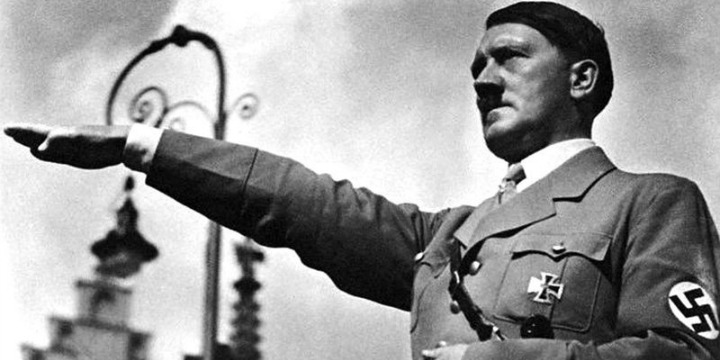
Adolf Hitler giving a Nazi salute. Photo: Wikimedia Commons.
Among the ideological causes of World War I were hubris and hatred by Germans that reinforced Kaiser Wilhelm’s — and ultimately Adolf Hitler’s — antisemitism.
In broad terms, many Germans became intoxicated with the “völkisch” conception of themselves as a conquering race. German antisemitism was also rife. It fueled the unreasoning fear that rich, powerful Jews in London, Paris, and St. Petersburg were conspiring against Germany.
Heinrich von Treitschke, a charismatic reactionary politician and historian, once said: “The Jews are our Misfortune!” During the Third Reich, this motto was emblazoned on the masthead of Julius Streicher’s Der Stürmer, and even propagated in a children’s book.
Treitschke’s lament was not lost on Houston Stewart Chamberlain, a prolific self-taught pseudo-scholar who had Kaiser Wilhelm II’s ear before and during World War I — and lived long enough to influence Hitler.
Chamberlain (no relation to Neville) was a British-born Germanophile, educated by a Prussian tutor. He became a naturalized German citizen, partly because of his adoration of Richard Wagner. Chamberlain’s second wife was Wagner’s daughter; she provided entrée for him to “the Bayreuth Circle” comprised of the composer’s fanatical admirers.
The Foundations of the Nineteenth Century (1899) — a massive, disjointed two-volume harangue written in German and then translated into English — gave Chamberlain a following as far as the United States, whose doom he prophesied.
The book’s obsessive theme was that Germans had been a master race ever since they vanquished the Roman Empire. Jesus was an Aryan, not a Jew. William Shakespeare was essentially “a Germanic playwright.” The French were decadent, and “Ju-England” worse. The English had degenerated into “a nation of shopkeepers” beholden to Jews such as Benjamin Disraeli and the Rothschilds.
In 1901, after Kaiser Wilhelm read Chamberlain’s Foundations, they became fast friends and regular correspondents. When the kaiser’s intimate, Count Eulenburg, was exposed as a homosexual, the kaiser wrote Chamberlain blaming the scandal on “Jewish cheek, slander, and lies.” Chamberlain told Wilhelm that there was no risk in pursuing an aggressive foreign policy because Germany was destined to rule the world.
German defeat and the kaiser’s abdication in 1918 did not end Chamberlain’s influence. Sensing that a man of destiny was emerging who would redeem Germany from humiliation, he wrote a fawning letter in 1923 thanking Hitler for “transform[ing] the state of my soul.” In 1927, Hitler reciprocated by attending the funeral of this hateful prophet, whom James D. Forman dubbed “Hitler’s John the Baptist.”
Historian Harold Brackman is coauthor with Ephraim Isaac of From Abraham to Obama: A History of Jews, Africans, and African Americans (Africa World Press, 2015).