 Pod Save America Hosts Call on Democrats to Cut All Israel Military Aid, No Longer Accept AIPAC Funding
 Jews, Israelis Targeted in Austria Amid Surge in Antisemitic Incidents; Local Jewish Community Calls for Action
 ‘All of Our Strength’: Over 1,000 Pro-Israel Activists Gather in DC for Solidarity Conference
 ‘Devastated’: Wesley LePatner, Killed in Manhattan Mass Shooting, Was a Jewish Communal, Philanthropic Leader
 Sen. Angus King Vows to No Longer Vote for Israel Military Aid Until Gaza Conditions Improve
 Europe Won’t Pressure Israel to ‘Commit Suicide’ Amid Gaza Backlash, Palestinian State Push, Says Israeli FM
 Israel’s National Soccer Coach Attacked in Athens Before Soccer Fans Chant ‘F–K Israel, Free Palestine’ at Match
 New York Judge Sentences Neo-Nazi to 5 Years for Livestreaming Bomb Threats Against Jewish Hospitals
 US Pressures Lebanon to Issue Cabinet Decision to Disarm Hezbollah Before Talks Continue
 UK Plans to Recognize Palestinian State in September Unless Israel Meets Conditions, Starmer Says


Germany Cracks Down on Hezbollah — Who’s Next?
Error: Contact form not found.
 by Rami Dabbas

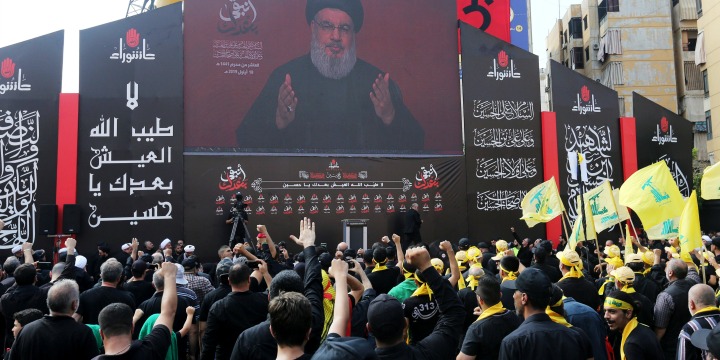
Hezbollah leader Hassan Nasrallah gestures as he addresses his supporters via a screen during the religious procession to mark the Shi’ite Ashura ceremony, in Beirut, Lebanon, Sept. 10, 2019. Photo: Reuters / Aziz Taher.
Following in the footsteps of the United States and the United Kingdom, authorities in Germany recently announced a complete ban on the activities of Hezbollah in the country. Security forces in Germany have embarked on a campaign to pursue and besiege the militia’s followers on German soil, which places Hezbollah in a real predicament, given their vital dependence on an external network of supporters spread throughout the world.
Germany represents one of the countries that has witnessed an extensive spread of Hezbollah institutions, religious centers, and associations. According to reports, it was estimated there were around 1,000 Hezbollah operatives active in Germany last year, and that about 30 mosques and cultural centers on German soil have links to Hezbollah.
The German Ministry of the Interior indicated that the authorities are investigating mosques and associations linked to Hezbollah on charges related to financial support and propaganda for the militia in Europe; these also include groups that worked to send funds directly to Hezbollah’s headquarters in Beirut.
Hezbollah has an external operations unit that is trying to find footholds in all areas vital to the militia — especially in Latin America and Europe.
In addition to the US and UK, Canada, the Netherlands, the League of Arab States, and a number of Latin American countries currently ban the entire organization — but the European Union has banned only the “military wing” of Hezbollah, while allowing its “political wing” to operate.
Hezbollah has always relied on a network of connections around the world with the aim of mobilizing financing on the one hand and finding logistical headquarters for its activities on the other. Germany’s recent ban and other efforts have put the organization in a predicament.
The German government justified its decision because of Hezbollah “continuing to demand the annihilation of Israel,” as well as its responsibility for the killing of many people in different regions around the world — among them, hundreds of thousands of Syrians.
Germany is of great importance to the party; it was considered a safe haven for some of its members, and — as the German Foreign Ministry said — “the party is working to collect donations in Germany and Europe through all the organizations and associations that have close ties with Arab and Islamic countries.”
The German step is very important, because it opens the door for more countries in Europe to follow in its footsteps.
Rami Dabbas is a civil engineer by profession who writes for several media outlets. He is a pro-Israel advocate, peace campaigner, and political activist speaking out against terrorism.