 Pod Save America Hosts Call on Democrats to Cut All Israel Military Aid, No Longer Accept AIPAC Funding
 Jews, Israelis Targeted in Austria Amid Surge in Antisemitic Incidents; Local Jewish Community Calls for Action
 ‘All of Our Strength’: Over 1,000 Pro-Israel Activists Gather in DC for Solidarity Conference
 ‘Devastated’: Wesley LePatner, Killed in Manhattan Mass Shooting, Was a Jewish Communal, Philanthropic Leader
 Sen. Angus King Vows to No Longer Vote for Israel Military Aid Until Gaza Conditions Improve
 Europe Won’t Pressure Israel to ‘Commit Suicide’ Amid Gaza Backlash, Palestinian State Push, Says Israeli FM
 Israel’s National Soccer Coach Attacked in Athens Before Soccer Fans Chant ‘F–K Israel, Free Palestine’ at Match
 New York Judge Sentences Neo-Nazi to 5 Years for Livestreaming Bomb Threats Against Jewish Hospitals
 US Pressures Lebanon to Issue Cabinet Decision to Disarm Hezbollah Before Talks Continue
 UK Plans to Recognize Palestinian State in September Unless Israel Meets Conditions, Starmer Says


Why Did God Expel the Jews From His Home?
Error: Contact form not found.
 by David Sasson

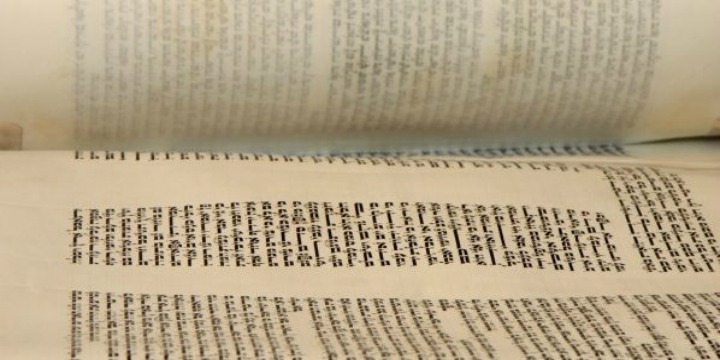
A Torah scroll. Photo: RabbiSacks.org.
As we start returning to our synagogues, it is important to remember that our temporary expulsion was not simply an unintended consequence of a biological event. It was God’s specific will. (God both created the world and actively runs it: “He causes vegetation to sprout for the cattle, and plants through man’s labor, to bring forth bread from the earth,” Psalm 104; “He spoke and the locust came, and grasshoppers without number,” Psalm 105.)
While the pandemic offers lessons for all of humanity, the Jewish belief in Divine providence compels us to find answers to our physical circumstance by examining the Jewish nation’s spiritual state. Rabbi Joseph B. Soloveitchik, the 20th century leader of American Jewish Orthodoxy known as the Rav, identified a corruption of the religious community that may have led to this short exile.
The synagogue is the anchor of our communities; a place to meet friends and celebrate life’s most important milestones. But its primary function is to meet God, not man. According to the Rav (in his Lonely Man of Faith), prayer is nothing less than the continuation of prophecy. Prayer only changed the order of the speech: the word of prophecy is God’s and is accepted by man; the word of prayer is man’s and accepted by God. To pray has only one connotation: to stand before God.”
Outside of Jewish learning institutions like a yeshiva or kollel, it is difficult to find anything resembling a prophetic encounter with God in synagogues. Instead, congregants and rabbis vacillate between reading from prayer books and conversing with neighbors. Can one imagine meeting the US president in the Oval Office only to turn and speak casually to someone else? Perhaps after repeated visits to God’s home we find ourselves acting more casually. But is the problem the frequency of our encounter with God or our approach?
In The Lonely Man of Faith, the Rav explains that God made man with two personalities. Tragically, we approach God with the wrong one. In the process, we have robbed God’s home for our own needs. The first personality we encounter, Adam 1, is described in Genesis chapter 1:
And Elokim said, “Let us make man in our image, after our likeness. They shall rule over the fish of the sea, the birds of the sky, and over the animal, the whole earth, and every creeping thing that creeps upon the earth.” So Elokim created man in His Image, in the image of Elokim. He created him, male and female He created them. Elokim blesses them and Elokim said to them, “Be Fruitful and multiply, fill the earth and subdue it.”
This is the personality of dignified-majestic man. God mentions both male and female in this creation story because dignity is not found in isolation: dignified-majestic man needs another to appreciate his wisdom and accomplishments. Adam 1 also finds strength in numbers to perform many tasks and conquer nature.
God creates Adam 1 with His name Elokim, which connotes God’s mastery over nature. Adam 1 is empowered to “rule” and “subdue” nature and, like his Creator, he is endowed with the power to create and commanded to be “fruitful.” Created in God’s image, Adam 1 is aware of his majesty and is driven by the force of his ego.
Man has embraced this personality. Adam 1 propels man to discover cures for disease, create art, build technologies, and explore new worlds. Dignified-majestic man proclaims his wisdom and accomplishments to the world; today he does so 24/7 through social media. This is the personality that has conquered earth and space. But it also conquered religion.
The personality that God is waiting to meet is described in Genesis Chapter 2: “And Y-H-V-H formed the man of dust from the ground, and He blew into his nostrils the soul of life; and man became a living being.”
Adam 2 is formed by God’s ineffable name “Y-H-V-H,” not the Elokim that rules nature. Y-H-V-H goes beyond nature’s physical limitations to humble Himself and meet man in this world. Y-H-V-H is merciful, not the Elokim of strict justice. He does not deliver the punishment man deserves and redeems His servant after sin.
Woman is not mentioned in this creation story because Adam 2 finds no purpose in announcing his accomplishments to distinguish himself and impress another. The Rav calls this personality the “Lonely Man of Faith” because his only concern is to tend to God’s garden — to follow God’s will. Adam 2 seeks redemption from his loneliness by uniting with his Creator. His redemption is found by controlling himself, not controlling the world around him.
Disciplined service and surrender to God are the hallmarks of a redemptive life. The Lonely Man of Faith does have a companion in his pursuit of redemption, but he finds her only in retreat and sacrifice: he is overpowered by sleep and must give part of himself before she appears. These partners do not serve each other’s egos and do not unite to rule nature or build political communities. They are equally lonely souls who come together because they are “starved for existential companionship” with God.
The Lonely Man of Faith does not simply reflect God’s outer image like Adam 1. God breathes His “soul of life” into Adam 2 with a Divine kiss using the same allegorical mouth that created the world through speech. God chooses to infuse Himself into dust because He wants intimacy, and the lowly dust does not allow ego to interfere in the relationship.
Only Adam 2 is the “living being,” which Onkelos translates as the “speaking spirit.” The Lonely Man of Faith uses speech to express his soul, not to seek dignity. Tragically, as God waits for the Lonely Man of Faith during prayer, the Adam 1 personality arrives and hijacks the power of speech for his own purpose. Adam 1 enters the synagogue to communicate with other men, display his wisdom, or advance his own selfish petition. The synagogue is yet another stage to bask in his own glory. Adam 1’s “dignity is discovered at the summit of success,” but redemption is found only “in the depth of crisis and failure.”
The Lonely Man of Faith does not leave his personality at the synagogue. Prayer is both the awareness of God’s presence and the act of committing oneself to His laws outside of the synagogue. The covenant extends to all facets of life. “It shall be that if you hearken to the voice of Y-H-V-H, your God, to observe, to perform all of his commandments … blessed shall be the fruit of your womb, and the fruit of your ground, and the fruit of your animals.” God’s covenant, not the cosmos, provides man with the answer to his petition.
God reveals Himself to the entire covenantal community, from “the hewer of thy wood unto the drawer of thy water.” But He does so for one purpose: to establish a personal relationship with each man through observance of His law. The king and laborer stand equally before God in this most democratic of communities, but each must seek God “face to face” as Moses met Y-H-V-H. “The man of faith, in order to redeem himself from his loneliness and misery, must meet God at a personal covenantal level.”
Adam 2 seeks a covenantal community, while Adam 1 established the religious communities we find today. In the covenantal community, Jewish leadership is not pursued; it is forced upon the most wise and humble who reluctantly assume the mantle of responsibility. The covenantal community does not seek the rabbi with strong oratory skills to entertain Adam 1 and keep him coming back. It is no coincidence that our first and greatest rabbi had a stutter. In how many synagogues must the rabbi worry about growing the membership, delivering an enchanting (and short) speech, and politicking with the wealthy who fund his salary and keep the lights on? The main function of a rabbi in a covenantal community is “to redress the grievances of those who are abandoned and alone.”
“The history of organized religion is replete with instances of the desecration of the covenant.” Jewish school tuition costs cater to the privileged few and advertising charitable donations, justified by Adam 1 to encourage others to donate, allows Adam 1 to pursue the plaque on the wall.
In the religious community, the polite Adam 1 interrupts Shabbat prayers to depart for the “Kiddish Club” to indulge in whiskey, food, and banter. The less polite Adam 1 bloviates inside the prayer room. Some congregations have a noble tradition to sing songs when people are called to recite the Torah blessing. Yet, this honor is usually extended to friends and family, not strangers. Are we glorifying the blessing of the Torah, or the person? “The Biblical account of the original sin is the story of the man of faith who realizes suddenly that faith can be utilized in the acquisition of majesty and glory.”
What becomes of Adam 1 in the covenantal community? Adam 1 plays only a supporting role to the mission of the Lonely Man of Faith. Adam 1 propels man to master science so he can understand God and care for His children; conquer earth and space so he can reveal God’s glory; and attain commercial success to loudly proclaim God as the source of wealth while discreetly providing for His poor. “There is only one world –not divisible into secular and hallowed sectors.”
There is no malice or evil intent by congregants in religious communities. The Adam 1 personality has so completely monopolized every aspect of life that man does not realize he has a Lonely Man of Faith personality, and he has lost perspective to appreciate the mammoth destruction Adam 1 has caused. Retreat, submission, and surrender are not qualities that are practiced or respected in our time.
King David declares, “To Elokim [God of judgment] I shall praise the Word, to Y-H-V-H [merciful God], I shall praise the Word.” We must praise God for expelling us from His synagogue, just as we must thank Him as He lets us return. The coronavirus reminds us that money, power, and scientific prowess cannot save. Self-isolation allows us the time and space to discover our Lonely Man of Faith and reintroduce ourselves to God and the world with the right personality leading the way. If we fail to find our lost personality, God will be merciful. But will we be merciful to ourselves and faithful to our Creator if we have to learn the lesson again?
This essay is inspired and guided by the writings of Rabbi Joseph B. Soloveitchik z’l. Omissions, errors, and misguided analyses are mine alone, for which I apologize and ask for forgiveness from God, the reader, and the Rav’s blessed memory.





