 Pod Save America Hosts Call on Democrats to Cut All Israel Military Aid, No Longer Accept AIPAC Funding
 Jews, Israelis Targeted in Austria Amid Surge in Antisemitic Incidents; Local Jewish Community Calls for Action
 ‘All of Our Strength’: Over 1,000 Pro-Israel Activists Gather in DC for Solidarity Conference
 ‘Devastated’: Wesley LePatner, Killed in Manhattan Mass Shooting, Was a Jewish Communal, Philanthropic Leader
 Sen. Angus King Vows to No Longer Vote for Israel Military Aid Until Gaza Conditions Improve
 Europe Won’t Pressure Israel to ‘Commit Suicide’ Amid Gaza Backlash, Palestinian State Push, Says Israeli FM
 Israel’s National Soccer Coach Attacked in Athens Before Soccer Fans Chant ‘F–K Israel, Free Palestine’ at Match
 New York Judge Sentences Neo-Nazi to 5 Years for Livestreaming Bomb Threats Against Jewish Hospitals
 US Pressures Lebanon to Issue Cabinet Decision to Disarm Hezbollah Before Talks Continue
 UK Plans to Recognize Palestinian State in September Unless Israel Meets Conditions, Starmer Says


How Will the West Respond to China’s Nefarious Hong Kong Crackdown?
Error: Contact form not found.
 by Roie Yellinek

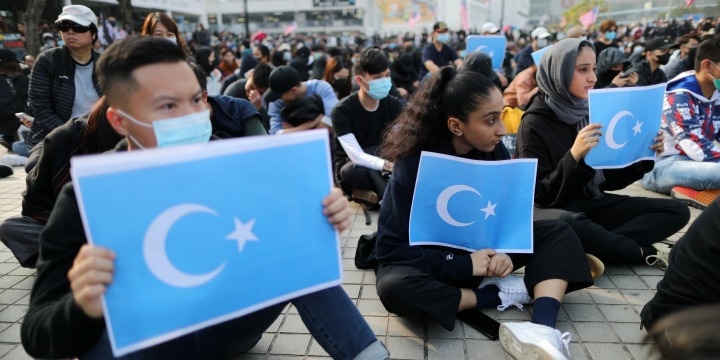
A pro-Uighur demonstration in Hong Kong, Dec. 22, 2019. Photo: Reuters / Lucy Nicholson.
In 1997, after 156 years of British rule, the United Kingdom transferred responsibility for the city-state of Hong Kong to China. Twenty-three years later, in 2020, China enacted a security law that extends its powers over Hong Kong in contravention of the terms of that transfer.
In doing so, Beijing is signaling its determination to expand its area of control and influence even in the face of international criticism.
Beijing took this step without consulting the local parliament, as was required by the transfer agreement. It also did so in defiance of both inevitable international criticism and the rioting and protests that have occurred in Hong Kong in recent months.
Under the new law, 7.5 million Hong Kong residents will be subject to restrictions imposed on Chinese residents, including a life sentence for “subversion” — a routine indictment used by the Chinese government to imprison and silence its opponents and human rights activists. This is probably the most significant political change in Hong Kong since its transfer to China.
Why has Beijing chosen this moment to impose the law? China is, after all, still trying to deal with the fallout of the coronavirus pandemic, which erupted in Wuhan. It is also engrossed in border battles with India and Russia, even as it gets more deeply involved in an expanding competition with the US for global hegemony.
Beijing did this because it can, and because it wants to continue to expand its sphere of influence.
The Chinese have been paying close attention to Washington’s response to their conduct for some time, from the oppression of the Uighur minority in Xinjiang to China’s aggressive operations in the South China Sea, to the eruption of the global coronavirus crisis, which was largely caused by China’s initial blunders. Donald Trump’s national security adviser, Robert O’Brien, said Washington has failed to understand China’s international conduct, calling it “the greatest failure of US foreign policy since the 1930s.”
In every one of the areas listed above, Beijing came out virtually unscathed. This bolstered its confidence that it could do whatever it wants to bring Hong Kong into line.
By imposing the security law on Hong Kong, Xi Jinping’s China is signaling that it will not tolerate any criticism of its conduct, whether internal or external. As Zhang Xiaoming, deputy head of the Chinese Office of Hong Kong and Macau, put it in response to sanctions imposed by the US Senate on Beijing: “Some countries are threatening us with sanctions. I would say this is the logic of bandits. … Long gone are the days when we Chinese had to takes cues from others.”
The question is whether the Western nations will be able to read the writing on the wall or continue to keep their heads in the sand.
Roie Yellinek is a PhD student at Bar-Ilan University, a doctoral researcher at the Begin-Sadat Center for Strategic Studies, and a non-resident scholar at the Middle East Institute.
A version of this article was originally published by The BESA Center.