 Pod Save America Hosts Call on Democrats to Cut All Israel Military Aid, No Longer Accept AIPAC Funding
 Jews, Israelis Targeted in Austria Amid Surge in Antisemitic Incidents; Local Jewish Community Calls for Action
 ‘All of Our Strength’: Over 1,000 Pro-Israel Activists Gather in DC for Solidarity Conference
 ‘Devastated’: Wesley LePatner, Killed in Manhattan Mass Shooting, Was a Jewish Communal, Philanthropic Leader
 Sen. Angus King Vows to No Longer Vote for Israel Military Aid Until Gaza Conditions Improve
 Europe Won’t Pressure Israel to ‘Commit Suicide’ Amid Gaza Backlash, Palestinian State Push, Says Israeli FM
 Israel’s National Soccer Coach Attacked in Athens Before Soccer Fans Chant ‘F–K Israel, Free Palestine’ at Match
 New York Judge Sentences Neo-Nazi to 5 Years for Livestreaming Bomb Threats Against Jewish Hospitals
 US Pressures Lebanon to Issue Cabinet Decision to Disarm Hezbollah Before Talks Continue
 UK Plans to Recognize Palestinian State in September Unless Israel Meets Conditions, Starmer Says


The Decline and Fall of Tolerance
Error: Contact form not found.
 by Jerold Auerbach

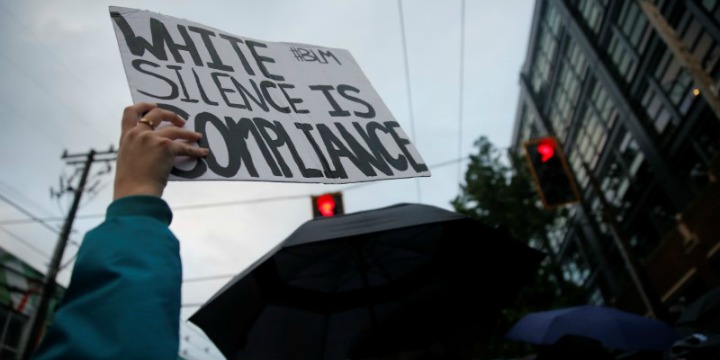
A protester holds a sign near umbrellas used by demonstrators as shields during a protest against police brutality, in Seattle, Washington, June 2, 2020. Photo: Reuters / Lindsey Wasson.
There was a time, not that long ago, when liberalism meant open-mindedness, even freedom of speech. Not any longer. Thoughtful and tolerant discourse has now yielded to violent street protests; smashed, looted and burned stores and government buildings; destruction of offending statues of one-time political and military heroes; and, in the apex of the academic world (as modeled by Yale and Princeton), the renaming of newly offensive buildings and programs. As a retired professor who taught the history of freedom of speech in the United States, I wonder whether it may have outlived its fundamental value for a free society.
Especially symptomatic is the descent of the newspaper that once epitomized responsible journalism into the morass of political correctness. For more than a century “All the News That’s Fit to Print” has served as the front page pledge of The New York Times. To be sure, “fitness” became a malleable commitment once its Jewish publishers ignored the Holocaust and subsequently launched unrelenting criticism of Israel for its rejection of Times guidelines toward those who sought to destroy it.
Embracing current standards of political correctness, the Times recently fired op-ed editor James Bennet, who dared to publish a column by Senator Tom Cotton entitled “Send in the Troops.” Cotton called for a military response, if necessary, to quell violent protests and the destruction of property in the current wave of uninhibited lawlessness. According to the acting editorial page editor, Cotton’s “jaw-dropping” title was “itchy-trigger-fingery” and “a metaphorical tear-gas canister into a tense national crisis.” But the Times’ verbal gymnastics could not conceal its shredding of freedom of the press to appease its passionately “liberal” editors and readers.
Then, responding to the tidal wave of political correctness that was flooding the Times, staff editor Bari Weiss resigned. Hired for the commendable (and, given pervasive Times bias, necessary) purpose of diversifying the Opinion page, she quickly realized that the opinions of political conservatives were unfit to print — or even speak. Badgered by feckless colleagues who preposterously labeled her a “Nazi” and a “racist,” she learned that only “ideologically kosher” opinion essays were acceptable. At the Times the rules of liberal intolerance demanded obedience.
A welcome corrective to the Times’ unrelenting closed-mindedness appeared in a Wall Street Journal “Note to Readers” (July 24). Even at that longtime bastion of prudent conservatism, nearly three hundred Journal colleagues had signed a letter to the publisher criticizing the opinion pages for violating newly fashionable liberal norms of censorship.
“It was probably inevitable,” the editors responded, “that the wave of cancel culture would arrive at the Journal, as it has at nearly every other cultural, business, academic and journalistic institution.” But the Journal, they pointedly (and reassuringly) wrote, is “not the New York Times.” Its opinion pages “offer an alternative to the uniform progressive views that dominate nearly all of today’s media” amid “a culture of growing progressive conformity and intolerance.”
Considering the currently tumultuous political climate, where reason has yielded to rioting and “progressive” has become regressive, the capitulation of self-proclaimed “liberal” media to political correctness — led by The New York Times — is likely to become ever more deeply embedded in American journalism. There is little reason to expect the Times to adhere to basic principles of trustworthy journalism, since it has already abandoned them.
For now, sadly, the censorship advocacy of liberal editors and columnists emulates the repressive policy of academic institutions that have transformed learning into indoctrination. As a historian comfortable with the past, I yearn for those good old days when challenging ideas could be debated, not suppressed, and not only in the classroom but anywhere that ideas are taken seriously. That, not street violence or the squelching of dissent, defines a democratic society. I eagerly await its return, but I am not optimistic.
Jerold S. Auerbach is the author of Print to Fit: The New York Times, Zionism and Israel 1896-2016, selected for Mosaic by Ruth Wisse and Martin Kramer as a Best Book for 2019.