 Pod Save America Hosts Call on Democrats to Cut All Israel Military Aid, No Longer Accept AIPAC Funding
 Jews, Israelis Targeted in Austria Amid Surge in Antisemitic Incidents; Local Jewish Community Calls for Action
 ‘All of Our Strength’: Over 1,000 Pro-Israel Activists Gather in DC for Solidarity Conference
 ‘Devastated’: Wesley LePatner, Killed in Manhattan Mass Shooting, Was a Jewish Communal, Philanthropic Leader
 Sen. Angus King Vows to No Longer Vote for Israel Military Aid Until Gaza Conditions Improve
 Europe Won’t Pressure Israel to ‘Commit Suicide’ Amid Gaza Backlash, Palestinian State Push, Says Israeli FM
 Israel’s National Soccer Coach Attacked in Athens Before Soccer Fans Chant ‘F–K Israel, Free Palestine’ at Match
 New York Judge Sentences Neo-Nazi to 5 Years for Livestreaming Bomb Threats Against Jewish Hospitals
 US Pressures Lebanon to Issue Cabinet Decision to Disarm Hezbollah Before Talks Continue
 UK Plans to Recognize Palestinian State in September Unless Israel Meets Conditions, Starmer Says


The Ben-Gurion Legacy: Independent National Security Policy
Error: Contact form not found.
 by Yoram Ettinger

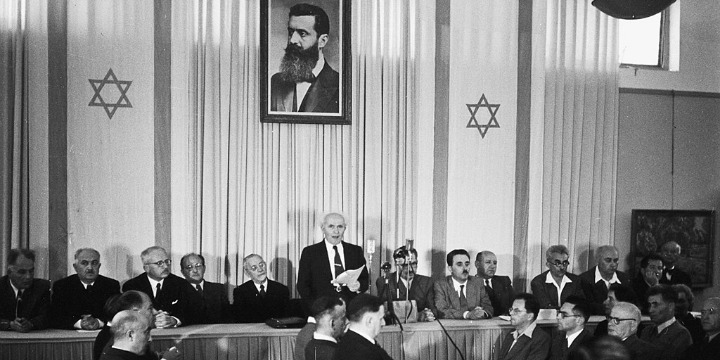
David Ben-Gurion declares Israel’s independence, at the Tel Aviv Museum, May 14, 1948. Photo: Wikimedia Commons.
The legacy of Israel’s first prime minister, David Ben-Gurion, contradicts conventional wisdom. It rejects the assumption that a White House “green light” is a prerequisite for the application of Israeli law to the Jordan Valley and the mountain ridges of Judea and Samaria.
Ben-Gurion’s May 14, 1948 Declaration of Independence was not preconditioned upon a “green light” from President Harry Truman. Ben-Gurion demonstrated independence of national security action in defiance of the US State Department, the Pentagon, the CIA, and others. Furthermore, President Truman was irresolute until the day of the declaration, while the US Mission to the United Nations was preoccupied with rounding up votes for a UN Trusteeship in Palestine (instead of an independent Jewish state).
Moreover, Ben-Gurion also applied Israeli law to areas in the Galilee, coastal plain, Negev, and Jerusalem that were acquired during Israel’s War of Independence, expanding Israel’s land by 30 percent, in defiance of a glaring “red light” from the White House and the entire foreign policy and national security establishment in Washington, DC.
According to James McDonald, the first US ambassador to Israel: “[Ben-Gurion] warned President Truman and the US Department of State that they would be gravely mistaken if they assumed that the threat, or even the use of sanctions, would force Israel to yield on issues considered vital to its independence and security. … Much as Israel desired friendship with the US, there were limits beyond which it could not go. Israel could not yield at any point which, in its judgement, would threaten its independence or its security. The very fact that Israel was a small state made more necessary the scrupulous defense of its own interests; otherwise, it would be lost.”
Ambassador McDonald wrote that Ben-Gurion was facing a powerful antagonistic coalition led by Secretary of State George Marshall, Defense Secretary James Forrestal, and the State Department “wise men,” including Under Secretary Robert Lovett, special counselor Charles Bohlen, Policy Planning chief George Kennan, former secretary Dean Acheson, head of the UN Division Dean Rusk, and head of the Near East and Asia Bureau Loy Henderson.
Ben-Gurion applied Israeli law despite severe US pressure to retreat to the suicidal November 29, 1947 partition plan lines. He rejected the immoral formula of “land for peace,” which would reward and fuel Arab aggression (aiming to annihilate the Jewish state) and punish the intended victim.
Ben-Gurion’s response to US pressure was unflinching: “What Israel has won on the battlefield, it is determined not to yield at the council table.”
Notwithstanding the sustained brutal pressure on Israel, Ambassador McDonald noted, “At the spring session of the UN General Assembly in Flushing Meadows, Israel was formally admitted [to the United Nations] — an interesting bit of evidence of the growth of respect for Israel.”
While Ben-Gurion’s defiance caused occasional short-term tension, which undermined Israel’s popularity, he earned long-term respect for himself and for his country, as documented by Ambassador McDonald: “[Ben-Gurion was] small in stature, but big in spirit. … He has unfaltering faith in the future of Israel. … The Prime Minister had no fear. … Ben Gurion had the unusual courage to resist the popular clamor, when he was convinced that the public was mistaken.”
Indeed, Ben-Gurion, in McDonald’s eyes, was one of the “few great statesmen of our day.” The frequent comparisons of the Israeli premier to Winston Churchill “did not exaggerate the Prime Minister’s qualities of leadership,” he wrote.
The Ben-Gurion legacy highlights that:
- There are no free lunches in the pursuit of bolstered national security.
- Experiencing — and defying — brutal pressure is an integral feature of Jewish history.
- The cost of fending off severe pressure is a prerequisite for the fulfillment of a long-term vision.
- Indecisiveness, hesitation, and retreat erode one’s posture of deterrence, undermine one’s role as a strategic ally, and invite more pressure.
- Defiance of pressure yields strategic respect among allies, while deterring enemies.
Yoram Ettinger is a former ambassador and head of Second Thought: A US-Israel Initiative.