 Pod Save America Hosts Call on Democrats to Cut All Israel Military Aid, No Longer Accept AIPAC Funding
 Jews, Israelis Targeted in Austria Amid Surge in Antisemitic Incidents; Local Jewish Community Calls for Action
 ‘All of Our Strength’: Over 1,000 Pro-Israel Activists Gather in DC for Solidarity Conference
 ‘Devastated’: Wesley LePatner, Killed in Manhattan Mass Shooting, Was a Jewish Communal, Philanthropic Leader
 Sen. Angus King Vows to No Longer Vote for Israel Military Aid Until Gaza Conditions Improve
 Europe Won’t Pressure Israel to ‘Commit Suicide’ Amid Gaza Backlash, Palestinian State Push, Says Israeli FM
 Israel’s National Soccer Coach Attacked in Athens Before Soccer Fans Chant ‘F–K Israel, Free Palestine’ at Match
 New York Judge Sentences Neo-Nazi to 5 Years for Livestreaming Bomb Threats Against Jewish Hospitals
 US Pressures Lebanon to Issue Cabinet Decision to Disarm Hezbollah Before Talks Continue
 UK Plans to Recognize Palestinian State in September Unless Israel Meets Conditions, Starmer Says


Western Intelligence Services Questioning Hezbollah Claim of Innocence for Beirut Blast, German News Report Says
Error: Contact form not found.
 by Algemeiner Staff

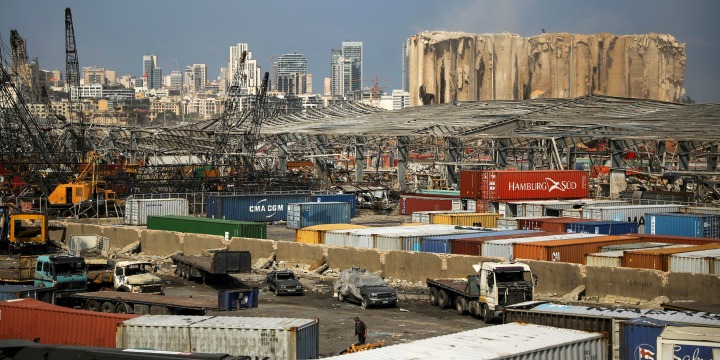
A man makes his way in the damaged port, following a massive explosion, in Beirut, Lebanon, Aug. 12, 2020. Photo: Reuters / Alkis Konstantinidis.
Western intelligence agencies are questioning the veracity of Hezbollah’s insistence that it had nothing to do with the devastating explosion in Beirut’s port area earlier this month, a German news outlet claimed this week.
Citing unnamed “Western intelligence sources,” a report in Die Welt stated that while it remained unclear who had owned and stored the ammonium nitrate that caused the Aug. 4 blast, the terrorist group had received at least three deliveries of the same explosive material from its patron, the Iranian regime.
These deliveries to Hezbollah were allegedly made in late 2013 and early 2014 — around the same time that the ammonium nitrate that caused the port blast arrived in the Lebanese capital.
“The Quds Force of the Islamic Revolutionary Guards Corps (IRGC-QF), which is responsible for foreign operations and which has a key political position in Iran, is said to have been responsible for the transport,” the report said.
The IRGC-Quds Force’s former commander, Gen. Qassem Soleimani, was killed by a US drone strike in Iraq in January of this year. Die Welt revealed that Soleimani had been in charge of the transport of ammonium nitrate to Hezbollah, which functions as Iran’s Shi’a proxy force in Lebanon.
The report said that between October 2013 and April 2014, Iran delivered up to 670 tons of ammonium nitrate to Hezbollah at a cost of approximately $400,000 in three separate deliveries.
One delivery arrived via air, the other two via a land route through Syria, the intelligence sources quoted in the report said.
The report identified Muhammed Qasir — the Beirut-based liaison between Hezbollah and the Tehran regime — as the individual responsible for receiving the explosives. The 57-year-old Qasir was sanctioned by the US Treasury Department in May 2018 for acting “as a critical conduit for financial disbursements from the IRGC-QF to Hezbollah.”
Welt noted that it was “uncertain” whether the ammonium nitrate involved in the Beirut blast was from the stock allegedly delivered to Hezbollah.
The outlet quoted an unnamed “security expert” who observed that the explosives could have been stored by Hezbollah for later use on behalf of its Syrian ally, President Bashar al-Assad, or for a direct attack upon Israel.