 Pod Save America Hosts Call on Democrats to Cut All Israel Military Aid, No Longer Accept AIPAC Funding
 Jews, Israelis Targeted in Austria Amid Surge in Antisemitic Incidents; Local Jewish Community Calls for Action
 ‘All of Our Strength’: Over 1,000 Pro-Israel Activists Gather in DC for Solidarity Conference
 ‘Devastated’: Wesley LePatner, Killed in Manhattan Mass Shooting, Was a Jewish Communal, Philanthropic Leader
 Sen. Angus King Vows to No Longer Vote for Israel Military Aid Until Gaza Conditions Improve
 Europe Won’t Pressure Israel to ‘Commit Suicide’ Amid Gaza Backlash, Palestinian State Push, Says Israeli FM
 Israel’s National Soccer Coach Attacked in Athens Before Soccer Fans Chant ‘F–K Israel, Free Palestine’ at Match
 New York Judge Sentences Neo-Nazi to 5 Years for Livestreaming Bomb Threats Against Jewish Hospitals
 US Pressures Lebanon to Issue Cabinet Decision to Disarm Hezbollah Before Talks Continue
 UK Plans to Recognize Palestinian State in September Unless Israel Meets Conditions, Starmer Says


The Arab League Boycott Remains in Force
Error: Contact form not found.
 by Mitchell Bard

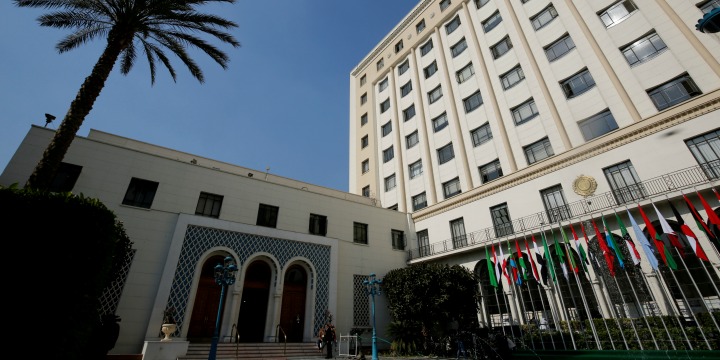
The Arab League’s headquarters, in Cairo, Egypt, Dec. 20, 2016. Photo: Reuters / Amr Abdallah Dalsh / File.
While the ineffectual BDS movement has gotten all the headlines in recent years, the original boycott initiated by the Arab League in 1945 remains in force. Like BDS, the Arab League boycott is antisemitic, having been directed at Jews even before the establishment of Israel.
The boycott, as it evolved after 1948, is divided into three components. The primary boycott prohibits direct trade between Israel and the Arab nations. The secondary boycott is directed at companies that do business with Israel. The tertiary boycott involves the blacklisting of firms that trade with other companies that do business with Israel.
In 1977, Congress prohibited US companies from compliance with the Arab boycott. The law requires US companies to report to the Commerce Department any request to cooperate with the boycott of Israel or deny employment to a US citizen based on race, religion, sex, or national origin.
Contrary to claims that the legislation would lead to a drastic reduction in American trade with the Arab world, imports and exports increased substantially. Broader diplomatic and cultural relations also improved.
The beginning of the end of the boycott started with Egypt signing a peace treaty with Israel, which ended its compliance with the boycott in 1979. It was not until 1994, however, that the six Gulf Cooperation Council states announced they would no longer support the secondary boycott barring trade with companies doing business with Israel. The following year, Egyptian, American, Jordanian, and Palestinian trade leaders signed the Taba Declaration supporting “all efforts to end the boycott of Israel.”
Since the signing of peace agreements between Israel and the PLO and Jordan, the boycott has gradually crumbled. The Arab League was forced to cancel several boycott meetings because of opposition from countries like Kuwait, Morocco, and Tunis
The primary boycott subsequently cracked as nations like Qatar, Oman, and Morocco
Still, the Arab League boycott remains technically in force. On August 12, 2020, the 94th session of the Conference of Liaison Officers of the Regional Offices of the Arab Boycott of Israel was held by video conference. According to a summary published by the Arab League:
The conference stressed the importance of following up and strengthening the work of the Arab boycott agencies, their efforts and activities in implementing the provisions of the Arab boycott, based on the decision of the Tunis summit held on March 31, 2019, which stated that “boycotting the Israeli occupation and its colonial regime is one of the effective and legitimate means of resisting it and ending it and saving the two-state solution and the peace process. Appreciating the coordination between liaison officers in the regional offices, noting the need to strengthen communication and follow-up with the main office of the province, regarding the implementation of decisions and recommendations, and within the framework of the liaison officers’ efforts in following up developments related to the provisions of the Arab boycott.
The continuation of the boycott is reflected in the number of cases logged by the US Office of Antiboycott Compliance. Since 2007, 84 companies have been alleged to have violated the antiboycott law. In 2019, 178 prohibited boycott requests from Arab League members were reported. By far, the most (81) came from the UAE, followed by Iraq (45), Qatar (17), and Saudi Arabia (17). Most of those countries have had little or no economic ties to Israel, so it is surprising that the UAE, the one country Israel has had reasonably good relations with, and now peace with, had the most requests. Israel’s other new peace partner, Bahrain, had only three requests. One byproduct of the Abraham Accords then should be to cut the boycott requests roughly in half.
One country that has largely been missing from the discussion of who will be next to normalize relations with Israel is Kuwait. In 2019, Kuwait Airways was accused of violating the US antiboycott law by preventing Israeli passport holders from flying on its New York to London route on 14 occasions between August 2014 and November 2015. The airline settled the complaint in 2019 without admitting or denying the charge, and agreed to pay what for the Kuwaitis is a paltry fine of $700,000. Of that, $100,000 was suspended for three years and will be waived if the airline complies with the terms of the settlement. The airline apparently sought to avoid further embarrassment by terminating its flights between JFK and Heathrow.
Coincidentally, a year earlier, a German court said that Kuwait’s boycott of Israel was “unacceptable” — but that it could not force Kuwait Airways to accept Israeli passengers.
The Abraham Accords were a significant step toward the acceptance of Israel by its neighbors. Though mostly ineffectual, the continuation of the Arab League boycott is a reminder, however, that most Arab countries still have not recognized Israel and continue to engage in economic warfare.
Mitchell Bard is a foreign policy analyst and authority on US-Israel relations who has written and edited 22 books including: The Arab Lobby, Death to the Infidels: Radical Islam’s War Against the Jews, and After Anatevka: Tevye in Palestine.