 Pod Save America Hosts Call on Democrats to Cut All Israel Military Aid, No Longer Accept AIPAC Funding
 Jews, Israelis Targeted in Austria Amid Surge in Antisemitic Incidents; Local Jewish Community Calls for Action
 ‘All of Our Strength’: Over 1,000 Pro-Israel Activists Gather in DC for Solidarity Conference
 ‘Devastated’: Wesley LePatner, Killed in Manhattan Mass Shooting, Was a Jewish Communal, Philanthropic Leader
 Sen. Angus King Vows to No Longer Vote for Israel Military Aid Until Gaza Conditions Improve
 Europe Won’t Pressure Israel to ‘Commit Suicide’ Amid Gaza Backlash, Palestinian State Push, Says Israeli FM
 Israel’s National Soccer Coach Attacked in Athens Before Soccer Fans Chant ‘F–K Israel, Free Palestine’ at Match
 New York Judge Sentences Neo-Nazi to 5 Years for Livestreaming Bomb Threats Against Jewish Hospitals
 US Pressures Lebanon to Issue Cabinet Decision to Disarm Hezbollah Before Talks Continue
 UK Plans to Recognize Palestinian State in September Unless Israel Meets Conditions, Starmer Says


Researchers at Ben-Gurion University Create Machine Learning Platform to Improve Clinical Medical Trials
Error: Contact form not found.
 by Yafit Ovadia / CTech

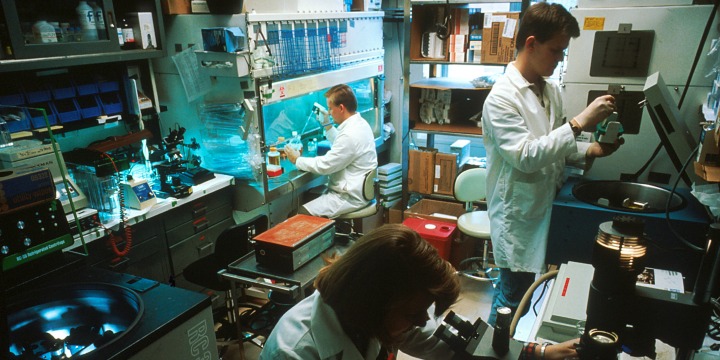
Scientists at work in laboratory. Photo: Wikimedia Commons.
CTech – Ben-Gurion University researchers have partnered up with a medical startup, Panacea, to create new technology that streamlines clinical trials — improving their efficiency, lowering their cost, and increasing success rates of drugs or medical devices by shortening their development process. Prof. Boaz Lerner is both Panacea’s founder and a lecturer and researcher at the university’s department of industrial engineering and management. Panacea was founded in conjunction with the school’s entrepreneurship center, Yazamut360, which helps students and faculty launch startups.
Panacea’s tool increases machine learning to improve the chance of a clinical trial’s odds of success by examining a patient population and tracking certain markers. In addition, the entire clinical trial is tested and given pre-trial recommendations, insights, and post-trial evaluations. Finally, proposals are made for possible areas of improvement in the event the trial fails.
Lerner added that historically clinical trials haven’t seen much change in the way they are carried out, and continue to be defined by their high costs and low chances of success.
“Our platform is highly beneficial for pharma and biotech companies, enabling them to increase efficiency and the chances of success by streamlining the trial and selecting the optimal participants and markers. Conversely, we can also help in understanding when to terminate a trial and what lessons can be derived from a failed trial,” he said.
So far, the technology has been used to test several types of neurodegenerative diseases such as Alzheimer’s, Parkinsons’, and ALS, or amyotrophic lateral sclerosis. It has also improved findings by grouping patients into separate groups and subgroups, and analyzing them individually and the progression of their disease, helping to foresee the rate of deterioration or any patterns that may yield light on a patient’s condition or others like it.
CEO of BGN Technologies Josh Peleg noted that more companies should turn to machine learning and AI to assist them in making better and faster decisions while improving their research.
“In the age of artificial intelligence and machine learning, it seems only natural that drug development should benefit from these sophisticated tools that can take into account large amounts of data, and integrate and analyze numerous parameters in order to optimize clinical trials and increase their probability of success.”
BGN Technologies has held joint partnerships with large companies such as PayPal Holdings, Lockheed Martin, Deutsche Telekom, Dell-EMC, and IBM, among others.