 Pod Save America Hosts Call on Democrats to Cut All Israel Military Aid, No Longer Accept AIPAC Funding
 Jews, Israelis Targeted in Austria Amid Surge in Antisemitic Incidents; Local Jewish Community Calls for Action
 ‘All of Our Strength’: Over 1,000 Pro-Israel Activists Gather in DC for Solidarity Conference
 ‘Devastated’: Wesley LePatner, Killed in Manhattan Mass Shooting, Was a Jewish Communal, Philanthropic Leader
 Sen. Angus King Vows to No Longer Vote for Israel Military Aid Until Gaza Conditions Improve
 Europe Won’t Pressure Israel to ‘Commit Suicide’ Amid Gaza Backlash, Palestinian State Push, Says Israeli FM
 Israel’s National Soccer Coach Attacked in Athens Before Soccer Fans Chant ‘F–K Israel, Free Palestine’ at Match
 New York Judge Sentences Neo-Nazi to 5 Years for Livestreaming Bomb Threats Against Jewish Hospitals
 US Pressures Lebanon to Issue Cabinet Decision to Disarm Hezbollah Before Talks Continue
 UK Plans to Recognize Palestinian State in September Unless Israel Meets Conditions, Starmer Says


Macron Versus Radical Political Islam in France
Error: Contact form not found.
 by Tsilla Hershco

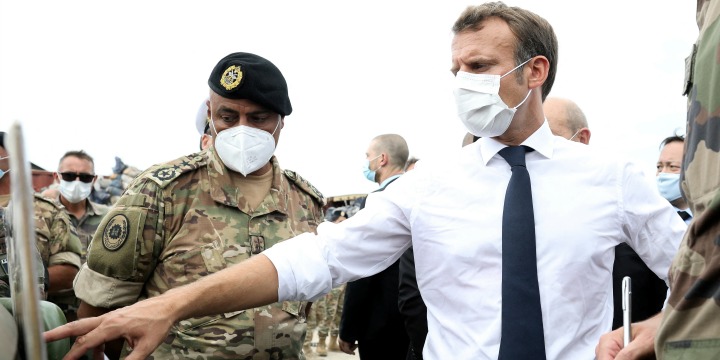
French President Emmanuel Macron meets members of the military mobilized for the reconstruction of the port of Beirut, in Beirut, Lebanon, Sept. 1, 2020. Photo: Stephane Lemouton / Pool via Reuters.
The shocking murder of teacher Samuel Paty by a teenaged Islamist Chechen immigrant provoked a tumultuous emotional response in France. Paty was killed after he showed his students the cartoons of the prophet Muhammad published by the satirical publication Charlie Hebdo that led to the January 2015 Islamist massacre of that paper’s journalists. Paty’s object in displaying the cartoons was to prompt a class discussion on the values of freedom of speech and expression that characterize French society.
This murderous blow to the heart of the liberal French republic, which welcomes refugees and immigrants and grants them civil and economic rights, provoked a heated debate. In the past five years, France has experienced 33 terrorist attacks by French Muslim citizens. The targeting of Paty for assassination, his gruesome public beheading, and the posting of video of the murder on the internet illustrated that Islamic zealots pose an existential threat to France’s basic republican order.
Over the years, French governments have tried to address the problem through two main venues: reforms to improve the economic and social situation in the suburbs and vigorous measures against extremist Islamist elements. The latter included overseeing religious teaching institutions; closing down radical institutions and associations; deporting foreign imams who incite violence, citizens with dual citizenship who were involved in terrorist activities, and illegal immigrants; monitoring extremist social networks; and increasing budgets and manpower for intelligence and surveillance operations. President Macron’s attempt to advance legislation to monitor more illegal immigrants failed due to political disagreements between right- and left-wing parties and the proposed laws’ disqualification by the Constitutional Court on the grounds that they violate human rights.
Public criticism of the rise of radical Islam in France, combined with criticism of the failed management of the fight against the COVID-19 pandemic, seems to have contributed to Macron’s decision to take a more resolute approach to escalating Islamist extremism, in part because doing so would improve his position in the run-up to the next presidential election vis-à-vis the far-right’s persistent demand for stricter measures against militant Islam and illegal immigration. The opening of the trial of the suspects in the 2015 Charlie Hebdo massacre and the republication of the Muhammad cartoons that aroused the Islamist terrorists’ ire have stoked fear of further attacks and ratcheted up tensions.
In a keynote address on October 2, two weeks prior to the murder of Samuel Paty, President Macron took a firm stand against “Islamist separatism” in France and defined it as a danger to the French Republican system. He warned of the intrusion of extremist Islamist associations into all spheres of public life in France, criticized the claim that Islamic law (sharia) supersedes the laws of the Republic, and denounced the Islamic aspiration to create a “state within a state” with goals and values that are inconsistent with those of the republic.
Stressing that the solution lies in enforcing state laws on Muslim associations and dismantling those associations that disregard these laws, Macron went on to present a series of initial steps to combat religious extremism, including banning Muslim religious schools in private homes and enacting a Republican compulsory education law from age three. At the same time, he stressed the need to avoid stigmatizing the Muslim population in France, as it could lead to feelings of alienation toward the French Republic. In a tweet, Macron emphasized that he is determined to support and fight for freedom of expression, including republishing the cartoons of Muhammad.
Macron’s statements and the punitive responses of the French authorities (which closed a mosque and an Islamist association that were involved in online incitement that led to the targeting and murder of Paty) provoked widespread protests in the Arab and Muslim world, led by Turkish president Recep Tayyip Erdogan. Erdogan denounced his French counterpart as mentally unstable and called for a boycott of French goods. Paris responded by recalling its ambassador from Ankara. The EU condemned Erdogan for his remarks, demanding that he apologize.
The tidal wave of violent anti-French demonstrations reflects the ongoing civilizational war between Western democracies and the non-democratic Muslim states, a war that has intensified against the backdrop of COVID-19 (which will have its own far-reaching economic and social consequences). The crisis between the French Republic and its Muslim population — especially its growing Islamist community — as well as the dramatic change in France’s traditionally friendly relations with many Arab and Muslim countries, illustrates that it was a serious mistake to avoid setting clear boundaries and enforcing restrictions on anti-republican sentiment and violent incitement within the country. Inevitably, the absence of such rules perpetuated the cycle of violence and harsh measures.
Dr. Tsilla Hershco is a senior researcher at the Begin-Sadat Center for Strategic Studies and a Spiegel Fellow at the Institute for Holocaust Studies, Bar-Ilan University. She is author of the book Those Who Walk in the Dark Will See the Light: The Jewish Resistance in France, Holocaust and Resurrection: 1949-1940.
A version of this article was originally published by The BESA Center.