 Pod Save America Hosts Call on Democrats to Cut All Israel Military Aid, No Longer Accept AIPAC Funding
 Jews, Israelis Targeted in Austria Amid Surge in Antisemitic Incidents; Local Jewish Community Calls for Action
 ‘All of Our Strength’: Over 1,000 Pro-Israel Activists Gather in DC for Solidarity Conference
 ‘Devastated’: Wesley LePatner, Killed in Manhattan Mass Shooting, Was a Jewish Communal, Philanthropic Leader
 Sen. Angus King Vows to No Longer Vote for Israel Military Aid Until Gaza Conditions Improve
 Europe Won’t Pressure Israel to ‘Commit Suicide’ Amid Gaza Backlash, Palestinian State Push, Says Israeli FM
 Israel’s National Soccer Coach Attacked in Athens Before Soccer Fans Chant ‘F–K Israel, Free Palestine’ at Match
 New York Judge Sentences Neo-Nazi to 5 Years for Livestreaming Bomb Threats Against Jewish Hospitals
 US Pressures Lebanon to Issue Cabinet Decision to Disarm Hezbollah Before Talks Continue
 UK Plans to Recognize Palestinian State in September Unless Israel Meets Conditions, Starmer Says


Iran Likely to Hold Off on Retaliation Over Scientist’s Killing, US Envoy Says
Error: Contact form not found.
 by Reuters and Algemeiner Staff

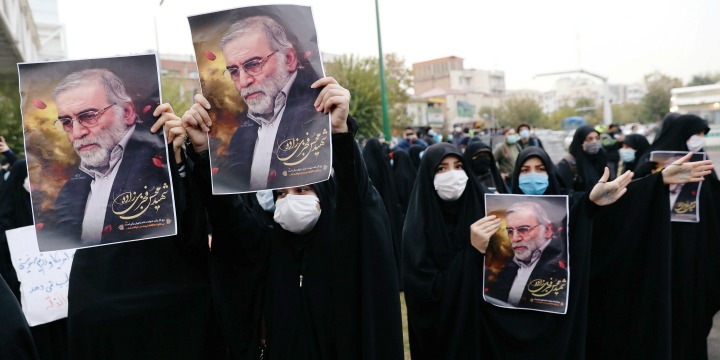
Protesters hold the pictures of Mohsen Fakhrizadeh, Iran’s top nuclear scientist, during a demonstration against his killing, in Tehran, Iran, Nov. 28, 2020. Photo: Majid Asgaripour / WANA (West Asia News Agency) via Reuters.
Iran is unlikely to retaliate over the assassination of a prominent nuclear scientist before the inauguration of Joe Biden in case it jeopardizes any future sanctions relief, the top US envoy on Iran told Reuters on Thursday.
Mohsen Fakhrizadeh, who had little public profile in Iran but had been named by Israel as a prime player in the Tehran regime’s nuclear weapons quest, was killed last Friday when he was ambushed on a highway near the Iranian capital and his car sprayed with bullets.
Elliott Abrams, Washington’s special representative on Iran and Venezuela, said in an interview that Tehran was “desperately” in need of sanctions relief from the United States and that would be a key calculation in their decision-making as President-elect Biden takes over from President Donald Trump on Jan. 20.
“If they want sanctions relief, they know that they’re going to need to enter some kind of negotiation after January 20, and it’s got to be in their minds that they don’t want to… undertake any activities between now and Jan 20 that make sanctions relief harder to get,” he said.
Iran’s clerical and military rulers have blamed Israel for Fakhrizadeh’s killing, which has raised the prospect of a new standoff between Tehran and its longtime enemy. Prime Minister Benjamin Netanyahu’s office has declined to comment on the killing.
Tensions between Washington and Tehran have risen since 2018, when Trump abandoned Obama’s 2015 nuclear deal, and restored harsh economic sanctions to pressure Tehran to negotiate stricter curbs on its nuclear program, ballistic missile development and support for regional proxy forces.
In retaliation, Tehran gradually breached the deal’s restrictions on its nuclear program. Biden has said he will return the United States to the deal if Iran resumes compliance.
Last week, Abrams said the Trump administration was planning to tighten sanctions on Tehran during its final weeks in power but also urged Biden to press for a deal that reduces the regional and nuclear threats posed by the Islamic Republic.
He added that he expected a negotiation to take place with Iran next year and that he believes a deal will be struck under the Biden administration.
Iran‘s clerical rulers have ruled out negotiations over its missile program or changing its regional policy. Instead it wants a change in US policy, including the lifting of sanctions.