 Pod Save America Hosts Call on Democrats to Cut All Israel Military Aid, No Longer Accept AIPAC Funding
 Jews, Israelis Targeted in Austria Amid Surge in Antisemitic Incidents; Local Jewish Community Calls for Action
 ‘All of Our Strength’: Over 1,000 Pro-Israel Activists Gather in DC for Solidarity Conference
 ‘Devastated’: Wesley LePatner, Killed in Manhattan Mass Shooting, Was a Jewish Communal, Philanthropic Leader
 Sen. Angus King Vows to No Longer Vote for Israel Military Aid Until Gaza Conditions Improve
 Europe Won’t Pressure Israel to ‘Commit Suicide’ Amid Gaza Backlash, Palestinian State Push, Says Israeli FM
 Israel’s National Soccer Coach Attacked in Athens Before Soccer Fans Chant ‘F–K Israel, Free Palestine’ at Match
 New York Judge Sentences Neo-Nazi to 5 Years for Livestreaming Bomb Threats Against Jewish Hospitals
 US Pressures Lebanon to Issue Cabinet Decision to Disarm Hezbollah Before Talks Continue
 UK Plans to Recognize Palestinian State in September Unless Israel Meets Conditions, Starmer Says


Israel Set for Snap Election as Budget Deadline Nears
Error: Contact form not found.
 by Reuters and Algemeiner Staff

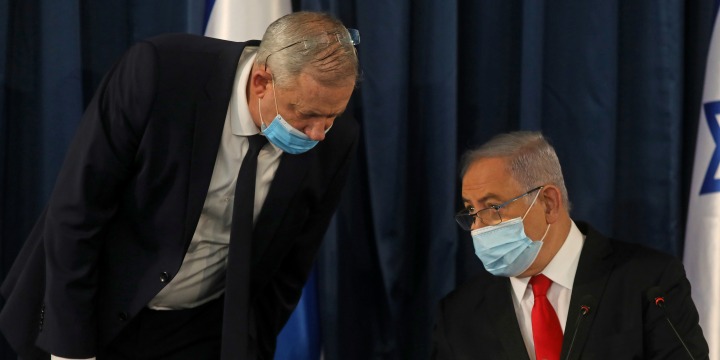
Israeli Alternate Prime Minister and Defense Minister Benny Gantz speaks with Prime Minister Benjamin Netanyahu, at a weekly cabinet meeting in Jerusalem, Israel, June 7, 2020. Photo: Menahem Kahana / Pool via Reuters.
Israel on Tuesday was on course for a fourth national election in two years after Prime Minister Benjamin Netanyahu and his main governing partner, Benny Gantz, failed to resolve a dispute over the budget.
Parliament voted late on Monday against an attempt by both men to delay a deadline of midnight on Tuesday for approval of the fiscal package.
Under law, failure to pass it by then would mean Israel going to the polls in March, and neither lawmakers nor the cabinet have passed it yet, a process near impossible to complete in a single day.
Netanyahu, leader of the right-wing Likud party, and Defense Minister Gantz, head of centrist Blue and White, established a unity government in May after three inconclusive elections held since April 2019.
Their pact involved Gantz taking over from Netanyahu as prime minister in November 2021, and passing a biennial budget for 2020 and 2021.
But even as that power-sharing pact was being inked, many analysts argued that Netanyahu, on trial for alleged corruption which he denies, would not relinquish his powerful post, and Likud has since demanded to pass the budgets separately while Blue and White insisted Netanyahu stick to their deal.
Israel has so far this year managed its finances on the basis of a pro-rated version of the 2019 budget.
The current fiscal deadlock has plunged Israel into more economic uncertainty at the end of a year when a coronavirus-induced slump is expected to shrink gross domestic product by 4.5% with the jobless rate standing at 12.1%.
Israel, also preparing for a new US administration led by President-elect Joe Biden, kicked off its vaccination campaign this week.
Analysts had seen Netanyahu pushing for an election in May or June next year, after the coronavirus crisis was expected to ease and the economy to begin to recover.
A March vote would be riskier for Israel‘s longest serving leader, who has been facing a wave of street protests against his alleged corruption, which he denies, and his handling of the COVID-19 pandemic.
Though polls show Netanyahu’s party emerging as the largest faction in parliament, surveys also predict a strong showing for a bloc of factions from across the political spectrum seeking to unseat him.