 Pod Save America Hosts Call on Democrats to Cut All Israel Military Aid, No Longer Accept AIPAC Funding
 Jews, Israelis Targeted in Austria Amid Surge in Antisemitic Incidents; Local Jewish Community Calls for Action
 ‘All of Our Strength’: Over 1,000 Pro-Israel Activists Gather in DC for Solidarity Conference
 ‘Devastated’: Wesley LePatner, Killed in Manhattan Mass Shooting, Was a Jewish Communal, Philanthropic Leader
 Sen. Angus King Vows to No Longer Vote for Israel Military Aid Until Gaza Conditions Improve
 Europe Won’t Pressure Israel to ‘Commit Suicide’ Amid Gaza Backlash, Palestinian State Push, Says Israeli FM
 Israel’s National Soccer Coach Attacked in Athens Before Soccer Fans Chant ‘F–K Israel, Free Palestine’ at Match
 New York Judge Sentences Neo-Nazi to 5 Years for Livestreaming Bomb Threats Against Jewish Hospitals
 US Pressures Lebanon to Issue Cabinet Decision to Disarm Hezbollah Before Talks Continue
 UK Plans to Recognize Palestinian State in September Unless Israel Meets Conditions, Starmer Says


Swiss Ban on Full Veil Raises Questions and Riles Islamists
Error: Contact form not found.
 by Hany Ghoraba

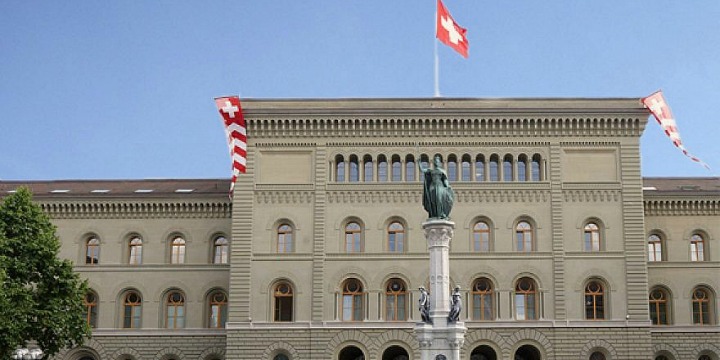
A Swiss government building. Photo: The Federal Council of Switzerland.
In an effort to curtail extremism, Switzerland last month voted to ban women wearing the burqa or niqab (full veil). The national referendum passed March 7 with 52 percent of the vote. Under the new restriction, people cannot completely cover their face in public areas.
Exceptions may be allowed in places of worship.
Switzerland is the latest European country to impose restrictions on the full veil, joining France, Austria, Belgium, Denmark, Bulgaria, and the Netherlands.
The referendum was pushed by the populist Swiss People’s Party (SVP), which argued that a vote for banning the veil was a step against extremism. It described the referendum as a “a strong symbol against radical Islam.”
The Swiss Parliament’s lower house backed a face veil ban in 2016, following neighboring European countries such as France, as a curb on radicalism in the wake of terrorist attacks. But to become law, it needed voter approval.
Muslims represent just 5.2 percent of the Swiss population, according federal statistics. But Swiss officials are wary of rising levels of extremism in the country. Swiss police conducted raids against extremists in 2019. Switzerland’s intelligence service estimated that 92 jihadists have traveled from Switzerland to Iraq, Syria, and Somalia since 2013 to join terrorist groups.
Last November, a 28-year-old Swiss woman attacked two women in a Lugano department store with a knife, seriously injuring one. Officials described it as “a suspected terrorist-motivated attack.”
Islamist groups expressed frustration about the referendum.
“Today’s decision opens old wounds, further expands the principle of legal inequality, and sends a clear signal of exclusion to the Muslim minority,” stated the Islamic Central Council of Switzerland in a statement, adding that it would challenge the decision in court. It described the vote as “Islamophobically related.”
“Switzerland has voted to ban the niqab. In a land where barely 0.00001 % of its citizens wear a face-covering, there is no question that the entire public vote & discussion was yet another European attempt to ban an iconic symbol associated with Islam. It’s not about the niqab,” tweeted Islamic theologian and scholar Yasir Qadhi, insinuating that ban is an attack on Muslims, even those who do not wear the veil.
Turkish state media heavily criticized the ban as “Islamophobic.” Pakistani news outlet Dawn said the vote “helps propel the agenda of far-right parties in Europe, who see Muslims, people of colour and racial minorities as ‘outsiders’ trying to change the continent’s ‘pure’ culture.”
The Organization of Islamic Cooperation (OIC)’s human rights board condemned the Swiss ban in a statement, saying it was “grossly discriminatory, disproportionate, contrary to ideals of pluralism and tolerance” and “violating international and regional human rights obligations.”
But some Swiss lawmakers defended the decision. “In Switzerland, our tradition is that you show your face. That is a sign of our basic freedoms,” said Wobmann.
Yet it’s not just Islamists who objected to the results of the referendum. “If the intention of this is in any way to protect women’s rights it fails abjectly,” said Cyrielle Huguenot, head of women’s rights at Amnesty International Switzerland. “Instead, this proposes to sanction women for their choice of clothing and in so doing undermines the freedoms Switzerland purports to uphold.”
Other concerns came from Swiss tourism industry experts. “A burqa ban would damage our reputation as an open and tolerant tourism destination,” said Nicole Brändle Schlegel of HotellerieSuisse, an alliance of hoteliers and tourism professionals.
But the wearing of the niqab is associated with the spread of fundamentalist Islamist movements like Salafism or Wahabbism. Salafists believe that the physical appearance of a believer is an integral part of abiding by the tenets of the Islamic faith.
Yet despite his conservative stances on many issues, Al Azhar Grand Imam Sheikh Ahmed al-Tayeb — the highest authority in Sunni Islam — has described the niqab as optional.
“The women who wear a niqab must never say [she] is wearing it because it is required by (Islamic) Sharia. It is like wearing or taking off a ring,” al-Tayeb told Egypt’s Extra News TV.
In 2007, al-Tayeb said the “niqab is forbidden during prayer and forbidden for women during Hajj (pilgrimage).”
In Muslim majority countries where the niqab is worn by more women, male and female criminals can sometimes use the face coverings to conceal their identities.
Morocco, which has a 99 percent Muslim population, banned the burqa and niqab in 2017, as a result of growing security concerns and to curb extremism. Algeria followed suit and banned wearing the niqab in government buildings in 2018. Tunisia banned the niqab in government buildings in 2019 after a suicide bombing in which a terrorist reportedly used a niqab as a disguise.
The niqab security threat is more profound in countries like Egypt, where many women wear it. However, the Egyptian parliament failed to approve a ban in 2018 citing public freedoms.
“Some of the terrorist attacks that happened in the past were carried out by people wearing the niqab,” said Mohamed Abu Hamed, a former Egyptian MP. He proposed an alternative bill banning the niqab in government intuitions, schools, and universities. The bill didn’t see the light of day but the niqab was banned for faculty members at Cairo and Ain Shams universities in 2020.
The fact that some Muslim-majority countries have taken similar actions should blunt some criticism of the Swiss referendum. Although the niqab is not widely worn in Switzerland, it remains a tool for extremists and poses security challenges. And influential Muslim scholars, including Al Azhar’s grand imam, describe it as optional for Muslim women.
Swiss voters see much of Europe grappling with the results of a laissez-faire attitude toward radical Islamist ideology at home. That likely influenced their decision.
The Investigative Project on Terrorism.Senior Fellow Hany Ghoraba is an Egyptian writer, political and counter-terrorism analyst at Al Ahram Weekly, author of Egypt’s Arab Spring: The Long and Winding Road to Democracy and a regular contributor to the BBC.
A version of this article was originally published by The Investigative Project on Terrorism.