 Pod Save America Hosts Call on Democrats to Cut All Israel Military Aid, No Longer Accept AIPAC Funding
 Jews, Israelis Targeted in Austria Amid Surge in Antisemitic Incidents; Local Jewish Community Calls for Action
 ‘All of Our Strength’: Over 1,000 Pro-Israel Activists Gather in DC for Solidarity Conference
 ‘Devastated’: Wesley LePatner, Killed in Manhattan Mass Shooting, Was a Jewish Communal, Philanthropic Leader
 Sen. Angus King Vows to No Longer Vote for Israel Military Aid Until Gaza Conditions Improve
 Europe Won’t Pressure Israel to ‘Commit Suicide’ Amid Gaza Backlash, Palestinian State Push, Says Israeli FM
 Israel’s National Soccer Coach Attacked in Athens Before Soccer Fans Chant ‘F–K Israel, Free Palestine’ at Match
 New York Judge Sentences Neo-Nazi to 5 Years for Livestreaming Bomb Threats Against Jewish Hospitals
 US Pressures Lebanon to Issue Cabinet Decision to Disarm Hezbollah Before Talks Continue
 UK Plans to Recognize Palestinian State in September Unless Israel Meets Conditions, Starmer Says


EU Set to Call for Israel-Palestinian Peace Talks with US, Russia
Error: Contact form not found.
 by Reuters and Algemeiner Staff

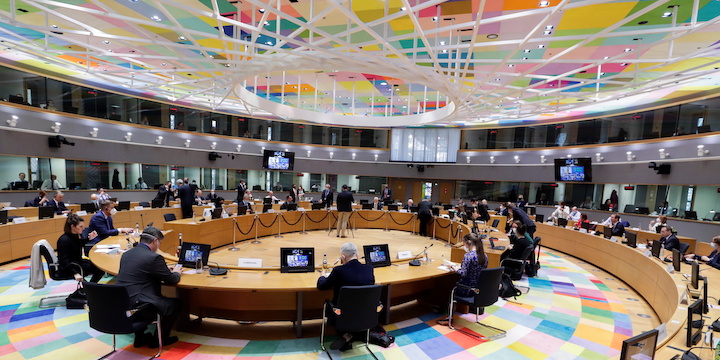
General view of European Union ambassadors with EU foreign policy chief Josep Borrell during special video conference of EU foreign ministers to discuss recent developments in the Middle East, in particular the ongoing violent confrontation in Israel and the disputed territories, in Brussels, Belgium May 18, 2021. Photo: Olivier Hoslet/Pool via REUTERS
European Union foreign ministers are set on Tuesday to call for a ceasefire between Israel and Palestinian Islamist group Hamas, offer more humanitarian aid, and try to relaunch peace talks, Malta’s foreign minister said.
EU foreign policy chief Josep Borrell began an emergency call with member states’ foreign ministers after criticism of the West’s response to violence that flared last week, including from Turkish President Tayyip Erdogan.
“I think I’m not being too optimistic (to say) that at a minimum, what will probably come out (of the EU meeting) is the call for a ceasefire, an offer of humanitarian aid, and then seeing how to restart the political process,” Bartolo told Reuters via video link after the ministers’ call began.
After a ceasefire, the EU would “work with the United States, work with Russia to try and deal with the situation,” he said.
The EU is a member of the Middle East quartet of mediators, along with Russia, the United Nations and the United States.
Washington has long played a dominant role in Middle East peacemaking and US President Joe Biden supported a ceasefire during a call with Israeli Prime Minister Benjamin Netanyahu on Monday.
Germany has called for a ceasefire and pledged 40 million euros ($48.86 million) in humanitarian aid for civilians in Gaza.
“An end to the violence is the first priority,” German Foreign Minister Heiko Maas said in a video statement streamed on social media.
The EU is Israel‘s biggest trade partner and a big aid donor to the Palestinians but member states are divided over policy and the bloc has been reluctant to use such leverage or discuss possible economic sanctions on Israel‘s government.
At least eight smaller EU states, led by Luxembourg and including Belgium, Ireland, Malta and Finland, are vocal defenders of the Palestinians.
Others, including Hungary, the Czech Republic, Austria, Greece, Cyprus and Poland, are more ready to defend Israel‘s interests. Austria flew an Israeli flag over the federal chancellery in Vienna on Friday.
Germany, which still carries the burden of guilt over the Nazi crimes of World War Two, is unwilling to discuss coercive measures against Israel.
“The European Union should have, right now, a leading role (in diffusing the crisis). It doesn’t have that role, either because of differences in approach by member states or because there is no strategic approach from Brussels,” Cypriot Foreign Minister Nikos Christodoulides told Cyprus’s Alpha TV.