 Pod Save America Hosts Call on Democrats to Cut All Israel Military Aid, No Longer Accept AIPAC Funding
 Jews, Israelis Targeted in Austria Amid Surge in Antisemitic Incidents; Local Jewish Community Calls for Action
 ‘All of Our Strength’: Over 1,000 Pro-Israel Activists Gather in DC for Solidarity Conference
 ‘Devastated’: Wesley LePatner, Killed in Manhattan Mass Shooting, Was a Jewish Communal, Philanthropic Leader
 Sen. Angus King Vows to No Longer Vote for Israel Military Aid Until Gaza Conditions Improve
 Europe Won’t Pressure Israel to ‘Commit Suicide’ Amid Gaza Backlash, Palestinian State Push, Says Israeli FM
 Israel’s National Soccer Coach Attacked in Athens Before Soccer Fans Chant ‘F–K Israel, Free Palestine’ at Match
 New York Judge Sentences Neo-Nazi to 5 Years for Livestreaming Bomb Threats Against Jewish Hospitals
 US Pressures Lebanon to Issue Cabinet Decision to Disarm Hezbollah Before Talks Continue
 UK Plans to Recognize Palestinian State in September Unless Israel Meets Conditions, Starmer Says


Ceasefire Agreements and the Question of Israel’s Sovereignty
Error: Contact form not found.
 by Grant Newman

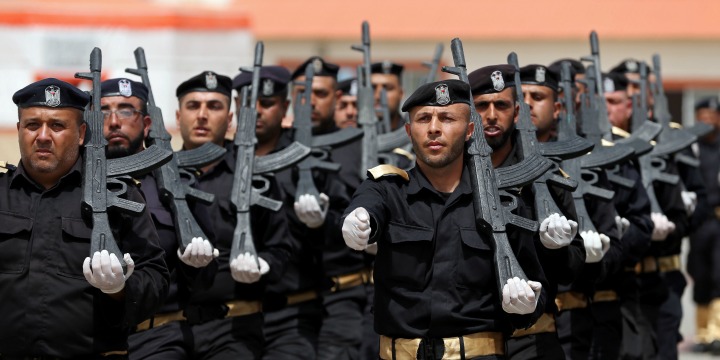
Palestinian police officers loyal to Hamas march during a graduation ceremony in Gaza City, April 29, 2019. Photo: Reuters / Ibraheem Abu Mustafa.
The current conflict between Israel and Hamas raises not just the question of whether Israel has the right to defend itself — and more specifically, whether the State of Israel has the duty to defend its citizens from terrorist attacks — but also raises the question of Israel’s sovereignty as it pertains to developing state policy.
The only party in the current conflict between Israel and Hamas that genuinely has Israel’s best interests in mind is Israel and its citizens. Even the United States is conflicted, as the Biden administration attempts to juggle America’s historic support for Israel with a Democratic Party succumbing more and more to anti-Zionism and antisemitism.
Israel must stand firm in the face of global anti-Israel sentiment, and not allow this hatred to influence its domestic decision-making mechanisms.
The last few weeks have seen protests around the world supporting Hamas and condemning Israel.
A pro-Hamas protest in front of the Consulate General of Israel in midtown Manhattan resulted in the closure of Second Avenue, and other protests led to violent attacks on Jews. Hamas supporters in London cried profanities and curses repugnantly aimed at Jews (and, even more repugnantly, their daughters), while their compatriots in Los Angeles attacked diners at a restaurant after asking them whether they were Jewish (they were).
Similar occurrences and mass protests were seen across the United States, Great Britain, and Europe. For all the talk of anti-Israel sentiment and antisemitism being entirely separate categories, such events indicate that there is an alarming level of cross-pollination occurring between these two supposedly separate categories. Nevertheless, these non-Israeli protesters undoubtedly have sway over their own non-Israeli political leaders, and these non-Israeli political leaders in turn are trying to influence Israel’s political leaders.
Whatever the global consensus regarding the Israel-Hamas conflict might be, a substantial portion of Israelis — the backbone of the nation of Israel — appear committed to continuing military operations against Hamas. Polls by The Times of Israel and Channel 9 suggested that between 70 and 80 percent of responding Israelis supported a continuation of Operation Guardian of the Walls, with many residents of Israel’s southern regions voicing support for a continuation of military operations if doing so would result in an extended period of peace.
Most Western governments — abetted by anti-Israel protests and politicians — sought to end the fighting. But in the face of such worldly influences, Israel must act in such a way that will enable it to maintain its sovereignty and ensure that Israel’s domestic mechanisms are making the decisions, not outside forces.
For example, if Israel were to decide on a ceasefire due to the aforementioned wave of anti-Israel protests and antisemitic attacks, then Israel risks setting a dangerous precedent whereby it is willing to make such decisions based on outside pressure from foreign streets. This could establish a dangerous precedent that if enough protesters take to the streets and maintain their presence there long enough, then international media outlets will promote an information campaign against Israel, foreign political leaders will be influenced to pressure Israel’s political leaders, and Israel will ultimately acquiesce to the demands of the protesters. This would be a massive hit to Israel’s sovereignty and national security.
This is not necessarily to suggest that Operation Guardian of the Walls should have continued solely for the purpose of showing the world that Israel will not give in to external street pressure. Rather, Israel should only enter into a ceasefire with Hamas because it has concluded that doing so is in its national interest, and not because supporters of Hamas flooded the streets of foreign cities.
The means by which a decision is made are often just as important as the decision itself. It is essential for Israel to make known to the world that, whatever decisions it makes, they will be made without the slightest bit of influence from Hamas’ supporters in the West. By doing so, Israel can ensure that its future remains in its own hands.
Grant Newman is a publishing Adjunct at The MirYam Institute. He graduated from Harvard Law School where he was an executive editor of the Harvard Journal of Law and Public Policy. Grant was the recipient of the Federalist Society’s James Madison Award in 2019, and was active in the Alliance for Israel.
The MirYam Institute is the leading international forum for Israel focused discussion, dialogue, and debate, focused on campus presentations, engagement with international legislators, and gold-standard trips to the State of Israel. Follow their work at www.MirYamInstitute.org.