 Pod Save America Hosts Call on Democrats to Cut All Israel Military Aid, No Longer Accept AIPAC Funding
 Jews, Israelis Targeted in Austria Amid Surge in Antisemitic Incidents; Local Jewish Community Calls for Action
 ‘All of Our Strength’: Over 1,000 Pro-Israel Activists Gather in DC for Solidarity Conference
 ‘Devastated’: Wesley LePatner, Killed in Manhattan Mass Shooting, Was a Jewish Communal, Philanthropic Leader
 Sen. Angus King Vows to No Longer Vote for Israel Military Aid Until Gaza Conditions Improve
 Europe Won’t Pressure Israel to ‘Commit Suicide’ Amid Gaza Backlash, Palestinian State Push, Says Israeli FM
 Israel’s National Soccer Coach Attacked in Athens Before Soccer Fans Chant ‘F–K Israel, Free Palestine’ at Match
 New York Judge Sentences Neo-Nazi to 5 Years for Livestreaming Bomb Threats Against Jewish Hospitals
 US Pressures Lebanon to Issue Cabinet Decision to Disarm Hezbollah Before Talks Continue
 UK Plans to Recognize Palestinian State in September Unless Israel Meets Conditions, Starmer Says


IMF Lifts Growth Forecasts for Rich Nations, Dims Outlook for Developing World
Error: Contact form not found.
 by Reuters and Algemeiner Staff

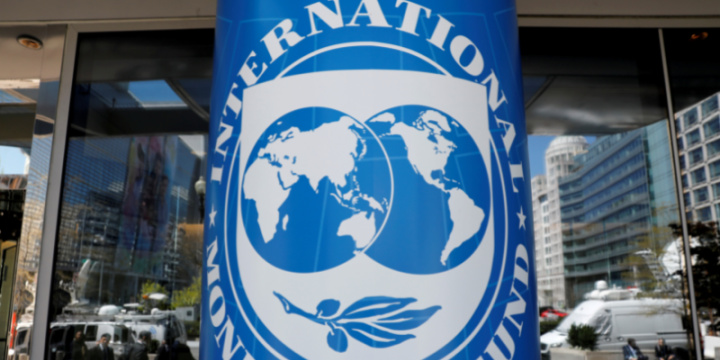
International Monetary Fund logo is seen outside its headquarters during the IMF/World Bank spring meetings in Washington, US., April 20, 2018. REUTERS/Yuri Gripas
The International Monetary Fund on Tuesday maintained its 6% global growth forecast for 2021, upgrading its outlook for the United States and other wealthy economies but cutting estimates for a number of developing countries struggling with surging COVID-19 infections.
The divergence is based largely on better access to COVID-19 vaccines and continued fiscal support in advanced economies, while emerging markets face difficulties on both fronts, the IMF said in an update to its World Economic Outlook.
“Close to 40 percent of the population in advanced economies has been fully vaccinated, compared with 11 percent in emerging market economies, and a tiny fraction in low-income developing countries,” Gita Gopinath, the IMF’s chief economist, said in a statement accompanying the report.
“Faster-than-expected vaccination rates and return to normalcy have led to upgrades, while lack of access to vaccines and renewed waves of COVID-19 cases in some countries, notably India, have led to downgrades,” she said.
The IMF significantly raised its forecasts for the United States, which it now expects to grow at 7.0% in 2021 and 4.9% in 2022 – up 0.6 and 1.4 percentage points, respectively, from the forecasts in April. The projections assume the US Congress will approve President Joe Biden’s roughly $4 trillion in proposed infrastructure, education and family support spending largely as envisioned by the White House.
Positive spillovers from the US spending plans, along with expected progress in COVID-19 vaccination rates, are boosting the IMF’s 2022 global growth forecast to 4.9%, up 0.5 percentage point from April.
The Fund cut its 2021 growth forecast for India, which has struggled with a massive wave of infections this year, by three percentage points to 9.5%. It also reduced its 2021 forecast for China by 0.3 percentage point, citing a scaling back of public investment and overall fiscal support.
The IMF also forecast lower prospects for Indonesia, Malaysia, the Philippines, Thailand and Vietnam where recent waves of COVID-19 infections are weighing on activity. The Fund forecast that emerging Asia would grow 7.5% this year, down 1.1 percentage points from the April forecast.
Low-income countries saw a downgrade of 0.4 percentage point in their 2021 growth, with the Fund citing the slow rollout of vaccines as the main factor impeding their recovery.
The IMF said downside risks remain significant globally, including the potential for new, highly contagious coronavirus variants to lead to new restrictions on movement and reduced economic activity. In one scenario affecting both emerging markets and advanced countries with high vaccine hesitancy, the Fund said 0.8 percentage point could be shaved from global GDP growth this year and in 2022.
‘DOUBLE-HIT’
The IMF said it views inflation pressures as the transitory result of “supply-demand mismatches” as economies reopen, with inflation expected to return to pre-pandemic ranges in most countries in 2022. But it warned that persistently high inflation readings could lead to a “reassessment” of the monetary policy outlook by the Federal Reserve and other central banks in advanced countries.
Pre-emptive action by these central banks would cause a “double-hit” to emerging markets, adding capital outflows and tighter financial conditions to their growth challenges.
Another significant downside risk is the potential for US infrastructure and social spending plans to be scaled back, the IMF said, amid deep divisions between Democrats and Republicans in Congress. The IMF estimated the proposed spending would boost US growth by 0.3 percentage point in 2021 and 1.1 percentage points in 2022.
The Fund left its policy prescriptions for countries largely unchanged: prioritize health spending, especially for vaccinations, support vulnerable households and firms and invest in education, training and projects that boost productivity, and accelerate the transition to a low-carbon economy.