 Pod Save America Hosts Call on Democrats to Cut All Israel Military Aid, No Longer Accept AIPAC Funding
 Jews, Israelis Targeted in Austria Amid Surge in Antisemitic Incidents; Local Jewish Community Calls for Action
 ‘All of Our Strength’: Over 1,000 Pro-Israel Activists Gather in DC for Solidarity Conference
 ‘Devastated’: Wesley LePatner, Killed in Manhattan Mass Shooting, Was a Jewish Communal, Philanthropic Leader
 Sen. Angus King Vows to No Longer Vote for Israel Military Aid Until Gaza Conditions Improve
 Europe Won’t Pressure Israel to ‘Commit Suicide’ Amid Gaza Backlash, Palestinian State Push, Says Israeli FM
 Israel’s National Soccer Coach Attacked in Athens Before Soccer Fans Chant ‘F–K Israel, Free Palestine’ at Match
 New York Judge Sentences Neo-Nazi to 5 Years for Livestreaming Bomb Threats Against Jewish Hospitals
 US Pressures Lebanon to Issue Cabinet Decision to Disarm Hezbollah Before Talks Continue
 UK Plans to Recognize Palestinian State in September Unless Israel Meets Conditions, Starmer Says


New York Times Has ‘Lost Its Way,’ Majority Say After Watching Debate
Error: Contact form not found.
 by Ira Stoll

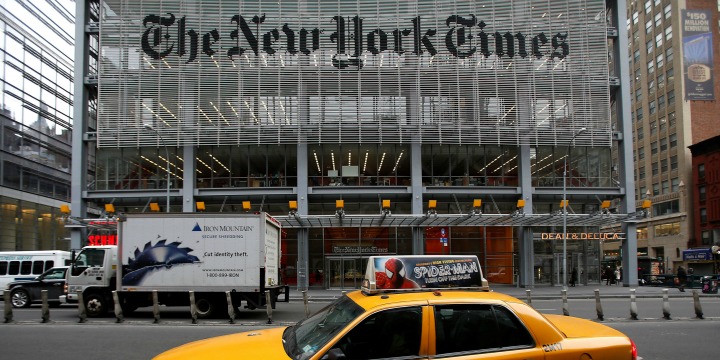
A taxi passes by in front of The New York Times head office, Feb. 7, 2013. Photo: Reuters / Carlo Allegri / File.
The New York Times has “lost its way,” say more than half of audience members who watched a formal debate on the topic.
Voting is still open on the resolution at intelligencesquaredus.org, the website of the nonprofit organization that hosted and organized the debate.
“Readers of the New York Times lose touch with reality,” said a professor at John Hopkins University, Yascha Mounk, who participated in the debate in favor of the motion. Batya Ungar-Sargon, author of the forthcoming book Bad News: How Woke Media Is Undermining Democracy, said the Times has chosen to cater to a passionate audience of partisan progressive activists rather than provide objective, traditional, unbiased journalism.
Even a debater who argued against the proposition that the Times has lost its way, former CNN Washington bureau chief Frank Sesno, conceded afterward, “I think there is insufficient ideological diversity in the reporting ranks. It does matter.”
Another Times defender, the cultural critic Virginia Heffernan, a former employee of the paper, praised its obituaries and what she described as its commitment to correct factual errors.
The Intelligence Squared debate format features a poll of the audience both before and after the debate. Before the debate, 48% agreed the Times has lost its way, 31% disagreed, and 21% were undecided. After the debate, 53% agreed the Times has lost its way, while 41% disagreed.
Questions from the audience suggested some of the dissatisfaction was driven by the paper’s coverage of Israel, which one audience member described as “consistently critical.” Ungar-Sargon’s book includes a case study on the Jews in which she writes, “To close readers of the Times’s coverage, there is an unmistakable cast to the reporting, as subtle but significant as an Instagram filter; it paints Jews as the agents of aggression and Palestinians as their victims.”
Never mind the final vote — that the question is even being debated in such a prominent setting is a sign of the pressure that the Times is facing. Among other recent developments:
- ComScore data show the newspaper’s web traffic has plummeted 33.9% year over year — a steep decline that looks more like partisan left-leaning sites such as the Guardian or the HuffPost, rather than mainstream outlets such as the Wall Street Journal or USA Today. Many attribute the decline to President Trump’s departure from office; readers had become dependent on these outlets for a steady diet of headlines to fuel their outrage at Trump.
- The New York Times Company’s share price has slumped from its 52-week high of $58.73. It has been trading at around $44, down more than 20%, even as the overall US stock market has soared to new highs.
- The company’s largest investor, Mexican billionaire Carlos Slim Helu, has bailed. The Times Company’s 2020 proxy statement showed Slim owning 9.8% of the company’s Class A stock, more than 5 times the shares owned by either the current publisher, A.G. Sulzberger, or his father, Arthur Sulzberger Jr. The company’s 2021 proxy statement doesn’t list Slim as a major holder.
- The Committee for Accuracy in Middle East Reporting and Analysis has posted a new billboard outside the Times headquarters, with a photo of A.G. Sulzberger and the words: “Hey, Mr. Sulzberger, The New York Times apologized for burying news about Nazi antisemitism. Why are you burying the full truth about attacks on Jews today? Get back to us at CAMERA.ORG.” Camera Executive Director Andrea Levin said the aim of the ad was to help bring attention to “the deplorable role of the Times today in failing to cover the full facts about antisemitism and actually fueling hostility towards Jews with its incessant, false and inflammatory depictions of Israel.”
- The Times indefinitely postponed its plans for a return to in-office work, amid a surge in coronavirus cases.
Ira Stoll was managing editor of The Forward and North American editor of The Jerusalem Post. His media critique, a regular Algemeiner feature, can be found here.