 Pod Save America Hosts Call on Democrats to Cut All Israel Military Aid, No Longer Accept AIPAC Funding
 Jews, Israelis Targeted in Austria Amid Surge in Antisemitic Incidents; Local Jewish Community Calls for Action
 ‘All of Our Strength’: Over 1,000 Pro-Israel Activists Gather in DC for Solidarity Conference
 ‘Devastated’: Wesley LePatner, Killed in Manhattan Mass Shooting, Was a Jewish Communal, Philanthropic Leader
 Sen. Angus King Vows to No Longer Vote for Israel Military Aid Until Gaza Conditions Improve
 Europe Won’t Pressure Israel to ‘Commit Suicide’ Amid Gaza Backlash, Palestinian State Push, Says Israeli FM
 Israel’s National Soccer Coach Attacked in Athens Before Soccer Fans Chant ‘F–K Israel, Free Palestine’ at Match
 New York Judge Sentences Neo-Nazi to 5 Years for Livestreaming Bomb Threats Against Jewish Hospitals
 US Pressures Lebanon to Issue Cabinet Decision to Disarm Hezbollah Before Talks Continue
 UK Plans to Recognize Palestinian State in September Unless Israel Meets Conditions, Starmer Says


Ideological Indigestion in the New York Times
Error: Contact form not found.
 by Jerold Auerbach

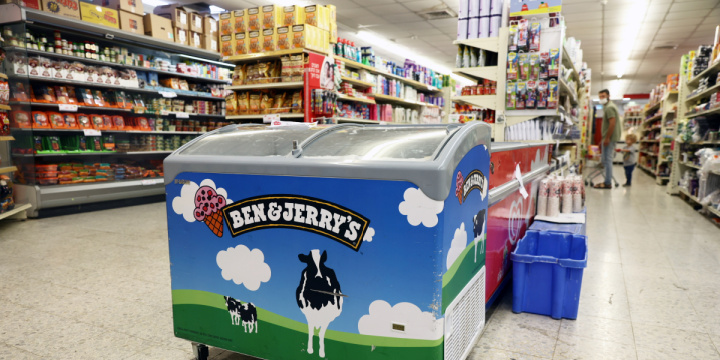
A refrigerator bearing the Ben & Jerry’s logo is seen at a food store in the Jewish settlement of Efrat in the West Bank July 20, 2021. REUTERS/Ronen Zvulun
Anyone familiar with the incessant criticism of Israel from journalist Mairav Zonszein is unlikely to be surprised by her most recent contribution to The New York Times Opinion page (July 28). After all, its daily motto — “All the News That’s Fit to Print” — long ago became, in reality, all the news that fits Times discomfort with a thriving democratic Jewish state in the historic homeland of the Jewish people.
Zonszein’s warped perception of Israel is a perfect fit and she is unabashed about exposing it. The Jewish state, she wrote four years ago (in the Washington Post), epitomizes “expropriation, inequality and discrimination.” Its flag is “synonymous with a destructive, intolerant form of Jewish nationalism.” She experienced Independence Day with “heavy doses of disillusionment, anger and cynicism” prompted by “the normalization of occupation.” At least she found comfort in an Israeli Facebook group called “Leftist Mothers.”
Her current obsession is the looming unavailability of Ben & Jerry’s ice cream in “the occupied Palestinian territories” in response to Israel’s “immoral behavior.” That behavior includes “home demolitions, institutionalized discrimination, land expropriation, administrative detention and shooting at unarmed Palestinian protesters.” Israel, in sum, is “a belligerent occupying power” with an “intricate system of control over the movement and lives of millions of Palestinians.” What could be more devastating for Israelis, she wonders, than the withholding of Ben & Jerry’s ice cream. Terrorism, perhaps?
To Zonszein’s dismay, Israel has “an extensive network of cameras tasked with observing every corner of the Old City of Jerusalem.” (Why that is necessary, given recent waves of Palestinian violence on the Temple Mount, is ignored.) And in Hebron, where eight hundred Jews live in a tiny enclave surrounded by 200,000 Palestinians who have not been known for kindness toward their Jewish neighbors, Israel maintains a “sophisticated system of data collection.” That, too, is unacceptable.
Zonszein seems unfamiliar with Hebron’s place in Jewish history — burial site of the patriarchs and matriarchs of the Jewish people and the city where King David reigned before relocating his throne to Jerusalem. That was millennia before the 20th century emergence of “Palestinians” as a self-identified and distinctive people. She ignores the murderous Arab rioting in 1929 that drove Jews from their ancient holy city and prevented their return until Israel’s victory in the Six-Day War opened the gate for the restoration of the decimated Jewish community.
For Zonszein, Ben & Jerry’s decision to withhold ice cream from Jewish “settlers” displays noble heroism, demonstrating that “the territories” — Biblical Judea and Samaria — “are not a legitimate part of Israel.” But there is still cause for (her) concern. As “a leading exporter of state-of-the-art surveillance technology,” which it uses “every day in the occupied territories as part of its intricate system of control over the movement and lives of millions of Palestinians,” Israel demonstrates its enduring cruelty as “a belligerent occupying power” — even without Ben & Jerry’s ice cream.
Zonszein is clearly frustrated by Israel’s technological innovations. Not only does it operate “an extensive network of cameras tasked with observing every corner of the Old City of Jerusalem.” Its “immoral behavior” includes “home demolitions, institutionalized discrimination, land expropriation, administrative detention and shooting at unarmed Palestinian protesters.” It also sells “highly controversial technology to authoritarian regimes.”
Perhaps the author should take a deep breath and swallow her unrelenting criticism of Israel with a soothing bowl of Ben & Jerry’s black raspberry ice cream. As for The New York Times, whose generations of Sulzberger publishers have long been mired in unrelenting criticism of the world’s only Jewish state, no antidote is likely to ease its discomfort. No wonder it provided a welcome forum for Zonszein’s ideological indigestion.
Jerold S. Auerbach is the author of twelve books, including Print to Fit: The New York Times, Zionism and Israel 1896-2016, selected for Mosaic by Ruth Wisse and Martin Kramer as a Best Book for 2019