 Pod Save America Hosts Call on Democrats to Cut All Israel Military Aid, No Longer Accept AIPAC Funding
 Jews, Israelis Targeted in Austria Amid Surge in Antisemitic Incidents; Local Jewish Community Calls for Action
 ‘All of Our Strength’: Over 1,000 Pro-Israel Activists Gather in DC for Solidarity Conference
 ‘Devastated’: Wesley LePatner, Killed in Manhattan Mass Shooting, Was a Jewish Communal, Philanthropic Leader
 Sen. Angus King Vows to No Longer Vote for Israel Military Aid Until Gaza Conditions Improve
 Europe Won’t Pressure Israel to ‘Commit Suicide’ Amid Gaza Backlash, Palestinian State Push, Says Israeli FM
 Israel’s National Soccer Coach Attacked in Athens Before Soccer Fans Chant ‘F–K Israel, Free Palestine’ at Match
 New York Judge Sentences Neo-Nazi to 5 Years for Livestreaming Bomb Threats Against Jewish Hospitals
 US Pressures Lebanon to Issue Cabinet Decision to Disarm Hezbollah Before Talks Continue
 UK Plans to Recognize Palestinian State in September Unless Israel Meets Conditions, Starmer Says


The Taliban and Al-Qaeda: What Next?
Error: Contact form not found.
 by James M. Dorsey

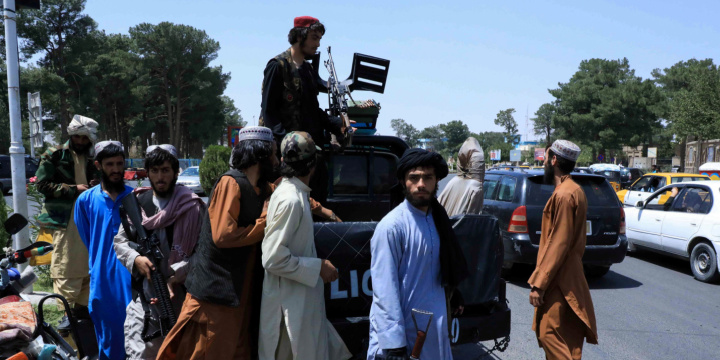
FILE PHOTO: Taliban forces patrol a street in Herat, Afghanistan August 14, 2021. REUTERS/Stringer
The Taliban proved that they value loyalty when they rejected US and Saudi pressure to hand over Osama bin Laden no matter the cost. The Taliban have since come to appreciate Al-Qaeda’s fighting skills and contributions to the Afghan jihadists’ cause, and their return to power seems good news for the Islamist terrorist group.
Abu Omar Khorasani was taken from Kabul’s Pul-i-Charkhi prison and unceremoniously shot — one of the first state-sponsored executions by the Taliban. Khorasani was ISIS’ head in South Asia until his arrest by government forces last year.
While the precise circumstances of his execution are not known, this move was, at least in part, designed to send a message to the international community, especially to Afghanistan’s neighbors, including China and Iran, as well as Russia — Central Asia’s security overlord. The message was that the Taliban were cracking down on foreign jihadists and terrorists in Afghanistan.
Khorasani was an easy symbol. The relations between the Taliban and ISIS, whose ranks of foreigners are primarily populated by Pakistanis and a sprinkling of Central Asians, Uighurs, Russians, Turks, Iranians, Indonesians, Indians, and Frenchmen, have long been adversarial. ISIS recently accused the Taliban of being more nationalist than pious in their negotiations with the United States.
The Taliban message is quite misleading, though. What is true for ISIS is not true for Al-Qaeda and others such as the Uighur Turkestan Islamic Party (TIP) and the Islamic Movement of Uzbekistan.
The Taliban appear to believe that they can get away with the differentiation because they perceived Washington as more focused during the withdrawal negotiations on ensuring that ISIS, Al-Qaeda, and other terrorists will not be allowed to use Afghanistan as a springboard for international terrorism rather than on getting them expelled from the country. The perceived US focus may have been rooted in a concern that if the Taliban’s hands were forced, they would let terrorists slip out of the country and not hand them over to the authorities. That would make it difficult to control their movements or ensure that they are either entered into de-radicalization programs or, if warranted, brought to justice. “It’s a Catch-22. The Taliban ensuring that Al-Qaeda sticks to rule risks putting a fox in charge of the chicken coop. How much better that is than having foxes run wild remains to be seen,” said a retired counter-terrorism official.
Officials of the Trump administration who negotiated the agreement suggest that the continued presence of Al-Qaeda and other terrorists in Afghanistan would violate the accord with the Taliban. Former Vice President Mike Pence as well as Trump-era State Department counter-terrorism coordinator Nathan Sales argued that the deal “required the Taliban…to refuse terrorists safe harbor.”
Russia and China, while publicly more measured in their statements, are likely to share western concerns. Moscow held military drills earlier this month with Tajik and Uzbek troops in Tajikistan, 20 kilometers from the border with Afghanistan.
While Al-Qaeda may have been boosted in recent weeks by multiple prison breaks in which the Taliban freed Al-Qaeda terrorists (as well as jihadists from other groups), it remains unclear to what degree the breaks will help the group strengthen its presence in Afghanistan. General Mark Milley, chairman of the US Joint Chiefs of Staff, warned last week that Al-Qaeda and ISIS could quickly rebuild their networks in Afghanistan.
The United Nations recently reported that Al-Qaeda “is present in at least 15 Afghan provinces,” and that its affiliate in the Indian subcontinent “operates under Taliban protection from Kandahar, Helmand and Nimruz provinces.”
“Without information on who exactly escaped, it is difficult to determine whether historically significant figures remain within AQ’s AfPak [Afghanistan-Pakistan] network, or if it is mainly composed of newer figures these days, whether local or regional foreign fighters,” cautioned political violence scholar Aaron Zelin. It is also unclear whether Al-Qaeda terrorists in Iran will be allowed to relocate to Afghanistan.
The prison breaks cast doubts about the Taliban’s readiness to police jihadists and other terrorists with aspirations beyond Afghanistan’s borders. Of particular concern is the fact that the balance of power has yet to be determined between Taliban leaders who in recent days have been eager to put a seemingly more moderate, accommodating foot forward with security guarantees for their opponents, minorities and women and the group’s far-flung less polished rank and file.
The concern about the Taliban’s ability and willingness to control terrorist activity on Afghan soil is magnified by worries regarding the continued existence of warlords with the power to organize violence, provide jobs and public services, and forge or strengthen ties with terrorists. “Warlords will play an active role in the future of Afghanistan. They will remain businessmen and political leaders, connected to global economic processes and networks. They will develop the military power that they need to control territory and wage war. They will, finally, continue to fight for more autonomy and, in some cases, might even manage to partially form their old regional polities once again,” said Romain Malejacq, author of a book on Afghan warlords. “Afghanistan’s availability as a sanctuary for terrorists is, to say the least, related to its status as a warlord-ridden wasteland,” said journalist and author Graeme Wood.
The Taliban’s refusal to expel terrorists complicates the group’s efforts to garner legitimacy in the international community and particularly its neighbors, even if Al-Qaeda has been significantly weakened since 9/11 and is less focused on attacking the United States and more on the Muslim world.
It also strengthens those who fear that Afghanistan will again emerge as a launching pad for transnational political violence. “We are going to go back to a pre-9/11 state — a breeding ground for terrorism,” warned Rep. Michael McCaul (R-TX), the ranking Republican member of the US House Foreign Affairs Committee.
Dr. James M. Dorsey, a non-resident Senior Associate at the BESA Center, is a senior fellow at the S. Rajaratnam School of International Studies at Singapore’s Nanyang Technological University and co-director of the University of Würzburg’s Institute for Fan Culture.
A version of this article was originally published by The BESA Center.