 Pod Save America Hosts Call on Democrats to Cut All Israel Military Aid, No Longer Accept AIPAC Funding
 Jews, Israelis Targeted in Austria Amid Surge in Antisemitic Incidents; Local Jewish Community Calls for Action
 ‘All of Our Strength’: Over 1,000 Pro-Israel Activists Gather in DC for Solidarity Conference
 ‘Devastated’: Wesley LePatner, Killed in Manhattan Mass Shooting, Was a Jewish Communal, Philanthropic Leader
 Sen. Angus King Vows to No Longer Vote for Israel Military Aid Until Gaza Conditions Improve
 Europe Won’t Pressure Israel to ‘Commit Suicide’ Amid Gaza Backlash, Palestinian State Push, Says Israeli FM
 Israel’s National Soccer Coach Attacked in Athens Before Soccer Fans Chant ‘F–K Israel, Free Palestine’ at Match
 New York Judge Sentences Neo-Nazi to 5 Years for Livestreaming Bomb Threats Against Jewish Hospitals
 US Pressures Lebanon to Issue Cabinet Decision to Disarm Hezbollah Before Talks Continue
 UK Plans to Recognize Palestinian State in September Unless Israel Meets Conditions, Starmer Says


A Message to Incoming Jewish College Students
Error: Contact form not found.
 by Aaron Kahane and Samuel Strickberger

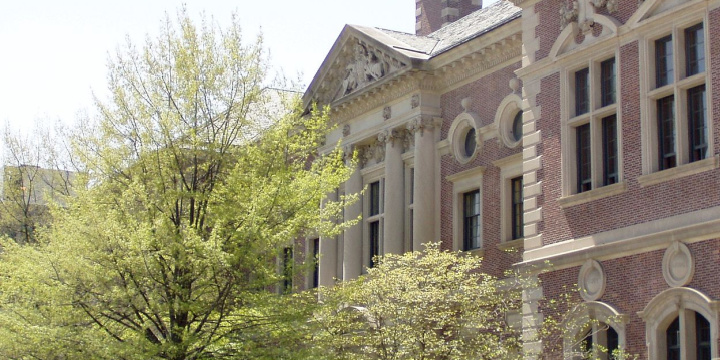
The eastern facade of the University of Pennsylvania Law School. Photo: WikiCommons, Jeffrey M. Vinocur.
To incoming first-years:
Unlocking our dorm rooms three years ago, we were filled with nervous excitement. We were excited to meet new people and learn their stories, but nervous about finding our place on campus. We were excited to learn from our professors, but nervous about the demanding class requirements and adjusting to college life.
Only at the end of our first week, when we shuffled to Shabbat services at Hillel, did we begin to feel at home on campus (or closer to it). Alongside dozens of unfamiliar faces, we welcomed Shabbat with soulful songs. And for the next three years, Jewish observance continued to offer us a home on campus.
We want to share with you how Judaism has grounded and directed our college experience, and how our college experience has strengthened and deepened our Judaism.
Despite our different Jewish backgrounds (Aaron graduated from a yeshiva day school and Sam from a Quaker high school), we identified two significant aspects of Jewish connection for us on campus: Shabbat and prayer.
Whether you come from a traditionally observant home, a family with minimal Jewish connection, or anything in between, we hope our experiences speak to you in some way. And we encourage you to give them a try (in some form) during your first weeks on campus.
College can be intense. We have felt constant pressure to complete assignments, participate in club activities, prepare for the next essay or exam, and apply for jobs. These to-do lists can feel incessant. Yet, our tradition teaches that the seventh day should be one of rest. For a 25-hour period, there is no studying, no group projects, and no email.
Some might support Shabbat based on this idea: “We need relaxation, because we cannot work continuously.” In other words, the Shabbat’s rest is “for the sake of activity,” as Rabbi Abraham Joshua Heschel articulated the utilitarian defense of Shabbat.
This approach is not ours. “The Sabbath is a day for the sake of life,” Rabbi Heschel argues in The Sabbath. “It is not an interlude but the climax of living.” Heschel conceives of Shabbat’s essence more holistically, a day for human connection, gratitude, and spirituality.
The ancient restrictions liberate us from the rush of our 168-hour week. This frees our time for what matters most, as we relinquish tools of creation and control.
We enjoy communal meals around a small, cozy table. We appreciate moments of silence through prayer. We go on long walks with close friends around campus, or play backgammon with new ones. No longer do we scroll, toggle, and juggle. Instead, we reflect, reconnect, and re-energize.
If Shabbat provides weekly guide posts during the year, prayer enables daily check-ins throughout the week.
Prayer continues where Shabbat left off. When the semester nears its crescendo, our vision becomes myopic, largely concerned with final grades and friends’ impressions. Those last weeks are jam-packed with late night studying, club presentations, and performing arts events. Yet, regardless of the day before or ahead, putting on the tefillin welcomes our morning. Wrapping the black leather around our left arm and head reminds us to direct our heart, mind, and actions towards something beyond ourselves and our studies.
When we are most focused and intentional, prayer can help us be more other-minded.
The language of Jewish prayer revolves around the plural first person: we. The “we” of community — past, present, and future — replaces the “I” of individualism. When our sole concern is finishing our final paper or landing that interview, we can sometimes feel that the world was created for “just me.” Prayer offers a healthy reminder that we are “but dust and ashes,” with obligations towards others, too.
On the other hand, when encountering an exam that went poorly or a more significant disappointment, we have felt the opposite. Here, prayer reminds us that we are valuable and endowed with inherent human dignity, irrespective of our outward successes.
Immersing ourselves in Judaism during our college experience has not always been convenient. We’ve rescheduled exams due to holidays, and missed social events on Shabbat. But Judaism in college has given us a vibrant, dynamic foundation of purpose. It has provided us with community, spiritual attunement, a history to engage with, and a tradition to shape. Prior to starting college, our Judaism was not blank like that dorm room we encountered on our first day. But our college experience has nonetheless colored and strengthened it.
We wish the same for you, and encourage you to lean into your Judaism.
On your first Shabbat on campus, try attending Friday night services and connecting to a few of the melodies. Start building your community from there, and ask to join a Shabbat meal afterwards. It may be a bit stressful to reach out, but trust us, you’ll be grateful you did — and so will those you dined with. Try saying the shema when you wake up and go to bed for your first couple of weeks on campus. See where it goes from there. Lastly, we’ve enjoyed reading the weekly Dvar Torahs from Zohar Atkins and the late Rabbi Jonathan Sacks. Maybe you will, too.
Aaron Kahane just graduated from the University of Pennsylvania, and is an incoming Associate Consultant at Bain & Company in New York. Sam Strickberger is a senior at the University of Pennsylvania, where he serves as Senior Class President.