 Pod Save America Hosts Call on Democrats to Cut All Israel Military Aid, No Longer Accept AIPAC Funding
 Jews, Israelis Targeted in Austria Amid Surge in Antisemitic Incidents; Local Jewish Community Calls for Action
 ‘All of Our Strength’: Over 1,000 Pro-Israel Activists Gather in DC for Solidarity Conference
 ‘Devastated’: Wesley LePatner, Killed in Manhattan Mass Shooting, Was a Jewish Communal, Philanthropic Leader
 Sen. Angus King Vows to No Longer Vote for Israel Military Aid Until Gaza Conditions Improve
 Europe Won’t Pressure Israel to ‘Commit Suicide’ Amid Gaza Backlash, Palestinian State Push, Says Israeli FM
 Israel’s National Soccer Coach Attacked in Athens Before Soccer Fans Chant ‘F–K Israel, Free Palestine’ at Match
 New York Judge Sentences Neo-Nazi to 5 Years for Livestreaming Bomb Threats Against Jewish Hospitals
 US Pressures Lebanon to Issue Cabinet Decision to Disarm Hezbollah Before Talks Continue
 UK Plans to Recognize Palestinian State in September Unless Israel Meets Conditions, Starmer Says


After Corruption Accusations, Divisions Strike the Muslim Brotherhood
Error: Contact form not found.
 by Hany Ghoraba

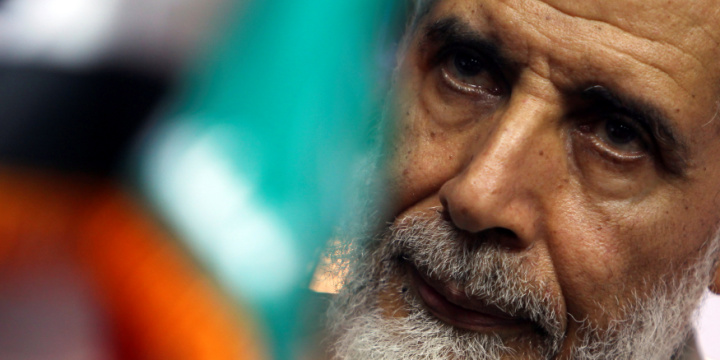
The Muslim Brotherhood’s Mahmoud Ezzat attends a news conference in Cairo May 30, 2010. REUTERS/Amr Abdallah Dalsh
Egypt’s Muslim Brotherhood has bragged for decades about the unity of its members, and its ability to withstand all external pressures. But the latest split hitting the group’s hierarchy ended with a Turkey-based faction declaring the ouster of London-based acting General Guide Ibrahim Munir.
Muslim Brotherhood spokesman Talaat Fahmy announced the move last month, after Munir suspended six Turkish-based members for alleged corruption and embezzlement.
Munir acted unilaterally, Fahmy said, and a Brotherhood governing panel that includes the same people he suspended decided he could no longer lead. “It is important that anyone who was sworn to hold higher positions in front of the Guidance Bureau of the group to uphold the system and bylaws,” said Fahmy.
This is an unprecedented act of dissent in the group’s 93-year existence. The decision to oust the general guide was taken by a group led by the Muslim Brotherhood’s General Secretary Mahmoud Hussein. It took place days after Munir suspended the six members, including Hussein, and opened an investigation into their activities.
Munir, 84, is the group’s oldest high-ranking member. He became a key leader in 2013, after Egypt’s military government banned the group and arrested then-General Guide Mohamed Badie. Badie received several life prison sentences last year in connection with violent protests that followed the Brotherhood’s forced removal from power by the Egyptian military.
Munir told a Parliament committee that Islamic law tolerates apostates and homosexuals. He became acting general guide in August 2020 after Egypt arrested Brotherhood mastermind Mahmoud Ezzat.
The competing accusations and power struggle led Mokhtar Nouh, a former Muslim Brotherhood leader turned whistleblower, to disclose that the Brotherhood’s Turkey office — led by Hussein — receives about $1.7 million monthly from the Turkish government, support that dates back to 2013. Munir is now trying to have that money sent to London instead of Istanbul.
In a video, Munir called his removal “unlawful and unconstitutional.” He said he was not surprised by the move, but argued that the suspended members are not authorized to act against him.
Munir recently bolstered his personal security after internal assassination threats, an unnamed source told Sky News Arabia. According to the same source, Hussein is preparing to declare himself as acting guide, while a group affiliated with him is trying to get rid of Munir.
“The culture of assassination and armed action is not a novelty for the Brotherhood, but it is a well-established custom, and it targeted anyone who disagrees or opposes the group’s orientations since its foundation by Hassan al-Banna,” Egyptian counter-terrorism expert Amro Farouk told Sky News Arabia.
Munir is trying to expose financial and administrative violations by Hussein and his allies to settle the score with them, Farouk said.
The group has experienced a number of rifts in recent years, with members trading accusations of selling out imprisoned Brotherhood members in Egypt, and embezzling donor money. Some of the imprisoned Brotherhood members have pledged to reconcile with the Egyptian government. A number of Muslim Brotherhood prisoners signed a petition for their release in exchange for quitting any political activity.
Munir’s spokesman, Osama Soliman, admitted that the Brotherhood is in crisis. The only resolution involves the Turkish faction backing down and complying with the investigation and its results, he said.
“If the Hussain group insists on their positions, they have removed themselves from the group,” said Soliman. “The crisis has negatively affected the strength of the group’s structure temporarily.”
Despite the rifts, Soliman denied that the group is splintering. “There is only one group and there is no dissent,” he told Al Jazeera Mubasher on October 18, “and the six individuals referred for investigation are obliged to remain silent for the time being.”
The Muslim Brotherhood’s global charter, modified in 1994, stipulates that the Shura Council could impeach the general guide if he becomes unable to perform his duties. An impeachment requires approval by two-thirds of the Brotherhood’s governing council. But Munir disbanded the council in July, and he claims the Turkish faction has no authority to remove him.
A recent effort to resolve the dispute failed, as the Brotherhood faction in Turkey refused to cede control of businesses and media outlets to Munir’s administration. These outlets include its “Watan” TV network, and the official Muslim Brotherhood website, Ikhwan Online, which is run by Fahmy.
Egyptian political observers see the current crisis as the deepest in the Brotherhood’s 93 year history. Moreover, this rift represents a breach of one of the group’s main tenets, which is hearing and obeying. This is a tenet that all new members of the group are sworn to obey without question. But the recent rift has tossed away this tenet and along with it, a lot of what’s left of the Muslim Brotherhood leaders’ credibility in the eyes of its members.
Investigative Project on Terrorism (IPT) Senior Fellow Hany Ghoraba is an Egyptian writer, political and counter-terrorism analyst at Al Ahram Weekly, author of Egypt’s Arab Spring: The Long and Winding Road to Democracy and a regular contributor to the BBC. A version of this article was originally published by the IPT.