 Pod Save America Hosts Call on Democrats to Cut All Israel Military Aid, No Longer Accept AIPAC Funding
 Jews, Israelis Targeted in Austria Amid Surge in Antisemitic Incidents; Local Jewish Community Calls for Action
 ‘All of Our Strength’: Over 1,000 Pro-Israel Activists Gather in DC for Solidarity Conference
 ‘Devastated’: Wesley LePatner, Killed in Manhattan Mass Shooting, Was a Jewish Communal, Philanthropic Leader
 Sen. Angus King Vows to No Longer Vote for Israel Military Aid Until Gaza Conditions Improve
 Europe Won’t Pressure Israel to ‘Commit Suicide’ Amid Gaza Backlash, Palestinian State Push, Says Israeli FM
 Israel’s National Soccer Coach Attacked in Athens Before Soccer Fans Chant ‘F–K Israel, Free Palestine’ at Match
 New York Judge Sentences Neo-Nazi to 5 Years for Livestreaming Bomb Threats Against Jewish Hospitals
 US Pressures Lebanon to Issue Cabinet Decision to Disarm Hezbollah Before Talks Continue
 UK Plans to Recognize Palestinian State in September Unless Israel Meets Conditions, Starmer Says


Iran Unveils Long-Range Missile as Vienna Nuclear Talks Resume
Error: Contact form not found.
 by Reuters and Algemeiner Staff

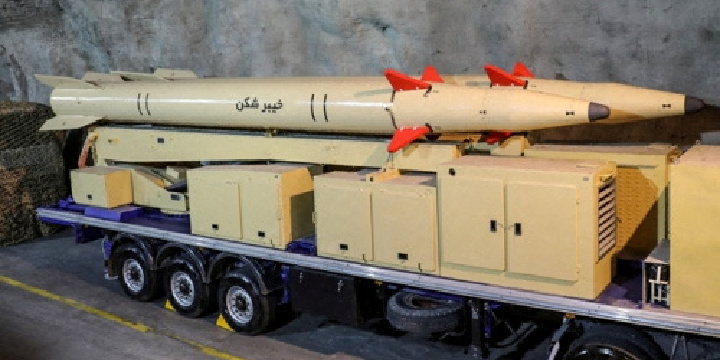
New Iranian “Kheibarshekan” missiles are seen in an undisclosed location in Iran, in this picture obtained on February 9, 2022. IRGC/WANA
Iran unveiled a new domestically-made missile with a range of 900 miles on Wednesday, state TV reported, a day after Tehran and Washington resumed indirect talks to salvage a 2015 nuclear deal.
Iran, which has one of the biggest missile programs in the Middle East, says its ballistic missiles have a range of up to 1,200 miles and are capable of reaching its arch-foe Israel and US bases in the region.
State TV displayed the new surface-to-surface “Kheibar Shekan” (Kheibar buster) missile, which refers to an ancient Jewish oasis called Kheibar in the Arabian Peninsula’s Hijaz region that was overrun by Muslim warriors in the 7th century.
“This long-range missile is domestically manufactured by the Revolutionary Guards (IRGC) … It has high accuracy and is propelled by solid fuel and is capable of penetrating missile shields,” Iranian state media reported.
Tehran regards its missile program as an important deterrent against the United States, Israel and other adversaries. It has rejected Western demands to halt its ballistic missile work.
“Iran will continue advancing its ballistic missile program,” Iran’s armed forces chief of staff Major General Mohammad Bagheri told a ceremony at an IRGC base where the new missile was displayed, Iranian media reported.
NUCLEAR DEAL
Sunni Muslim Saudi Arabia, a regional rival of Shi’ite-led Iran, has repeatedly called on major powers to address Gulf Arab concerns about Tehran’s missiles.
Israel, which the Islamic Republic does not recognize, has long threatened military action against Iran if the talks in Vienna fail to curb Tehran’s nuclear work. Iran says its nuclear ambitions are peaceful.
In 2018, then-US President Donald Trump withdrew from the nuclear deal — designed to stop Iran developing a nuclear weapon — and reimposed sanctions in a bid to force Tehran into talks on a broader agreement that would have also addressed its ballistic missile program and support for proxies in the Middle East.
Iran responded a year later by gradually breaching the pact’s nuclear limits, rebuilding stockpiles of enriched uranium, refining it to higher fissile purity and installing advanced centrifuges to speed up output.
Indirect talks between Tehran and Washington to revive the deal started after Joe Biden replaced Trump in the White House, but despite eight rounds since April differences remain between Iran and world powers.
Tehran and Washington have blamed each other for the lack of progress.
“Voices from the US government show there is no coherence in that country to make political decisions in the direction of advancing the Vienna talks,” Iran’s top security official Ali Shamkhani tweeted on Wednesday.