 Pod Save America Hosts Call on Democrats to Cut All Israel Military Aid, No Longer Accept AIPAC Funding
 Jews, Israelis Targeted in Austria Amid Surge in Antisemitic Incidents; Local Jewish Community Calls for Action
 ‘All of Our Strength’: Over 1,000 Pro-Israel Activists Gather in DC for Solidarity Conference
 ‘Devastated’: Wesley LePatner, Killed in Manhattan Mass Shooting, Was a Jewish Communal, Philanthropic Leader
 Sen. Angus King Vows to No Longer Vote for Israel Military Aid Until Gaza Conditions Improve
 Europe Won’t Pressure Israel to ‘Commit Suicide’ Amid Gaza Backlash, Palestinian State Push, Says Israeli FM
 Israel’s National Soccer Coach Attacked in Athens Before Soccer Fans Chant ‘F–K Israel, Free Palestine’ at Match
 New York Judge Sentences Neo-Nazi to 5 Years for Livestreaming Bomb Threats Against Jewish Hospitals
 US Pressures Lebanon to Issue Cabinet Decision to Disarm Hezbollah Before Talks Continue
 UK Plans to Recognize Palestinian State in September Unless Israel Meets Conditions, Starmer Says


Ukraine: Lessons Not Being Learned
Error: Contact form not found.
 by James M. Dorsey

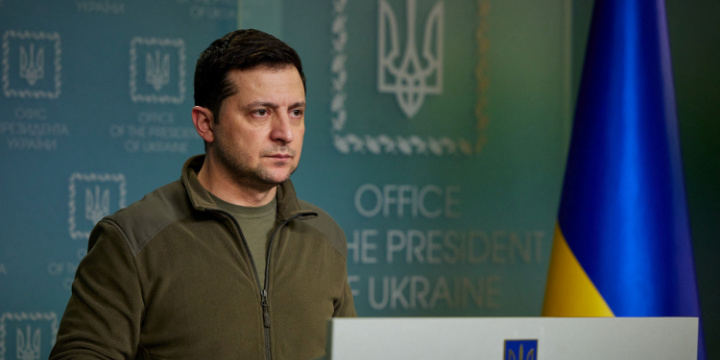
Ukrainian President Volodymyr Zelenskiy makes a statement in Kyiv, Ukraine, February 25, 2022. Ukrainian Presidential Press Service/Handout via REUTERS
Russian President Vladimir Putin’s invasion of Ukraine — and the international condemnation it generated– contains key lessons for policymakers.
They are lessons that should have been learned in past global crises but weren’t. However, the Ukraine crisis offers an opportunity to correct that mistake.
A first lesson is that failure to firmly stand up to violations of international law as they occur convinces trespassers that they can get away with them. It emboldens violators to commit even more flagrant infringements.
Kicking the can down the road by failing to immediately and firmly respond to violations amounts to allowing an open wound to fester. The longer the wound festers, the more difficult, costly, and risky it is to cure it.
The last 14 years of Putin’s rule are a case in point.
Putin began the recreation of his Russian world in 2008, when he recognized the two Georgian breakaway republics of Abkhazia and North Ossetia. The recognition constituted the first step in Putin’s defining of Russia’s borders in civilizational rather than international legal terms.
Putin has made no bones about the fact that he sees territories populated by Russian speakers and adherents of Russian culture as the determinants of Russia’s borders, not international law. And the Russian leader demonstrated in 2008, and since, his willingness to enforce his definition of Russia’s border with military might.
In 2008, the international community effectively looked the other way. The United States and Europe responded by slapping Putin’s wrists. The sanctions imposed at the time did little to stop Putin from increasing his war chest or making the cost of continued pursuit of his strongman tactics too costly and risky. The Russian invasion of Ukraine resulted from the international community’s failure to draw a line in the sand back in 2008 or at the latest in 2014.
Russia is the most dramatic, most recent example of the cost of not responding firmly and unequivocally to infringements of international law as they occur.
Other examples are numerous. They include the ethnic cleansing of Rohingya and the subsequent military coup in Myanmar, the 2013 toppling of Egypt’s first and only democratically elected president in a takeover by the armed forces, the meek response to the brutal repression of Turkic Muslims in China, the increasingly blatant discrimination and disenfranchisement of Muslims in India and missed opportunities to resolve the Israeli-Palestinian conflict, to name a few.
In a video message, journalist Lyse Doucet explained that her reporting on the current crisis in Ukraine prevented her from personally accepting an award in the Iraqi Kurdish capital of Irbil — the 2022 Shifa Gardi Award — which was named after a journalist killed in 2017 in Iraq by a roadside bomb.
“If anyone knows about the pain and hardship of living with war, it’s the people of Iraq, of Kurdistan. And if anyone knows what it’s like to live in a war that never seems to end, of living with powerful neighbours, and the importance of independent journalism, it is the Kurdish people,” Doucet said.
Her message brought it all together: the linkages between failing to stand up early and firmly to flagrant violations of international law, abuse of human rights, and suppression of freedom of expression.
Kurds formed the bulk of thousands of desperate refugees in Belarus who were trying to cross the border into Poland just four months ago. Although this kind of event may be accepted when it happens in the Arab world, many have expressed shock that “this could happen in 21st century Europe.”
Europeans would be better served to recognize that their continent is as prone to conflict as are other parts of the world. Ukraine is not the first such incident in Europe. It was preceded by the brutal wars in Chechnya, Georgia, and the former Yugoslavia in the 1990s that three decades later could erupt again.
And that realization may be seeping in. “War is no longer something visited upon impoverished and remote populations. It can happen to anyone,” wrote Telegraph journalist Peter Hannan.
It’s never too late to learn lessons. The world is finally standing up to Putin. Yet, there is little indication that the broader lessons that his war in Ukraine offers, are finally being learned.
Dr. James M. Dorsey is an award-winning journalist and scholar, a Senior Fellow at the National University of Singapore’s Middle East Institute and Adjunct Senior Fellow at Nanyang Technological University’s S. Rajaratnam School of International Studies, and the author of the syndicated column and blog, The Turbulent World of Middle East Soccer