 Pod Save America Hosts Call on Democrats to Cut All Israel Military Aid, No Longer Accept AIPAC Funding
 Jews, Israelis Targeted in Austria Amid Surge in Antisemitic Incidents; Local Jewish Community Calls for Action
 ‘All of Our Strength’: Over 1,000 Pro-Israel Activists Gather in DC for Solidarity Conference
 ‘Devastated’: Wesley LePatner, Killed in Manhattan Mass Shooting, Was a Jewish Communal, Philanthropic Leader
 Sen. Angus King Vows to No Longer Vote for Israel Military Aid Until Gaza Conditions Improve
 Europe Won’t Pressure Israel to ‘Commit Suicide’ Amid Gaza Backlash, Palestinian State Push, Says Israeli FM
 Israel’s National Soccer Coach Attacked in Athens Before Soccer Fans Chant ‘F–K Israel, Free Palestine’ at Match
 New York Judge Sentences Neo-Nazi to 5 Years for Livestreaming Bomb Threats Against Jewish Hospitals
 US Pressures Lebanon to Issue Cabinet Decision to Disarm Hezbollah Before Talks Continue
 UK Plans to Recognize Palestinian State in September Unless Israel Meets Conditions, Starmer Says


Ben & Jerry’s Israel in NJ Court: Unilever ‘Conceded’ Key Argument Over Refusal to Engage in Illegal Boycott
 by Shiryn Ghermezian

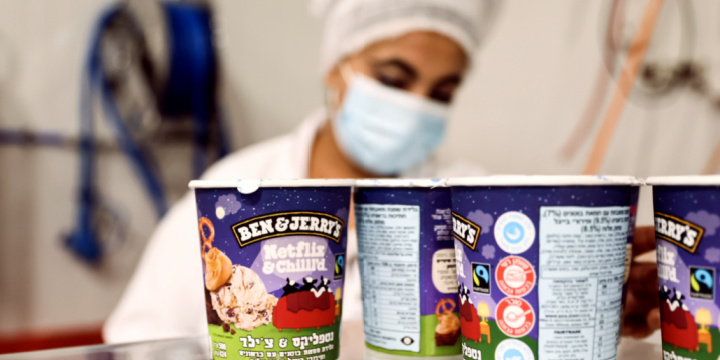
Tubs of ice-cream are seen as a labourer works at Ben & Jerry’s factory in Be’er Tuvia, Israel July 20, 2021. REUTERS/Ronen Zvulun
Attorneys for Ben & Jerry’s distributor and manufacturer in Israel, American Quality Products (AQP), argued in a rebuttal brief filed with the US District Court of New Jersey on Tuesday that the ice cream maker’s parent company Unilever “effectively concede[s]” that the only reason not to renew AQP’s license was its refusal to engage in an illegal boycott of Israeli territories.
AQP and its owner Avi Zinger said Unilever is minimizing as a “side show” the Israeli company’s argument that it is illegal to end a business relationship due to one side’s refusal to commit an unlawful act — which, in this case, would be AQP discriminating against customers in the West Bank and eastern Jerusalem by not selling Ben & Jerry’s products there.
The Vermont-based ice cream company announced its boycott of areas it termed “Occupied Palestinian Territory” in July 2021. Zinger has argued that because AQP refuses to comply with the boycott demands, his company is now being “forced out” of its decades-long licensing agreement with Ben & Jerry’s.
In March, AQP filed a lawsuit against Unilever in the US District Court of New Jersey for wrongful termination of their licensing agreement. It seeks a court injunction that would allow the company to continue making and distributing Ben & Jerry products throughout Israel.
AQP pointed out in their rebuttal brief that Unilever is “pejoratively diminishing” as a “red herring” the fact that its boycott demand violates Israeli law; the 2001 antitrust Consent Decree of the Israeli Competition Authority; United States export law; and anti-boycott laws and public policies of the United States and many states.
“Defendants effectively concede that the only reason for not renewing AQP’s license is AQP’s refusal to engage in illegal conduct,” the brief said. “They do not dispute AQP’s understanding of the Israeli and American laws and policies that Defendants’ demand would have forced AQP to violate.”
Nor did Unilever dispute evidence that terminating the licensing agreement would cause “irreparable harm” to Zinger and his company, AQP argued.
“Unilever’s unlawful demand that Avi Zinger and AQP discriminate against customers based on their residence isn’t a ‘side show’ — it’s the main show,” said Alyza Lewin, president of the Louis D. Brandeis Center for Human Rights Under Law, which is one of the parties representing Zinger. “By insisting Zinger violate Israel and US anti-discrimination and anti-boycott laws and public policy, Unilever violated the Consent Decree and License Agreement it signed and unlawfully attempted to coerce AQP to violate laws both parties agreed to obey.”
The US District Court could call for a hearing of oral arguments on the case as early as April 12.