 Pod Save America Hosts Call on Democrats to Cut All Israel Military Aid, No Longer Accept AIPAC Funding
 Jews, Israelis Targeted in Austria Amid Surge in Antisemitic Incidents; Local Jewish Community Calls for Action
 ‘All of Our Strength’: Over 1,000 Pro-Israel Activists Gather in DC for Solidarity Conference
 ‘Devastated’: Wesley LePatner, Killed in Manhattan Mass Shooting, Was a Jewish Communal, Philanthropic Leader
 Sen. Angus King Vows to No Longer Vote for Israel Military Aid Until Gaza Conditions Improve
 Europe Won’t Pressure Israel to ‘Commit Suicide’ Amid Gaza Backlash, Palestinian State Push, Says Israeli FM
 Israel’s National Soccer Coach Attacked in Athens Before Soccer Fans Chant ‘F–K Israel, Free Palestine’ at Match
 New York Judge Sentences Neo-Nazi to 5 Years for Livestreaming Bomb Threats Against Jewish Hospitals
 US Pressures Lebanon to Issue Cabinet Decision to Disarm Hezbollah Before Talks Continue
 UK Plans to Recognize Palestinian State in September Unless Israel Meets Conditions, Starmer Says


Applying (or Ignoring) Double Standards in Ukraine Is Risky Business
Error: Contact form not found.
 by James M. Dorsey

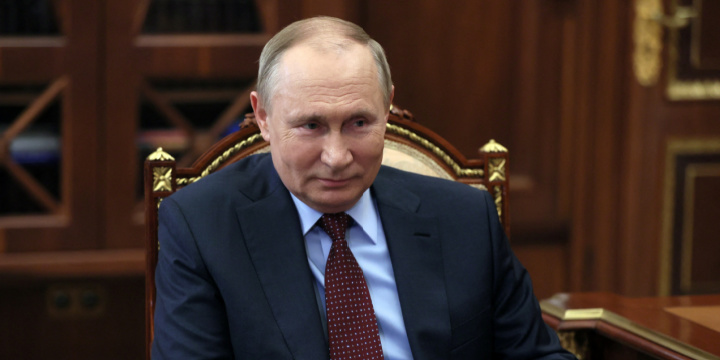
Russian President Vladimir Putin attends a meeting with the head of the Russian Union of Industrialists and Entrepreneurs Alexander Shokhin in Moscow, Russia March 2, 2022. Sputnik/Mikhail Klimentyev/Kremlin via REUTERS
Russia’s suspension from the United Nations Human Rights Council was long overdue, even without the mass killing of innocent civilians in the Ukrainian town of Bucha.
A country that poisons or otherwise does away with its critics at home and abroad — and also stifles freedom of the press, expression, and association — should not qualify for a seat on the Council.
A quick look at current and past membership in the Council explains why the UN General Assembly vote to suspend Russia, like multiple aspects of the Ukraine war, raises the spectre of double standards.
Current member China, for example, ranks alongside Russia among the world’s worst human rights violators.
China has brutally repressed its Turkic Muslim population in the north-western province of Xinjiang in an effort to Sinicise its ethnic and religious identity. China has also built a surveillance state in which free access to information and basic human rights are denied.
Saudi Arabia was a Council member for the first five years of the kingdom’s military intervention in Yemen, which has sparked one of the world’s worst humanitarian crises in the Arab world’s poorest nation. Saudi Arabia lost the vote in 2020 for another term, less because of the Yemen war and more due to the 2018 killing of Saudi journalist Jamal Khashoggi.
The Yemen war has been driven by the Saudi-led coalition and the Iranian-backed Houthi rebels. Raising hopes for an end to the eight-year-long war, the warring partners agreed to a two-month ceasefire this week. However, those hopes were dampened by a Houthi refusal to engage with a newly created presidential council that was empowered by Yemen’s internationally recognised president, Abed Rabbo Mansour Hadi.
None of this, excuses or diminishes Russia’s actions.
However, the double standards exposed by Russia’s suspension from the Human Rights Council go beyond the question of whether the Council should have a fit-and-proper test for membership. The double standards also raise issues that go further than the difference between the reception granted by Europe and the United States to Ukrainian refugees as opposed to those fleeing wars in Syria, Libya, and Yemen, or the Western country’s willingness to counter foreign occupation in some places and not others.
The problem for the United States and Europe is that Ukraine has put their failure to address seemingly hypocritical double standards in the spotlight in ways that other conflicts have not. The failure is likely to influence the broader battle for a new bi- or multipolar world order between the United States and China, now that Russia has effectively removed itself from the equation.
The impact was already visible in a comparison of voting patterns in last month’s condemnation of the Russian invasion of Ukraine by the UN General Assembly and this month’s suspension of Russian membership in the Human Rights Council.
The assembly condemned the invasion, with 141 countries voting in favor, five against, and 35 abstaining. However, those numbers dropped to 93 in favor, 24 against, and 58 abstaining in the vote on the Council.
Singapore, the only Southeast Asian nation to join the US and European sanctioning of Russia, abstained in the Council vote, pending the results of an international commission of inquiry looking into human rights violations in Ukraine. Singapore said earlier that it had joined the sanctions to uphold the rule of law.
“We cannot accept the Russian government’s violation of the sovereignty and territorial integrity of another sovereign state. For a small state like Singapore, this is not a theoretical principle, but a dangerous precedent,” the Singapore foreign ministry said at the beginning of the Russian invasion.
Civlisationalist leaders, including the presidents of Russia and China, Vladimir Putin and Xi Jinping, and Indian and Hungarian prime ministers Modi and Orban, think in terms of collective rather than individual rights; authoritarian if not autocratic rule; and civilizational rather than nationally defined external and/or internal boundaries.
The spotlighting of the differences between democrats and civilizationalists puts a higher premium on consistency, integrity, and adherence to principle, and raises the cost of maintaining double standards.
Dr. James M. Dorsey is an award-winning journalist and scholar, a Senior Fellow at the National University of Singapore’s Middle East Institute and Adjunct Senior Fellow at Nanyang Technological University’s S. Rajaratnam School of International Studies, and the author of the syndicated column and blog, The Turbulent World of Middle East Soccer.