 Pod Save America Hosts Call on Democrats to Cut All Israel Military Aid, No Longer Accept AIPAC Funding
 Jews, Israelis Targeted in Austria Amid Surge in Antisemitic Incidents; Local Jewish Community Calls for Action
 ‘All of Our Strength’: Over 1,000 Pro-Israel Activists Gather in DC for Solidarity Conference
 ‘Devastated’: Wesley LePatner, Killed in Manhattan Mass Shooting, Was a Jewish Communal, Philanthropic Leader
 Sen. Angus King Vows to No Longer Vote for Israel Military Aid Until Gaza Conditions Improve
 Europe Won’t Pressure Israel to ‘Commit Suicide’ Amid Gaza Backlash, Palestinian State Push, Says Israeli FM
 Israel’s National Soccer Coach Attacked in Athens Before Soccer Fans Chant ‘F–K Israel, Free Palestine’ at Match
 New York Judge Sentences Neo-Nazi to 5 Years for Livestreaming Bomb Threats Against Jewish Hospitals
 US Pressures Lebanon to Issue Cabinet Decision to Disarm Hezbollah Before Talks Continue
 UK Plans to Recognize Palestinian State in September Unless Israel Meets Conditions, Starmer Says


Did Sanctions Work Against Iran? The New York Times Scratches Its Head, Strokes Its Chin, and Flops Again
Error: Contact form not found.
 by Ira Stoll

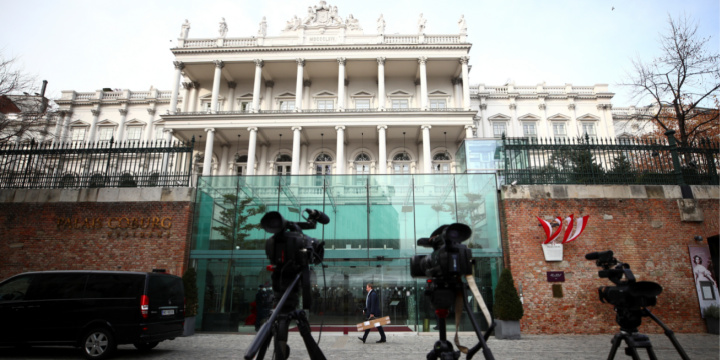
Cameras stand outside Palais Coburg, the site of a meeting of the Joint Comprehensive Plan of Action (JCPOA), in Vienna, Austria, November 29, 2021. REUTERS/Lisi Niesner
Did sanctions against Iran work?
The New York Times can’t seem to make up its mind.
“Crippling sanctions brought Iran to the negotiating table over its nuclear program,” the Times wrote in a staff editorial issued April 22.
In a front-page news article published in the April 26 New York Times, reporter David Sanger asserts, “Donald Trump often said that the 1,500 sanctions he placed on Iran would bring the country to the bargaining table, begging for a deal. They did not.”
The paper’s Iran sanctions coverage is flawed for reasons that go beyond the mere contradictory elements.
The passage from the editorial says, “Sanctions historically have not been particularly effective in changing regimes, and their record at changing dictators’ behavior is mixed at best. Cuba, Venezuela and North Korea never bowed to American demands. Where there are success stories, they are modest: Crippling sanctions brought Iran to the negotiating table over its nuclear program, but that regime never stopped asserting its right to enrich uranium.”
Nobody much cares about Iran “asserting its right.” It can assert whatever it wants, just like the Times. What people care about is Iran building nuclear weapons, funding and perpetrating terrorism, killing Jews, and killing Americans. And what arguably lured Iran to the negotiating table weren’t the sanctions, but former President Barack Obama’s foolish willingness to turn over hundreds of billions in sanctions relief to Iran in exchange for unverifiable promises to temporarily slow the pursuit of nuclear weapons.
As for Sanger’s claim that Trump’s sanctions failed, it’s certainly possible that in a second Trump term, the Iranians would have returned to the table — and that they were just waiting to see what would happen in the presidential election. They likely thought they could get a better deal on sanctions relief from the Biden administration than from Trump, Mike Pence, and Secretary of State Mike Pompeo.
Anyway, readers looking for intelligent guidance on the usefulness of sanctions in statecraft, at least in the example of Iran, are not going to be able to find it from these two examples of Times journalism.
Ira Stoll was managing editor of The Forward and North American editor of The Jerusalem Post. His media critique, a regular Algemeiner feature, can be found here.