 Pod Save America Hosts Call on Democrats to Cut All Israel Military Aid, No Longer Accept AIPAC Funding
 Jews, Israelis Targeted in Austria Amid Surge in Antisemitic Incidents; Local Jewish Community Calls for Action
 ‘All of Our Strength’: Over 1,000 Pro-Israel Activists Gather in DC for Solidarity Conference
 ‘Devastated’: Wesley LePatner, Killed in Manhattan Mass Shooting, Was a Jewish Communal, Philanthropic Leader
 Sen. Angus King Vows to No Longer Vote for Israel Military Aid Until Gaza Conditions Improve
 Europe Won’t Pressure Israel to ‘Commit Suicide’ Amid Gaza Backlash, Palestinian State Push, Says Israeli FM
 Israel’s National Soccer Coach Attacked in Athens Before Soccer Fans Chant ‘F–K Israel, Free Palestine’ at Match
 New York Judge Sentences Neo-Nazi to 5 Years for Livestreaming Bomb Threats Against Jewish Hospitals
 US Pressures Lebanon to Issue Cabinet Decision to Disarm Hezbollah Before Talks Continue
 UK Plans to Recognize Palestinian State in September Unless Israel Meets Conditions, Starmer Says


The Power of Prophecy
Error: Contact form not found.
 by Jeremy Rosen

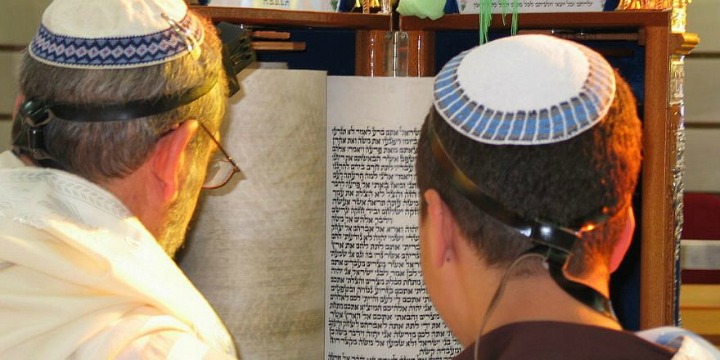
Reading from a Torah scroll in accordance with Sephardi tradition. Photo: Sagie Maoz via Wikimedia Commons.
Three people are called prophets in the Torah — Abraham, Miriam, and Moses. And yet Moses, the greatest of them all, is usually referred to as a teacher, Moshe Rabbeynu, and not a prophet. The Hebrew words used in the Bible for what we call a prophet are Navi, from the root “to bring” (a message), Chozeh, “someone who has a vision,” Roeh, “someone who sees things clearly,” and Cholem, “a dreamer.”
The Torah gives us very mixed messages as to what the nature and the role of a prophet was. In Abraham’s case, he was described as a prophet who could pray to God to cure people. In Miriam’s case, it was simply her charisma and leadership. And in Moses’ case, it was his relationship with God, who “mouth to mouth,” conveyed the Torah to him for him to teach it to the children of Israel. Which is why he was the great teacher.
Deuteronomy describes the role of the prophet more specifically. He or she is an inspirational guide to remind people of God’s will. A dreamer who comes with a message and then may back it up with “a sign, a wonder.” One might think from the wording that this implies predictions and forecasts, all backed by wondrous signs, even miracles. Yet most Biblical prophets (after Elijah and Elisha) did not get involved with signs or wonders. And the Torah says that if someone who displays signs of wonder encourages you to ignore the Torah, those wonders should be ignored. Anyone can turn tricks. It is the message that counts.
The later books of the Bible fleshed out the role of the prophet. They taught the poor and served as healers and advisors. They resisted authority, often at great risk to themselves, and often ended up pursued and even jailed. They often had to encounter false prophets and, of course, competing pagan influences. The great Biblical prophets all attacked corruption, hypocrisy, and inhumanity, and yet they also saw their mission as trying to guide and improve other nations, too.
This week we read about someone called Bilaam Ben Beor who was a renowned prophet and magician in Mesopotamia. He was invited by Balak, the king of both Moabites and Midianites, to come and curse the Israelites to prevent them from invading. After initially abandoning his mission, he returns to advise Balak on how to defeat the Israelites by devious means. Bilaam is not called a prophet in the Torah, although the Talmud bestows this title on him as a prophet to the non-Jews (a title given both to Isaiah and Jeremiah). And one wonders why the Torah devotes three chapters to Bilaam.
There really was a Bilaam beyond the Torah. In 1967, archeologists at Deir Alla, Jordan discovered an ancient text, that has nothing to do with Judaism, mentioning the activities of a renowned magician and prophet named Bilaam, the Son of Beor. Speculation only places the text around the time of King Uzziah and the prophet Amos, at about 760 BCE. But clearly, he was a well-known figure.
When all is said and done, miracles and signs are only helpful if they can bring people to become better humans — not if they simply reinforce corrupt hypocrisy or self-serving ideologies. And being better people is the essence of the Divine message that the role of the prophet was meant to reinforce. There are plenty of people nowadays in every religion, who claim to speak in God’s name. But no prophets. Prophecy is out of fashion nowadays. Too many failed prophets. And the qualities of charisma and strong leadership have been abused too often.
The author is a writer and rabbi based in New York.