 Pod Save America Hosts Call on Democrats to Cut All Israel Military Aid, No Longer Accept AIPAC Funding
 Jews, Israelis Targeted in Austria Amid Surge in Antisemitic Incidents; Local Jewish Community Calls for Action
 ‘All of Our Strength’: Over 1,000 Pro-Israel Activists Gather in DC for Solidarity Conference
 ‘Devastated’: Wesley LePatner, Killed in Manhattan Mass Shooting, Was a Jewish Communal, Philanthropic Leader
 Sen. Angus King Vows to No Longer Vote for Israel Military Aid Until Gaza Conditions Improve
 Europe Won’t Pressure Israel to ‘Commit Suicide’ Amid Gaza Backlash, Palestinian State Push, Says Israeli FM
 Israel’s National Soccer Coach Attacked in Athens Before Soccer Fans Chant ‘F–K Israel, Free Palestine’ at Match
 New York Judge Sentences Neo-Nazi to 5 Years for Livestreaming Bomb Threats Against Jewish Hospitals
 US Pressures Lebanon to Issue Cabinet Decision to Disarm Hezbollah Before Talks Continue
 UK Plans to Recognize Palestinian State in September Unless Israel Meets Conditions, Starmer Says


Defense Reforms May Be the Key to US-Saudi Relations
Error: Contact form not found.
 by James M. Dorsey

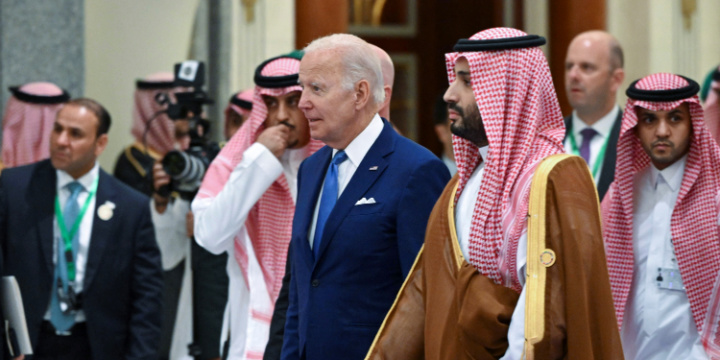
US President Joe Biden and Saudi Crown Prince Mohammed bin Salman arrive for the family photo during the Jeddah Security and Development Summit (GCC+3) at a hotel in Jeddah, Saudi Arabia July 16, 2022. Mandel Ngan/Pool via REUTERS
Saudi Arabia’s little touted effort to overhaul its defense and national security architecture may be the United States’ best bet to rebuild relations with the kingdom in ways that imbue values and complicate the establishment of similar defense ties with China or Russia.
“Through the vehicle of defense reform, the Biden administration has an opportunity to engage the Saudis on critical national security matters while safeguarding US strategic interests and honoring American values,” said political-military analyst and former Pentagon official Bilal Y. Saab.
Biden’s visit may have helped persuade Saudi Arabia to divert to Europe oil shipments destined for Asia, but did little to restore Middle Eastern confidence in the reliability of the United States as a global leader and security guarantor. If anything, the visit served to rehabilitate Saudi Crown Prince Mohammed bin Salman (MBS)’s reputation, tarnished by the 2018 killing of journalist Jamal Khashoggi with little in return in terms of, for example, human rights in the kingdom.
The Saudi overhaul of the defense and national security architecture, the most radical military reform since the creation of Saudi Arabia in 1932, aims to enable the kingdom to defend itself, absorb and utilize US weapons systems, and make meaningful military and defense contributions to regional security, Saab said. If successful, the reforms would offer “invaluable lessons for US military assistance across the region.”
“For far too long, Washington has sold the Saudis and other Arab partners expensive weapons they either didn’t need or know how to use and sustain properly, never bothering to assist them in developing their armed forces so they could ably assume their own national-security duties,” Saab asserted.
Over the years, Saudi expenditure on the acquisition of arms, among the highest in the world, was juxtaposed with the kingdom’s inability to perform on the battlefield and defend itself. The Saudi failure was one driver of past widespread empathy with jihadists who, with 9/11 and until the defeat of the Islamic State in Syria and Iraq, appeared able to achieve more with less.
To be sure, Gulf states have progressed since the days when they were unable to field a military response to Iraqi leader Saddam Hussein’s 1990 invasion of Kuwait, and needed the international community to come to their rescue.
Saudi Arabia has since fielded and sustained a military force in Yemen for the past seven year, but has been unable to reverse the territorial and strategic advances of the Houthi rebels or prevent one of the world’s worst humanitarian crises.
MBS, who has gained complete control of all of Saudi Arabia’s defense and security forces since coming to office, has been driven in his national security reforms by the lessons of the war in Yemen, Houthi and/or Iranian attacks on oil and other critical infrastructure in the kingdom, and the US failure to respond robustly to those incidents.
“Instead of breaking or downgrading defense ties with the Americans, the Saudis wisely chose to more effectively partner with them and seek their advice on how to create a better-functioning defense establishment. Washington answered the call,” Saab said.
But Saab cautioned that, “the Saudis still have to execute, and given the broad scope of their defense reforms, the journey will be long and arduous,” he said.
MBS set the tone for the reforms by noting, “when I enter a base in Saudi Arabia, I find the ground is made of marble, walls are ornamented and finished with high quality. When I enter a base in America, I see no ceiling; the ground is neither furnished with carpets nor made of marble, but only concrete and practical.”
The state of Saudi defense was abysmal before the launch of the reforms in 2017. The Saudis lacked systematic defense analysis and strategic planning to prioritize missions and capabilities and identify requirements, which would have helped them avoid buying expensive equipment they did not need.
Saudi air and missile defense may be where the kingdom has progressed the most. It has intercepted hundreds of Houthi missile and drone attacks, even if some have defeated Saudi defenses.
“Many of Saudi Arabia’s defense problems … still exist. What’s encouraging, though, is that the Saudis, under MBS’ leadership, now recognize these deficiencies and seem, for the first time, determined to address them in partnership with the United States and to a degree with the United Kingdom,” Saab said.
And all this might paint a more optimistic picture than meets the eye.
Dr. James M. Dorsey is an award-winning journalist and scholar, a Senior Fellow at the National University of Singapore’s Middle East Institute and Adjunct Senior Fellow at Nanyang Technological University’s S. Rajaratnam School of International Studies, and the author of the syndicated column and blog, The Turbulent World of Middle East Soccer.