 Pod Save America Hosts Call on Democrats to Cut All Israel Military Aid, No Longer Accept AIPAC Funding
 Jews, Israelis Targeted in Austria Amid Surge in Antisemitic Incidents; Local Jewish Community Calls for Action
 ‘All of Our Strength’: Over 1,000 Pro-Israel Activists Gather in DC for Solidarity Conference
 ‘Devastated’: Wesley LePatner, Killed in Manhattan Mass Shooting, Was a Jewish Communal, Philanthropic Leader
 Sen. Angus King Vows to No Longer Vote for Israel Military Aid Until Gaza Conditions Improve
 Europe Won’t Pressure Israel to ‘Commit Suicide’ Amid Gaza Backlash, Palestinian State Push, Says Israeli FM
 Israel’s National Soccer Coach Attacked in Athens Before Soccer Fans Chant ‘F–K Israel, Free Palestine’ at Match
 New York Judge Sentences Neo-Nazi to 5 Years for Livestreaming Bomb Threats Against Jewish Hospitals
 US Pressures Lebanon to Issue Cabinet Decision to Disarm Hezbollah Before Talks Continue
 UK Plans to Recognize Palestinian State in September Unless Israel Meets Conditions, Starmer Says


After Biden Visit, More Israelis Say US Considers Their Security in Iran Talks; Most Remain Dubious
Error: Contact form not found.
 by Algemeiner Staff

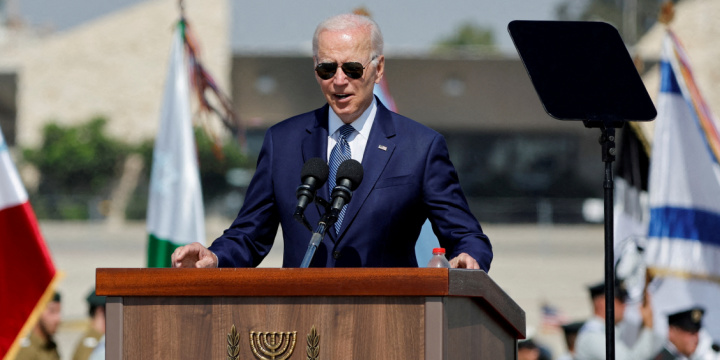
US President Joe Biden delivers remarks during a welcoming ceremony at Ben Gurion International Airport in Lod, near Tel Aviv, Israel, July 13, 2022. Photo: REUTERS/Ammar Awad
Since the visit of President Joe Biden, more Israelis are convinced that the United States takes their security into account while negotiating with Iran, but fewer believe Washington will help advance a peace agreement between the Jewish state and Saudi Arabia, according to a poll released Monday.
The Jerusalem-based Israel Democracy Institute surveyed respondents before Biden arrived in Israel on July 13, and after he had returned to Washington.
Ahead of Biden’s presidential tour, Israelis were dubious of Washington’s commitment to their security during nuclear negotiations with Iran, whose leaders employ eliminationist rhetoric against the Jewish state and sponsor US-designated terrorist groups on Israel’s borders.
When asked whether they trust the Biden administration to consider Israel’s interests in the talks, 15 percent of Jews agreed, as well as 20.5 percent of Arabs.
But after the visit, the numbers rose to 34 percent among Jewish respondents, and 26 percent among Arabs.
However, majorities in both populations remained skeptical in the post-visit survey, with 58 percent of Jewish respondents saying they believed the Biden administration was only accounting for Israel’s security during negotiations in Vienna to a “small or very small extent” — a figure that was 61 percent among Arabs.
Respondents were also asked about their confidence in Washington’s ability to secure steps towards peace between Israel and Saudi Arabia — an achievement that has been increasingly anticipated since Jerusalem struck normalization agreements with several Arab states as part of the Abraham Accords, which were brokered under the auspices of then President Donald Trump.
While Biden’s visit to the region ultimately marked an incremental warming of Saudi-Israeli relations, the kingdom’s foreign minister indicated there would not be imminent normalization.
Queried before the trip, 45.5 percent of Jewish respondents said they believed in Biden’s capability to secure a breakthrough with Saudi Arabia, and an equal number were not convinced. The relative optimism reduced after the president’s visit, with only 37 percent of Jewish respondents expressing confidence and 54 percent of respondents expressing doubt.
Arab respondents also indicated greater skepticism. While the number of respondents who believed in the president’s ability to accomplish a breakthrough with Saudi stayed fairly constant, from 35 percent before the trip to 36.5 percent after the trip, the proportion of Arab respondents who gave similar answers grew — from 39 percent before the trip, to 47 percent afterwards.