 Pod Save America Hosts Call on Democrats to Cut All Israel Military Aid, No Longer Accept AIPAC Funding
 Jews, Israelis Targeted in Austria Amid Surge in Antisemitic Incidents; Local Jewish Community Calls for Action
 ‘All of Our Strength’: Over 1,000 Pro-Israel Activists Gather in DC for Solidarity Conference
 ‘Devastated’: Wesley LePatner, Killed in Manhattan Mass Shooting, Was a Jewish Communal, Philanthropic Leader
 Sen. Angus King Vows to No Longer Vote for Israel Military Aid Until Gaza Conditions Improve
 Europe Won’t Pressure Israel to ‘Commit Suicide’ Amid Gaza Backlash, Palestinian State Push, Says Israeli FM
 Israel’s National Soccer Coach Attacked in Athens Before Soccer Fans Chant ‘F–K Israel, Free Palestine’ at Match
 New York Judge Sentences Neo-Nazi to 5 Years for Livestreaming Bomb Threats Against Jewish Hospitals
 US Pressures Lebanon to Issue Cabinet Decision to Disarm Hezbollah Before Talks Continue
 UK Plans to Recognize Palestinian State in September Unless Israel Meets Conditions, Starmer Says


What Does Hezbollah Want?
Error: Contact form not found.
 by Gershon Hacohen / JNS.org

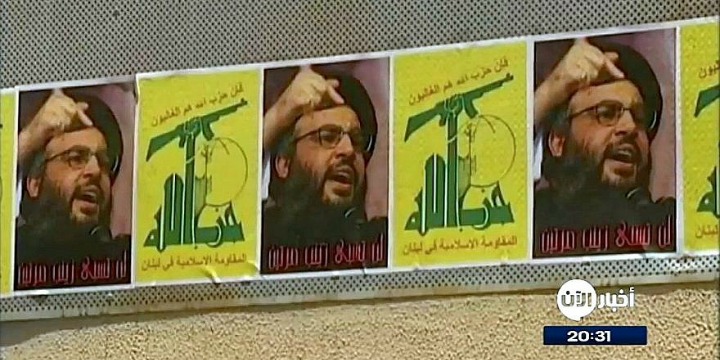
Posters of Hezbollah’s flag and the terrorist group’s leader, Hassan Nasrallah, in Beirut. Photo: Al Aan Arabic Television via Wikimedia Commons.
JNS.org – Defense Minister Benny Gantz made the right call by sounding the alarm on Monday, saying that a Hezbollah attack on Israel’s gas installations in the Mediterranean Sea could trigger war. Such a clarion call makes sense because it on the one hand serves as a warning to Hezbollah Secretary-General Hassan Nasrallah and on the other, alerts Israelis and the international community.
Israel’s security officials have not taken Nasrallah’s threats lightly. There is no doubt that his repeated threats to attack Israel have upped the ante, and this should not be ignored.
Israel and Lebanon can find a way to resolve their maritime dispute. The Karish gas barge is well within Israel’s territorial waters, while the northern gas field, Qana, lies in Lebanese jurisdiction. Israel has made it abundantly clear that it wants Lebanon to extract gas from the northern field, and the US mediation efforts could make that a reality. Lebanon is suffering from a major economic crisis and desperately needs the gas from the Qana field, which is why we have to find the actual rationale for Nasrallah’s repeated threats.
The conventional wisdom within Israel’s national security community is that his threats are driven by domestic interests as part of the Shi’ite terrorist group’s battle for hegemony in Lebanon. The threats underscore his desire to have Hezbollah get the credit for resolving this crisis in a way that benefits Lebanon and results in gas being supplied. Thus, while his statements are designed to create the threat of war, he is hardly keen on an actual flare-up. That said, Israel must take seriously the option that he wants an escalation that would serve as a pretext for another round of hostilities between Israel and Lebanon.
Israel must look at various hidden considerations that factor into Nasrallah’s calculus to find what could drive him toward confrontation in the near term. Perhaps he is trying to capitalize on the internal political instability in Israel, believing this is an opportune moment to fight the Jewish state on favorable terms. There is also the possibility that there are much larger forces at work, such as Iran.
In any event, Nasrallah’s threats have seen politicians on both the right and the left rally to defend the country’s sovereign interests. The government will get the opposition’s full support if it decides to use the IDF for a decisive response that would crush Hezbollah if it attacks. Israel must make it clear that if it decides to trigger another round of hostilities, it will face an IDF that is fully prepared to meet the challenge in a proper and unexpected manner.
Maj. Gen. (res.) Gershon Hacohen is a senior research fellow at the Begin-Sadat Center for Strategic Studies. He served in the IDF for 42 years, commanding troops in battles with Egypt and Syria. He was formerly a corps commander and commander of the IDF Military Colleges.
This article first appeared in Israel Hayom.