 Pod Save America Hosts Call on Democrats to Cut All Israel Military Aid, No Longer Accept AIPAC Funding
 Jews, Israelis Targeted in Austria Amid Surge in Antisemitic Incidents; Local Jewish Community Calls for Action
 ‘All of Our Strength’: Over 1,000 Pro-Israel Activists Gather in DC for Solidarity Conference
 ‘Devastated’: Wesley LePatner, Killed in Manhattan Mass Shooting, Was a Jewish Communal, Philanthropic Leader
 Sen. Angus King Vows to No Longer Vote for Israel Military Aid Until Gaza Conditions Improve
 Europe Won’t Pressure Israel to ‘Commit Suicide’ Amid Gaza Backlash, Palestinian State Push, Says Israeli FM
 Israel’s National Soccer Coach Attacked in Athens Before Soccer Fans Chant ‘F–K Israel, Free Palestine’ at Match
 New York Judge Sentences Neo-Nazi to 5 Years for Livestreaming Bomb Threats Against Jewish Hospitals
 US Pressures Lebanon to Issue Cabinet Decision to Disarm Hezbollah Before Talks Continue
 UK Plans to Recognize Palestinian State in September Unless Israel Meets Conditions, Starmer Says


As Hunger Striking Palestinians Spark Media Fury, Israeli Detention Policy Gets Twisted Along the Way
Error: Contact form not found.
 by Rachel O'Donoghue

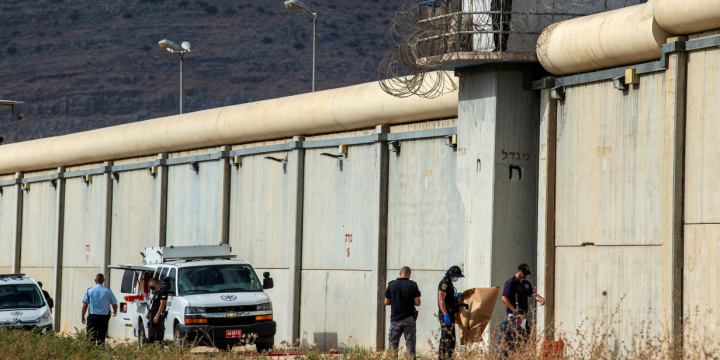
Israeli security personnel stand together outside the walls of Gilboa prison after six Palestinian militants broke out of it in north Israel September 6, 2021. REUTERS/ Gil Eliyahu
Hunger-striking Palestinian prisoner Khalil Awawdeh made headlines around the world after disturbing images of him lying emaciated and pale on a hospital bed were released.
The alleged member of Palestinian Islamic Jihad began starving himself shortly after his arrest in December 2021, in protest of being held under administrative detention by Israel. He suspended his strike this month, after claiming he received confirmation that he would be released in October.
Media reports covering Awawdeh’s protest have frequently characterized Israel’s policy of keeping individuals in pre-trial detention as utterly unique and incomparable to any policy anywhere else (see here and here).
The New York Times drew attention to Awawdeh’s protest in an August feature piece, in which controversial journalist Raja Abdulrahim wrote about how “thousands of Palestinians” had been incarcerated over the years, “many of them political prisoners held under what is called administrative detention, without charges or trial based on secret evidence.”
The article continues:
There are currently about 500 Palestinian prisoners being held under administrative detention, according to Palestinian rights groups. Israel does not divulge information on the number of people held or what they are accused of, and says that the administrative detentions are necessary for preventing attacks against its citizens.
Palestinian prisoners have long responded with hunger strikes, either collectively with dozens or hundreds taking part, or individually, to protest prison conditions and get basic amenities, or as protests against the open-ended detentions themselves.
Yet, Abdulrahim fails to elaborate on what these supposedly harsh prison conditions and withheld basic necessities are.
The most recent large-scale hunger strike was organized in response to actions by the Israeli Prison Service — undertaken after the high-profile Gilboa jailbreak last year — breaking up clusters of Palestinian Islamic Jihad (PIJ) prisoners, either by moving members to other cells or transferring certain members out to other jails. Family visits were also postponed, and the recaptured Gilboa escapees, the majority of which were PIJ terrorists, were also moved to other detention centers.
It would appear, then, that the Times believes the denial of basic rights includes the freedom of terrorists to consort with their militant comrades from the comfort of their cells.
It should also be noted that Israel’s policy of not divulging evidence on security grounds is hardly unique. The fact, is numerous liberal democracies around the world have similar laws.
The United Kingdom, for example, allows suspects to be held in pre-charge detention in cases primarily pertaining to terrorism. Prosecutors in terrorism trials may also apply to withhold evidence from defense lawyers if the “information in question is sensitive, such as the identity of an agent (CHIS) or details of a sensitive investigative technique.”
Critics of Israel’s administrative detention policy also consistently overlook the fact that it is not used solely for the purpose of detaining Palestinians.
And Jewish Israelis have also been made subject to administrative arrest warrants for decades, including several earlier this year under an order made directly by Defense Minister Benny Gantz.
In an op-ed published last year, Israel’s former ambassador to the United Kingdom, Mark Regev, discussed another oft glossed-over aspect of administrative detention — specifically, that Israel’s High Court has previously ruled that these detentions are an extreme measure that must be cautiously used. The court has made abundantly clear that these orders must only be made when there is no other legal recourse available and cannot be applied punitively — that is, the individuals upon which they are applied must present a clear and direct danger to public safety.
Israeli law contains numerous safeguards to ensure the application of administrative detention is not abused, such as the requirement that all intelligence and alternatives to the order are reviewed by a military prosecutor and then a judge. There is an additional right to appeal the decision before a judge and later Israel’s Supreme Court if the order is upheld, with all hearings heard in Hebrew and concurrently translated into Arabic if necessary. Lastly, there is a six-month limit on detention, which can only be extended if the initial process for the order is repeated in full.
Israel’s legal safeguards comprise a powerful framework against arbitrary and unlawful detention that is consistent with other democratic nations.
It is therefore clear that administrative detention is neither distinctive nor egregious. Yet, it is invariably treated as such when Israel when makes use of it to protect its citizens.
The author is a contributor to HonestReporting, a Jerusalem-based media watchdog with a focus on antisemitism and anti-Israel bias — where a version of this article first appeared.