 Pod Save America Hosts Call on Democrats to Cut All Israel Military Aid, No Longer Accept AIPAC Funding
 Jews, Israelis Targeted in Austria Amid Surge in Antisemitic Incidents; Local Jewish Community Calls for Action
 ‘All of Our Strength’: Over 1,000 Pro-Israel Activists Gather in DC for Solidarity Conference
 ‘Devastated’: Wesley LePatner, Killed in Manhattan Mass Shooting, Was a Jewish Communal, Philanthropic Leader
 Sen. Angus King Vows to No Longer Vote for Israel Military Aid Until Gaza Conditions Improve
 Europe Won’t Pressure Israel to ‘Commit Suicide’ Amid Gaza Backlash, Palestinian State Push, Says Israeli FM
 Israel’s National Soccer Coach Attacked in Athens Before Soccer Fans Chant ‘F–K Israel, Free Palestine’ at Match
 New York Judge Sentences Neo-Nazi to 5 Years for Livestreaming Bomb Threats Against Jewish Hospitals
 US Pressures Lebanon to Issue Cabinet Decision to Disarm Hezbollah Before Talks Continue
 UK Plans to Recognize Palestinian State in September Unless Israel Meets Conditions, Starmer Says


Future of Christianity in Jerusalem At Grave Risk, Jordanian Monarch Claims in UN General Assembly Address
 by Andrew Bernard

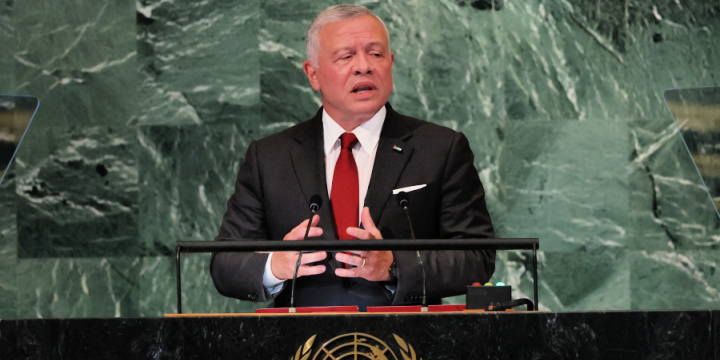
Jordan’s King Abdullah addressing the UN General Assembly. Photo: Reuters/Brendan Mcdermid
On the first day of the UN General Assembly in New York on Tuesday, Jordan’s King Abdullah II asserted in his address that the Christian faith in Israel is in jeopardy.
“Today, the future of Jerusalem is an urgent concern,” Abdullah said. “As a Muslim leader, let me say clearly that we are committed to defending the rights, the precious heritage, and the historic identity of the Christian people of our region. Nowhere is this more important than in Jerusalem.”
Abdullah added that “today, Christianity in the Holy City is under fire. The rights of churches in Jerusalem are threatened. This cannot continue. Christianity is vital to the past and present of our region and the Holy Land. It must remain an integral part of our future.”
Abdullah did not specify the nature of the threat to Christian rights or cite any specific examples. The status of religious sites in the Old City is frequently the cause of clashes, and events like the annual Jerusalem Day march have sparked religious violence in the past.
Churches in the Old City have previously claimed that Jewish settlers are disturbing the demographic balance of the Christian Quarter of Jerusalem. In the West Bank, where there are estimated to be fewer than 50,000 Christians remaining, rights groups have documented the Palestinian Authority’s abuse and torture of Christians. In the wider Middle East, a 2019 UK-commissioned report described the persecution of Christians as “coming close to meeting the international definition of genocide.”
King Abdullah’s comments came ahead of his meeting Israeli Prime Minister Yair Lapid, who will deliver his first address to the General Assembly on Thursday.
Lapid is also expected to meet with Turkey’s President Recep Tayyip Erdogan on Tuesday, amid an improvement in relations between Israel and Turkey in recent months. On Monday, Israel appointed an ambassador to Ankara for the first time in four years. Turkey announced last month that it would reciprocate.
In his own address to the GA on Tuesday, Erdogan condemned Israeli settlements, but also said that Turkey is “determined to continue to develop our relations with Israel for the sake of the future, peace and stability.”
In his wide-ranging remarks, Erdogan also touted Turkey’s role in peace talks between Ukraine and Russia. In July, Turkey and UN Secretary-General Antonio Guterres negotiated a deal with Ukraine and Russia that allowed Ukraine to resume grain exports. The impact of the Russian invasion of Ukraine on global food security has been a major focus at the UN since February, given the large number of countries that rely on Ukrainian grain and other food exports.
“We need to find together a reasonable, just and viable diplomatic solution that will provide both sides the opportunity of an ‘honorable exit,'” Erdogan said.
Erdogan also used his time in New York on Monday to meet with Jewish leaders from the Conference of Presidents and the World Jewish Congress.