 Pod Save America Hosts Call on Democrats to Cut All Israel Military Aid, No Longer Accept AIPAC Funding
 Jews, Israelis Targeted in Austria Amid Surge in Antisemitic Incidents; Local Jewish Community Calls for Action
 ‘All of Our Strength’: Over 1,000 Pro-Israel Activists Gather in DC for Solidarity Conference
 ‘Devastated’: Wesley LePatner, Killed in Manhattan Mass Shooting, Was a Jewish Communal, Philanthropic Leader
 Sen. Angus King Vows to No Longer Vote for Israel Military Aid Until Gaza Conditions Improve
 Europe Won’t Pressure Israel to ‘Commit Suicide’ Amid Gaza Backlash, Palestinian State Push, Says Israeli FM
 Israel’s National Soccer Coach Attacked in Athens Before Soccer Fans Chant ‘F–K Israel, Free Palestine’ at Match
 New York Judge Sentences Neo-Nazi to 5 Years for Livestreaming Bomb Threats Against Jewish Hospitals
 US Pressures Lebanon to Issue Cabinet Decision to Disarm Hezbollah Before Talks Continue
 UK Plans to Recognize Palestinian State in September Unless Israel Meets Conditions, Starmer Says


Does High-Tech Help or Hurt Iran Protesters? New York Times Offers Conflicting Accounts
Error: Contact form not found.
 by Ira Stoll

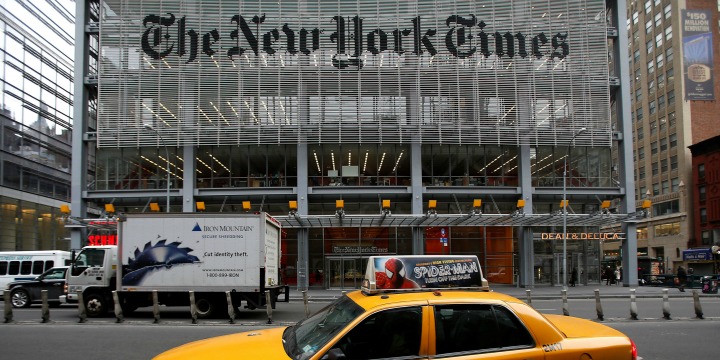
A taxi passes by in front of The New York Times head office, Feb. 7, 2013. Photo: Reuters / Carlo Allegri / File.
Are smartphones and social media good or bad for those protesting against Iran’s terror-sponsoring, Holocaust-denying, woman-oppressing theocracy?
The New York Times can’t seem to make up its mind.
An “Interpreter” column by the newspaper’s Max Fisher suggests that the technology, in the medium term, could undercut the protests. Fisher writes that “social media, which enables protests to organize and gather in once-unthinkable numbers, often with little or no formal leadership, may also paradoxically undermine those movements, according to a theory advanced by Zeynep Tufekci, a Columbia University sociologist.”
Fisher identifies Tufekci as “a Columbia University sociologist,” but she’s also a New York Times opinion columnist. It’s a pattern; when the New York Times news columns look for expert commentary, they turn to people who already have regular platforms on the Times op-ed page, as with Peter Beinart.
Fisher explains further that, “in earlier eras, activists might spend months or years building the organizational structures and real-world ties necessary to launch a mass protest.” In contrast, today’s leaderless anemic social media protests “are less equipped to endure government repression” and “more easily fracture.”
But in tension with this Fisher-Tufekci theory is a Times news article by Vivian Yee headlined “Despite Iran’s Efforts to Block Internet, Technology Has Helped Fuel Outrage.”
That article reports that in Iran, “the authorities have seen the unfettered internet as a threat since 2009, when social media helped mobilize millions of Iranians in the Green Movement protests over what they believed was a rigged presidential election.”
The article says, “One solution, Iranian activists say, is for American tech companies to re-enter the field in Iran after backing away when President Donald J. Trump imposed tougher American sanctions on Iran.”
If you believe Fisher and Tufekci, that wouldn’t be a “solution” but a way to deprive protesters of the “traditional activist infrastructure,” and to increase the chances that the protests fizzle out quickly.
My own gut sense is that overall technology and smartphones help the protesters more than hurt them. But this is one of those things it’s hard to know for sure. Rather than being straightforward and humble about the limits of knowledge, or publishing a forum intentionally designed to give multiple views on the issue, the Times backs its way into offering two seemingly authoritative but actually contradictory views of the issue.
Ira Stoll was managing editor of The Forward and North American editor of The Jerusalem Post. His media critique, a regular Algemeiner feature, can be found here.